
Fight IQ — MMA Fundamentals
Nearly one in five UFC fights ends by submission — but a small handful of techniques account for the vast majority of tapout victories. This is your definitive statistical guide to the most popular submissions in MMA.
Data sourced from UFCStats.com across 3,100+ bouts spanning three decades. Covers finish rates, fighter records, escape principles, and the techniques currently reshaping the submission landscape.
Nearly one in five UFC fights ends with a fighter tapping out or going unconscious. That statistic alone makes submissions one of the most decisive weapons in mixed martial arts, but the real story is in which techniques actually get the job done.
After analyzing data from over 3,100 UFC bouts spanning three decades, clear patterns emerge. A small handful of submissions account for the vast majority of tapout victories, and the rear naked choke sits so far ahead of the pack that it exists in a category of its own.
This guide breaks down every major submission in MMA by the numbers: how often each technique finishes fights, why certain submissions dominate while others fade, and what the latest 2025 data reveals about where the ground game is heading. Whether you are a new fan trying to understand what you are watching, a practitioner looking for the highest-percentage techniques, or an analyst digging into fight data, this is your definitive statistical resource.
📊 UFC Submission Breakdown: All-Time Statistics
Source: UFCStats.com | 3,100+ bouts analyzed
Chokes account for 65.5% of all submission finishes | Joint locks: 34.5%
Most Popular Submissions in MMA
The Numbers Behind MMA Submissions: What the Data Actually Says
The overall submission rate in the UFC is approximately 19.8%, according to a peer-reviewed study published in the Journal of Sports Medicine and Physical Fitness, which analyzed all 3,123 fights across 293 PPV events from 1993 to 2023. Choking submissions are significantly more common than joint locks, accounting for 65.5% of all submission finishes versus 34.5% for joint attacks.
What makes this even more interesting is the trend line. Submission rates have actually decreased over the decades as defensive grappling has improved across the sport. In the early UFC era, submissions accounted for roughly 30% of finishes. Today, that number hovers closer to 18–20%, meaning every modern submission finish represents a fighter overcoming better-trained defenses than ever before.
The head and neck remain the primary targets, with upper-body submissions — chokes and arm attacks combined — responsible for 78% of all submission finishes. This makes strategic sense in MMA’s striking environment: attacking the upper body allows the top fighter to maintain positional control while threatening the finish, rather than sacrificing position to chase leg entanglements. For a full breakdown of how grappling fits into the broader MMA game, see our guide to takedowns, clinches, throws, and ground control in MMA.
Gender and Weight Class Patterns
Female fighters achieve a slightly higher submission rate at 21.1% compared to 17.3% for males, though the difference is not statistically significant. The more meaningful pattern appears across weight classes. Intermediate divisions — welterweight through middleweight in men’s MMA — record the highest submission frequencies, while heavyweights show the lowest. Lower weight classes tend to feature more submission attempts but also more successful defenses, creating a dynamic ground game. Heavyweights, by contrast, rely more on striking power and often lack the gas tank for extended grappling exchanges.
The Big Three: Submissions That Dominate the Octagon
1. Rear Naked Choke — The Undisputed King
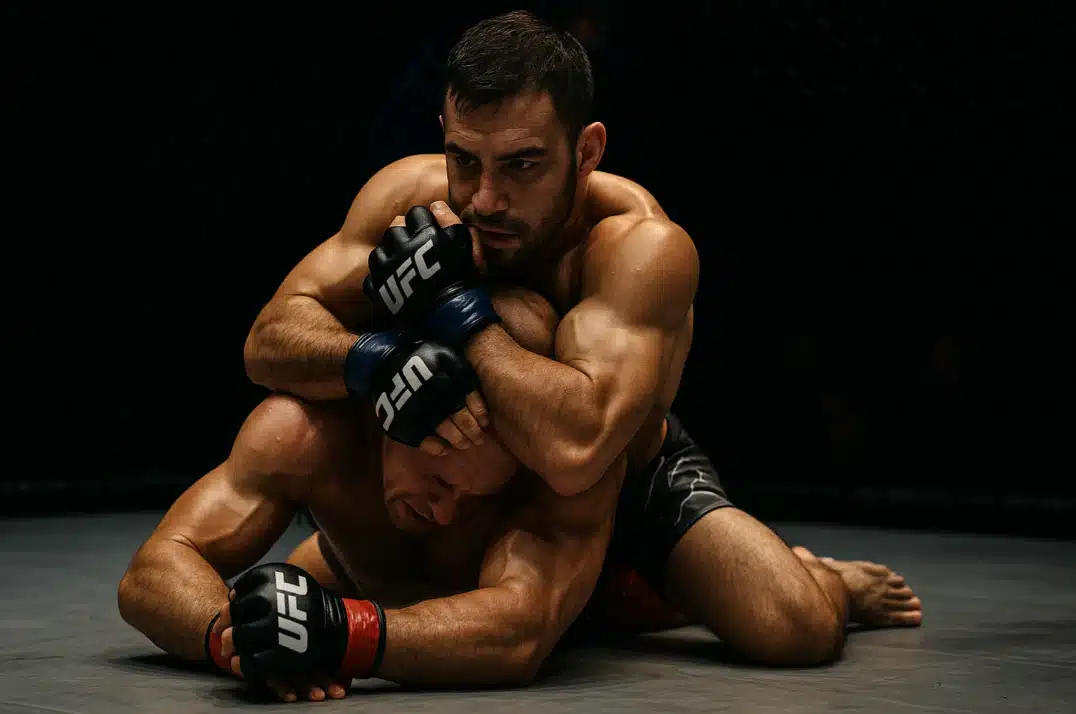
The rear naked choke is the most successful submission in UFC history by a staggering margin. It accounts for 585 recorded submission victories, more than double any other technique, and represents roughly 33% of all UFC submissions according to cumulative UFCStats.com data. Some analyses place this figure as high as 50% depending on the time period studied.
The mechanics explain the dominance. The RNC is a blood choke that compresses both carotid arteries simultaneously, cutting off blood flow to the brain. An opponent who does not escape will lose consciousness in an average of 8.9 seconds. It is applied from back control, widely considered the single most dominant position in MMA, because the attacker can strike and choke while the defender has almost no offensive options.
The technique does not require a gi (hence “naked”), works across all body types and size differentials, and offers multiple grip variations, including the figure-four lock and the clasped-hands finish. Because it is a blood choke rather than an air choke, it causes less structural damage when held slightly too long, making it the responsible choice as well as the effective one.
All-Time Leader: Charles Oliveira holds the UFC record with 16 career submission victories, with the RNC being his most frequent weapon alongside the guillotine. His back-take and finish sequences have become a benchmark for how the technique works at the championship level. See the broader, greatest UFC fighters debate for where he stands historically.
2. Guillotine Choke — The Takedown Punisher
The guillotine choke ranks second with 264 recorded UFC submission wins, representing approximately 17% of all tapout victories. This front-facing choke targets either the carotid arteries (in the high-elbow “Marcelotine” variation) or the windpipe (in the standard grip), and its versatility makes it a constant threat during scrambles and takedown exchanges.
What makes the guillotine unique among high-percentage submissions is its role as a counter-grappling weapon. Wrestlers who shoot for takedowns while leaving their neck exposed are prime guillotine targets. This creates a fascinating tactical dynamic: the better a fighter’s takedowns, the more they need to respect the guillotine threat, which in turn opens up other defensive and offensive opportunities for the bottom fighter. Understanding this interplay is central to the sprawl-and-brawl tactic used by many striker-grapplers.
The guillotine presents an interesting statistical paradox. While it is the second-most-common UFC finish, its success rate when attempted is relatively low (around 9.5% in pure grappling competition). The high finish count reflects the sheer volume of attempts rather than a high conversion rate. Specialists like Dustin Poirier (10 UFC guillotine victories) and Charles Oliveira demonstrate that the technique becomes devastating in the hands of fighters who master the subtle details of grip depth, hip positioning, and timing.
Key Variations: Standard guillotine, high-elbow (Marcelotine), arm-in guillotine, mounted guillotine, standing guillotine.
🛡️ Want to Survive These Submissions?
Our complete guide breaks down escape techniques for each choke with step-by-step instructions and video references.
Read: Top 10 MMA Chokes & How to Escape Them →3. Armbar — The Classic Joint Lock
The armbar is the most common joint lock in UFC history, with approximately 158 recorded finishes, representing about 10% of all submissions. It targets the elbow joint through hyperextension, and the mechanics are straightforward: isolate the arm, position the hips over the elbow, and extend. The simplicity of the concept contrasts with the complexity of achieving it against a resisting opponent.
Multiple setup positions make the armbar a constant threat. Fighters attack it from mount, closed guard, knee-on-belly, side control, and even from the back. This positional versatility means a grappler with a strong armbar game can threaten it from virtually any ground position, forcing opponents to constantly defend rather than advance.
Ronda Rousey built her entire early career on the armbar, winning her first eight professional fights with the technique and making it her signature — a story covered in our look at Rousey’s crossover into pro wrestling. The armbar remains a consistent presence at the highest level of the sport, appearing across weight classes and proving that positional mastery translates to finishing ability regardless of era.
Critical Detail: Unlike chokes, which cut off blood or air supply, the armbar threatens permanent structural damage to the elbow. This makes the “tap early” principle especially important. Fighters who refuse to tap risk torn ligaments and months of recovery.
The Next Tier: High-Impact Submissions Beyond the Big Three
Arm Triangle Choke
The arm triangle choke has accumulated 110 UFC wins and represents one of the most reliable finishes from top position. It uses the opponent’s own shoulder as part of the choking mechanism: the attacker wraps their arm around the opponent’s neck while trapping one arm inside, then squeezes to compress the carotid artery on one side while the trapped shoulder compresses the other.
Fighters like Jon Jones have used the arm triangle to devastating effect, applying it from top position after establishing chest-to-chest pressure that makes posture-based defence nearly impossible. The arm triangle’s value from top position makes it a natural companion to ground-and-pound work — the same pressure that sets up strikes also creates the entry point for the choke.
Triangle Choke
The triangle choke is a hallmark of Brazilian Jiu-Jitsu that translates effectively to MMA. Applied from the bottom position (typically guard), the attacker uses their legs to form a figure-four lock around the opponent’s neck and one arm, compressing the carotid arteries with the thighs. The key setup detail is achieving the “one arm in” position — once the attacker clears one shoulder and locks their legs, the choke is extremely difficult to escape.
Tony Ferguson and Anderson Silva both built legacies, in part, on spectacular triangle finishes. The technique remains viable in modern MMA at all levels, and the triangle is also a foundational submission in the 10th Planet rubber guard system, where it is set up from unorthodox bottom positions.
D’Arce Choke
Named after grappler Joe D’Arce, this technique threads the choking arm under the opponent’s near arm and across their neck. Islam Makhachev has made the short D’Arce a signature weapon — the variant does not require the attacker to sink their arms as deeply as the classic version, making it accessible for shorter-limbed grapplers and effective from wrestling scrambles where opponents post on their near arm. The mere threat of it changes how opponents move against him — as explored in our breakdown of Makhachev’s judo-based grappling.
Kimura
The kimura shoulder lock applies rotational pressure to the shoulder joint beyond its natural range of motion. It serves dual purposes in MMA: as a direct submission threat and as a powerful positional control tool. Fighters frequently use kimura grips to sweep, advance position, or take the back, even when the submission itself is not available.
The kimura’s dual function as both a control grip and a finish makes it strategically valuable beyond its raw submission numbers. Top fighters use the kimura grip to stall escapes, force positional concessions, and set up the transition to back control — the same grip that can finish the fight is also a positional management tool that changes how the bottom fighter defends entirely.
Anaconda Choke
The anaconda choke is the cousin of the D’Arce. Where the D’Arce threads under the arm first, the anaconda threads under the neck first and exits through the armpit. The signature “gator roll” finish involves rolling the opponent to collapse their base and complete the choke. The anaconda and D’Arce (also called the “brabo” choke) occupy similar finishing ranges in MMA — both are wrestling-scramble chokes that reward fighters who think a move ahead during takedown exchanges.
Face Crank / Neck Crank
Face cranks and neck cranks apply pressure to the jaw and cervical spine when an opponent defends traditional chokes by tucking their chin — the attacker redirects to the structural attack the chin-tuck creates. The technique appears most commonly when a fighter is caught in a body triangle or back control position and protects their neck so aggressively that the cervical spine becomes the path of least resistance.
Khabib Nurmagomedov’s neck crank submission of Conor McGregor at UFC 229 remains one of the most high-profile applications of a crank-family finish, landing from a dominant ground control position after extended top pressure. Face cranks and neck cranks remain relatively rare compared to blood chokes — they require a specific defensive posture from the opponent to become available — but they serve as the submission that punishes fighters who over-protect their neck at the expense of their spine.
The Evolving Submission Landscape: Emerging Techniques
Heel Hooks and Leg Locks
Leg locks have experienced a fascinating trajectory in MMA. While they remain a significant weapon in submission grappling competition — heel hooks in particular have reshaped no-gi grappling over the past decade — their adoption in MMA has been more selective. Individual practitioners have proven they can be devastating when built into a complete system, with specialists who develop entire positional games around leg entanglements achieving results that generalist grapplers cannot replicate simply by adding the technique.
The selective adoption reflects a strategic reality: attacking leg locks in MMA often requires sacrificing top position and exposing yourself to strikes during the leg entanglement. Most fighters calculate that maintaining top control and hunting chokes or arm attacks carries better risk-reward odds. The economics of grappling as a sport are explored further in our piece on how much professional grapplers actually earn.
The Buggy Choke
Mitchell Goode’s “Craziest Come From Behind Submission of 2024” showcased the buggy choke: a creative head-and-arm technique executed from bottom side control. This hybrid triangle/arm triangle demonstrates that submission grappling continues to evolve, with practitioners developing techniques from positions previously considered purely defensive.
All-Time UFC Submission Leaders
The fighters who accumulate the most submission wins tend to share common traits: exceptional positional control, diverse finishing ability, and remarkable career longevity. Here are the athletes who have defined the submission game at the highest level.
| Rank | Fighter | Sub Wins | Division | Signature Submissions |
|---|---|---|---|---|
| 1 | Charles Oliveira | 16 | Lightweight | RNC, Guillotine, Anaconda, Calf Slicer |
| 2 | Jim Miller | 13 | Lightweight | RNC, Guillotine, Arm Triangle |
| 3 | Demian Maia | 11 | WW/MW | RNC, Back Choke |
| 4 | Ronda Rousey | 9 | W. Bantamweight | Armbar |
| 5 | Frank Mir | 8 | Heavyweight | Armbar, Kimura, Kneebar, Toe Hold |
| 6 | Nate Diaz | 8 | Lightweight/WW | Guillotine, Triangle, RNC |
| 7 | Glover Teixeira | 7 | Light Heavyweight | RNC, Guillotine |
🏆 UFC All-Time Submission Leaders
Source: UFCStats.com | Approximate — official counts shift as records update
How to Survive: Escape Principles for the Most Common Submissions
Understanding submissions is not complete without understanding defenses. These are the core escape principles that apply across the most common techniques. For detailed, step-by-step escape breakdowns for each individual choke, see our complete guide to MMA chokes and how to escape them.
Rear Naked Choke Escape
Drop your chin immediately and “two-on-one” the choking arm. Grab the wrist with both hands and pull it down below your chin to prevent the second hand from locking behind your head. From there, work to turn into the attacker and fight your hips to the mat to begin escaping back control.
Guillotine Defense
The secret is lateral movement. Move your body to the side opposite your trapped head. This “clears the line” and makes the finish mechanically impossible. Fighters who stay square in front of a guillotine grip are giving the attacker exactly what they need.
Armbar Escape
Stack your weight onto the attacker and look at the ceiling. Proper posture prevents the attacker from straightening your arm. Once stacked, work to extract your elbow past their hip line. Speed matters: once the hips are fully locked over your arm, the mechanical advantage is overwhelmingly in the attacker’s favor.
Triangle Defense
Posture is your primary weapon. Drive your trapped shoulder forward and look up, creating space between your neck and the attacker’s legs. If you cannot posture up, stack forward aggressively to compress the attacker’s ability to squeeze. The critical window is before the legs fully lock. Once the figure-four is secured, escape becomes exponentially harder.
Can You Safely Practice Submissions?
Absolutely. Controlled drilling with clear communication protocols is the foundation of grappling training worldwide. Proper technique emphasizes gradual pressure over explosive force. The “tap early, tap often” principle is universal across every legitimate grappling gym. Regular conditioning, appropriate protective gear, and emphasis on technique over strength create environments where submissions become learning tools rather than injury risks. Real-world applications of this disciplined approach are explored in our piece on police BJJ training statistics and the use of BJJ in nursing and healthcare settings.
💪 Level Up Your Ground Game
Frequently Asked Questions About MMA Submissions
What is the most common submission in MMA?
The rear naked choke is the most common and successful submission in MMA history by a wide margin. It accounts for approximately 33% of all UFC submission finishes, with 585 recorded victories — more than double any other technique.
What percentage of UFC fights end in submission?
Approximately 19.8% of UFC fights end in submission, according to peer-reviewed research analyzing all PPV events from 1993 to 2023. This rate has gradually declined from roughly 30% in the early UFC era as defensive grappling skills have improved across the sport.
Are chokes or joint locks more common in MMA?
Chokes dominate submission statistics, accounting for 65.5% of all submission finishes versus 34.5% for joint locks. The rear naked choke, guillotine, and triangle choke combine for nearly 70% of all choke finishes.
Who has the most submission wins in UFC history?
Charles Oliveira holds the all-time UFC record with 16 career submission victories across a diverse array of techniques, including the rear naked choke, guillotine, anaconda choke, and calf slicer.
Do female fighters submit opponents more often than males?
Female fighters achieve a slightly higher submission rate at 21.1% compared to 17.3% for males, though the difference is not statistically significant. The pattern likely reflects differences in striking power dynamics between male and female divisions.
What submissions are banned in amateur MMA?
Amateur MMA competitions commonly prohibit neck cranks, can openers, spinal twisters, heel hooks, angled leg locks (except straight knee bars), and minor joint manipulation targeting fingers or toes. Smothering techniques and direct throat chokes using the hands are also widely banned. However, amateur MMA rules vary by jurisdiction and governing body — IMMAF rules, regional commission rules, and individual promotion rules do not all match exactly. Always check the specific ruleset for the event or competition you are preparing for.
When should you tap out during training?
Tap immediately when experiencing joint hyperextension, choking, loss of circulation, inability to breathe, dizziness, or any pain beyond mild discomfort. Tapping early prevents injury and maintains training consistency. Every reputable gym worldwide teaches that tapping is smart training, not a sign of weakness.
The Ground Game Keeps Evolving
The submission landscape in MMA continues to evolve. Each year delivers conventional finishes alongside rare techniques — Ezekiel chokes, triangle armbars, reverse can openers — that remind us the ground game never fully settles. But the data consistently returns to the same conclusion: the rear naked choke, guillotine, and armbar are not trending techniques; they are the bedrock of the ground game, proven effective across thousands of fights and three decades of competition.
For fighters, the message is clear: master the high-percentage submissions first, then develop specialized weapons that fit your body and game. For fans, understanding submissions transforms watching MMA from mere spectatorship into a strategic chess match unfolding in real time.
Level Up Your Fight IQ
Submissions connect to every phase of the MMA ground game:
Related Reading
- The Art of the Finish: Top 10 Chokes That Define Modern MMA
- Grappling in MMA: Takedowns, Clinches, Throws, and Ground Controllers
- Unlocking the Rubber Guard: A 10th Planet Guide to Control and Submissions
- Losing the Gi: A Grappler’s Guide to No-Gi Jiu-Jitsu
- Brazilian Jiu-Jitsu Belts 101: The Guide to the Ranking System
- Jiu-Jitsu vs. Judo: Key Differences and How to Choose
- Clinching in MMA: What Is the Standing Grappling Position?