
Fight IQ — Pro Wrestling Glossary
A finisher is the signature move that defines a wrestler — the one that ends matches, ignites crowd reactions, and becomes inseparable from the performer’s identity.
This guide covers what a finisher actually is, the mechanics behind the most famous examples, how finishers are protected for maximum impact, and what separates a legendary finisher from a forgettable one.
The Finishing Move That Ends It All
What Is a Finisher in Pro Wrestling?
A finisher — also called a finishing move or signature move — is the specific maneuver a professional wrestler uses to end matches. It is the move they are most closely associated with, the one that reliably produces a pinfall or submission, and the one that crowds have been conditioned to recognise as the end of the match. When a wrestler hits their finisher, the expectation — built through consistent use over time — is that the match is over.
What makes a finisher distinct from any other move in a wrestler’s arsenal is the combination of protected presentation and emotional weight. Promotions carefully manage how often finishers are kicked out of or countered, because each time a finisher is beaten cleanly, it loses credibility as a match-ender. The Stone Cold Stunner, the Tombstone Piledriver, the RKO — these moves carry the force they do in major moments precisely because they have been consistently treated as devastating throughout their performers’ careers.
A finisher is also a central part of a wrestler’s identity. The move communicates something about who the character is — their style, their personality, their role in the story. The People’s Elbow works as a finisher not because a standing elbow drop is physically devastating, but because The Rock’s theatrical setup and genuine crowd connection transformed a simple move into a cultural spectacle. Understanding finishers means understanding how booking, ring psychology, and character work combine to make specific moments feel definitive.
The Foundation of Wrestling’s Most Powerful Moves
Wrestling’s most effective finishers operate on fundamental principles of physics and biomechanics, transforming athletic performance into compelling theatre.
Leverage and torque form the backbone of submission holds and impact moves, allowing wrestlers to maximise force while maintaining control. The Brock Lock exemplifies this approach, using precise joint manipulation to create inescapable pressure that reads as credible even to viewers who understand the cooperative nature of professional wrestling.

Gravity and momentum amplify aerial techniques like moonsaults and leg drops, converting height into devastating impact. Body weight distribution becomes essential — a properly executed splash channels the wrestler’s entire mass into a concentrated strike zone, making the physics of the impact visible and believable to the audience.
Rotational force powers signature strikes such as spinning elbows and discus attacks, generating torque that enhances striking power beyond simple linear motion. The most effective finishers share a common characteristic: they work against opponents of any size or skill level, meaning the move’s visual logic holds regardless of who is receiving it. This universal adaptability is one of the key criteria bookers consider when evaluating whether a move has genuine finisher potential.

How Signature Moves Shape Wrestler Identity and Crowd Connection
A wrestler’s signature move serves as their calling card — the visual shorthand that instantly communicates their personality, power, and purpose to audiences worldwide. These moves distinguish performers within crowded rosters through unique execution, setups, taunts, and the specific crowd reactions they reliably generate.
John Cena’s “You Can’t See Me” taunt before the Five Knuckle Shuffle exemplifies how psychological elements amplify character traits while building crowd anticipation. The taunt itself is part of the move’s meaning — it signals not just an athletic maneuver but a specific character dynamic between Cena and whoever he is in the ring with. Orange Cassidy’s barely-committed kicks serve a completely different function, using restraint and understatement to generate humour and investment simultaneously.
Signature moves create powerful audience cues that trigger conditioned emotional responses and vocal participation. Fans who have watched a performer for years develop deep expectations for these moments, forming a feedback loop between performer and crowd unique to professional wrestling. The pre-determined nature of the medium allows wrestlers to perfect these sequences and consistently deliver the emotional payoffs that audiences have been trained to anticipate and respond to.
Beyond entertainment, signature moves serve as narrative exclamation points in ongoing storylines. Their execution or reversal often marks a turning point in a feud. A finisher hit at an unexpected moment signals a shift in momentum; a finisher countered at a critical juncture can completely reframe the match narrative. The appropriation of another wrestler’s signature move — hitting someone with their own finisher — is a specific storytelling device that escalates personal animosity and communicates dominance in a way that landing any other move cannot.
Legendary Finishers That Defined Wrestling History
Certain finishing moves transcend their role as match-enders to become cultural touchstones — moments so inseparable from an era or a performer that hearing the setup music or seeing the taunt triggers an immediate emotional response even decades later.
Stone Cold Steve Austin’s Stunner epitomised the rebellious Attitude Era, generating explosive crowd reactions that consistently rank it among wrestling’s greatest finishers. The move’s effectiveness was amplified by Austin’s opponents — particularly The Rock, Vince McMahon, and Dude Love — mastering the art of selling it with reactions so physical and exaggerated that each Stunner appeared genuinely catastrophic, regardless of how many times audiences had seen it.
The Undertaker’s Tombstone Piledriver became synonymous with his legendary WrestleMania streak, combining genuine intimidation with technical precision. Its visual logic — driving an opponent headfirst into the mat while Undertaker crosses their arms in a funeral pose — reinforced the character’s mythology with every use.
The Rock’s People’s Elbow transformed a physically modest move into pure spectacle through masterful crowd engagement. The elaborate setup — the pause, the run, the dramatic drop of the elbow pad — gave audiences time to respond at every stage, making the move feel like a shared performance rather than something done to a passive crowd.
Shawn Michaels’ Sweet Chin Music defined championship-defining moments across two decades through its deceptive simplicity. Hulk Hogan’s Leg Drop closed the most significant matches of the 1980s and early 1990s, proving that context and star power can make even a physically simple move feel definitive. Bret Hart’s Sharpshooter demonstrated how a submission hold could be presented as inescapable, establishing its effectiveness across multiple generations of opponents.
Technical Categories of Finishing Maneuvers
Wrestling finishers fall into four broad technical categories, each with distinct physical requirements, visual logic, and the kinds of characters they tend to suit.
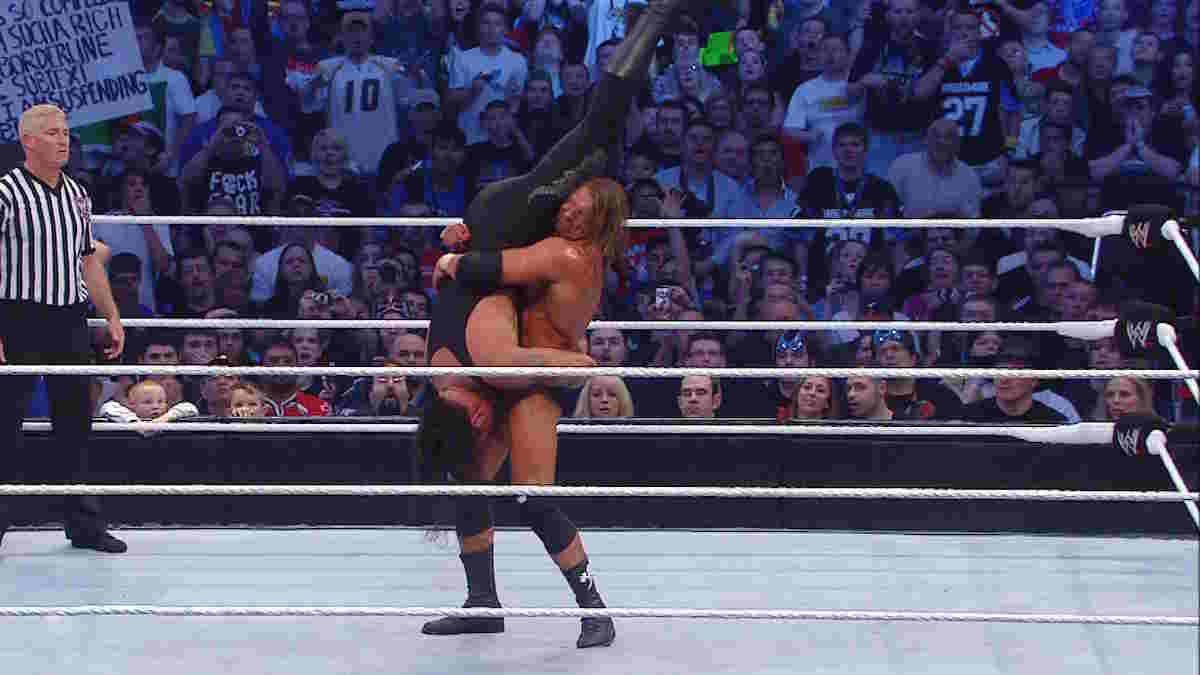
Power-based finishers dominate through raw strength — moves like the Chokeslam, the F-5, and the Jackknife Powerbomb that require explosive lifting and slamming techniques. These maneuvers communicate physical superiority in immediate, visceral terms and suit larger performers or characters built around physical dominance. The visual of one wrestler lifting another entirely off the ground carries obvious storytelling weight without requiring any additional narrative context.
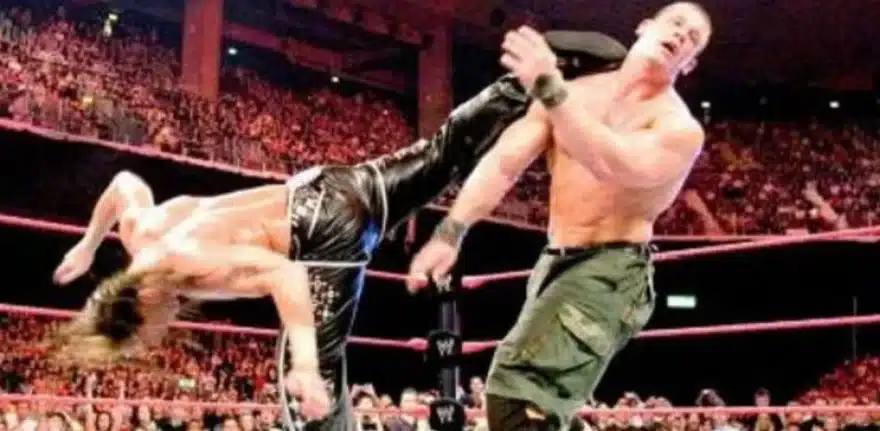
Strike-based finishers rely on speed and timing rather than strength. Moves like Sweet Chin Music and the RKO target vulnerable areas with surgical precision, often delivered without warning to amplify shock value. The RKO’s effectiveness as a finisher — and the “RKO outta nowhere” phenomenon — specifically exploits this quality, conditioning audiences to accept that the move can land from any position at any moment.
Submission-based finishers emphasise technical grappling through joint locks and chokeholds — the Sharpshooter, the Crossface, the Walls of Jericho. These require both performers to communicate the gradual building of pressure through physical performance, with the receiving wrestler’s body language telling the story of whether escape is possible.
Aerial finishers combine agility with risk — diving elbows, shooting star presses, the Swanton Bomb — requiring spatial awareness and body control that makes the athleticism itself part of the move’s spectacle. The risk element is visible to audiences, which contributes to the gasps and reactions these moves generate, even from crowds that have seen them many times before.
Match Pacing and Strategic Move Deployment
Knowing when to use a finisher is as important as having one. The strategic timing of a finishing move transforms it from an athletic display into a pivotal storytelling moment — and mismanaging that timing is one of the most common ways matches fail to deliver the emotional impact they’re building toward.
Effective match pacing follows a narrative structure that builds gradually, then reaches a climactic peak. Early sequences establish competitive equality through back-and-forth exchanges. Signature moves are strategically withheld until maximum crowd investment has developed — this restraint amplifies the emotional impact when the finisher finally appears, because the audience has been waiting and investing rather than seeing it deployed from the outset.
Wrestlers manipulate audience psychology by teasing the finisher before hitting it — setup positions that get blocked, near-executions that get reversed. These near-misses build anticipation through the specific frustration of anticipation denied. Rest holds and methodical control segments provide necessary breathing room, allowing crowds to process dramatic moments while performers conserve energy for sustained quality in the match’s final act.
Overusing high-impact sequences early in a match diminishes the effectiveness of the finishing move when it eventually lands. The heart monitor analogy applies: matches require controlled fluctuations in intensity to maintain sustained suspense. A match that peaks too early has nowhere to go; a match that builds carefully toward a single definitive moment creates the conditions for a finish that feels genuinely earned. Targeting a specific body part throughout a match — setting up the finisher as the logical conclusion of that damage — adds a further layer of storytelling continuity, elevating athletic competition into a memorable narrative.
Level Up Your Fight IQ
The finisher is the payoff — these guides cover the story that builds to it:
Frequently Asked Questions
How long does it take wrestlers to develop their signature finishing move?
Wrestlers typically require several months to several years to develop their signature finishing move. The initial process involves experimenting with techniques tailored to body type, wrestling style, and mentor influence. Most wrestlers debut refined finishers after 2–5 years of professional experience. However, refinement continues beyond the initial selection — adjustments for safety, crowd reaction, and opponent compatibility often continue well past the move’s debut. Some performers switch finishers entirely as their character evolves, while others refine the same move for decades.
What happens when two wrestlers have the same finishing move?
When wrestlers share similar or identical finishing moves, they differentiate through unique names, setup styles, taunt sequences, and overall presentation. Promotions generally accept this overlap rather than restricting move use, focusing instead on execution and performer charisma. Commentary teams craft distinct narratives around each version, while camera work emphasises different visual elements. Historical precedent shows many classic finishes have been shared across generations — DDTs, suplexes, and powerbombs have been used as finishers by dozens of performers. Audience conditioning and storytelling maintain each wrestler’s individual identity around the move.
Can wrestlers trademark or copyright their signature moves?
Wrestlers can trademark their stage names and catchphrases for commercial protection — WWE does this extensively with character identities. However, signature moves rarely qualify for copyright protection because athletic maneuvers are generally considered ideas rather than expressive works. Copyright law typically covers scripted, choreographed performances rather than individual wrestling techniques. The move’s name can sometimes be trademarked if it is closely associated with a specific brand or character, but the physical technique itself cannot be owned.
Are high-risk finishing moves more likely to cause injuries?
Wrestlers face considerably higher injury risk when executing high-risk finishing maneuvers than when using routine techniques. These moves generate greater impact forces and target vulnerable areas, including the head, neck, and shoulders. Aerial finishers and moves involving significant falls carry the highest risk profiles. The repeated performance of these moves across long careers compounds the cumulative wear on joints and soft tissue. This is part of why promotions carefully limit how often certain high-risk finishers are performed, both to protect performers and to preserve the move’s credibility through selective use.
How much say do wrestlers have in choosing their own finisher?
Wrestlers and promoters share decision-making authority over finishing moves through a collaborative process. Wrestlers typically initiate choices by testing moves that suit their physical abilities and character identity, while promoters evaluate selections based on safety, crowd reaction potential, and how the move fits within the existing roster. Promoters can veto moves already closely associated with other active talent or those deemed unsafe for regular use. Final approval typically requires management sign-off, balancing wrestler creativity with promotional needs, marketability, and the overall visual logic of the character being presented.