
The rear naked choke stands as the single most effective submission technique in mixed martial arts history. When properly applied, this blood choke renders an opponent unconscious in seconds, ending fights across all weight classes and skill levels. From Gene LeBell’s historic 1963 victory to Islam Makhachev’s modern dominance, the rear naked choke has proven its effectiveness for over six decades.
🎯 Key Takeaways
- Most effective finish: The rear naked choke accounts for more submission victories in UFC history than any other technique
- Blood choke mechanics: Cuts off blood flow to the brain via the carotid arteries, causing unconsciousness in 8-13 seconds
- Universal application: Works effectively regardless of size, strength, or weight class differences
- Historic significance: Gene LeBell used the rear naked choke to defeat boxer Milo Savage in 1963, the first televised MMA-style bout
- Safety when trained: One of the safest submissions when applied and released properly in controlled training environments
The Rear Naked Choke
What Is a Rear Naked Choke?
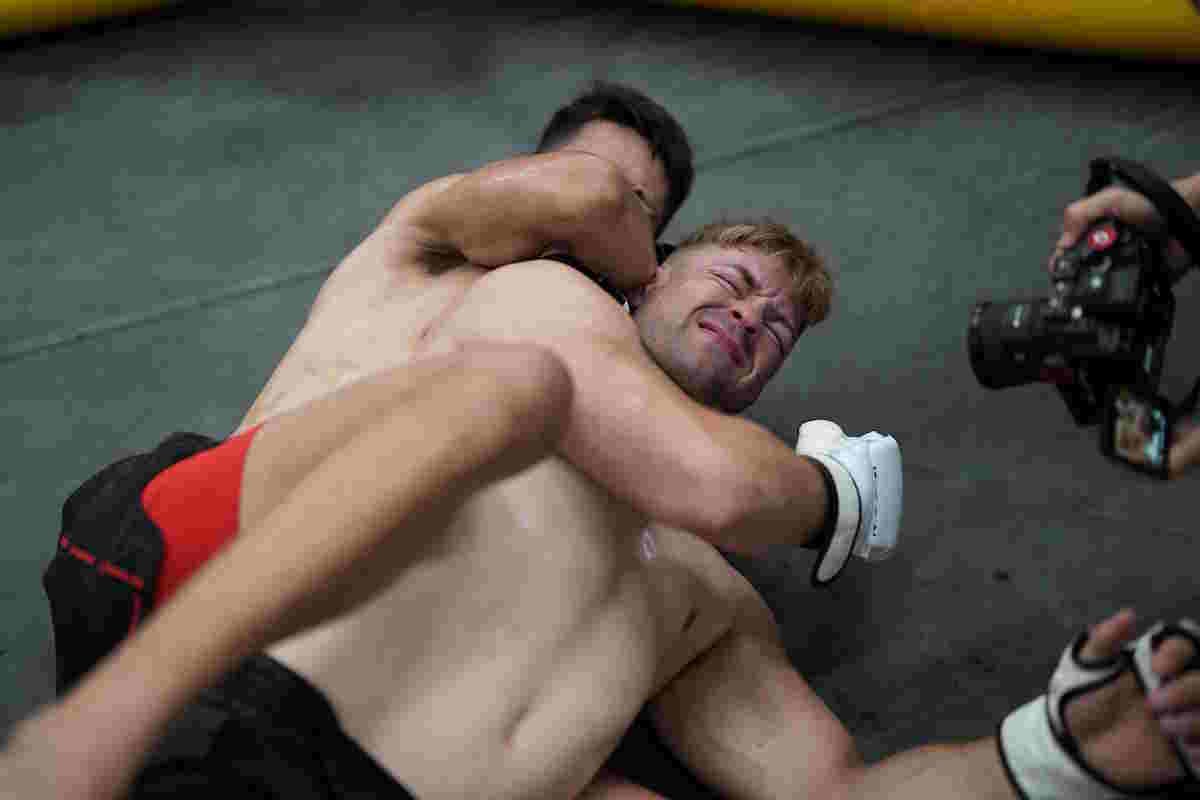
The rear naked choke (RNC), also called the “hadaka jime” in judo or simply “the choke” in Brazilian jiu-jitsu, is a blood choke applied from behind an opponent. The technique involves wrapping one arm around the opponent’s neck while using the other arm to secure the position, cutting off blood flow to the brain through compression of the carotid arteries.
Unlike air chokes that restrict breathing, the rear naked choke targets the circulatory system. When applied correctly, it causes rapid loss of consciousness—typically within 8 to 13 seconds—making it one of the fastest and most reliable finishes in combat sports.
Quick Facts: Rear Naked Choke
The Science: How the Rear Naked Choke Works
Understanding the mechanics of the rear naked choke reveals why it’s so devastatingly effective. The technique exploits basic human anatomy that cannot be overcome through strength or conditioning.
Blood Choke Mechanics
The rear naked choke works by compressing the carotid arteries on both sides of the neck. These arteries carry oxygen-rich blood from the heart to the brain. When both arteries are simultaneously compressed, the brain is rapidly starved of oxygenated blood.

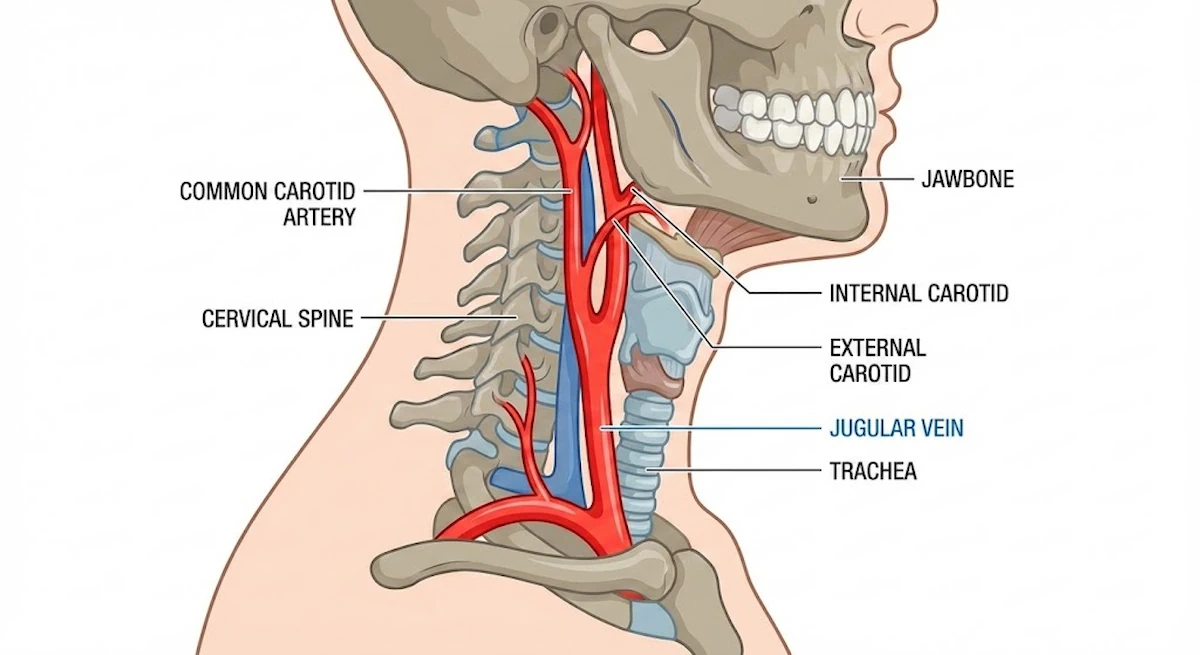
- Compression points: The bicep of the choking arm presses against one carotid artery, while the forearm or wrist bone presses against the other
- Secondary pressure: The other hand, placed behind the opponent’s head, drives it forward into the choke, increasing compression
- Rapid effect: With both carotids blocked, unconsciousness occurs within 8-13 seconds
- Safe release: When released immediately upon tap or unconsciousness, the choke causes no lasting damage
💡 Pro Tip: The “Choking Arm” Position
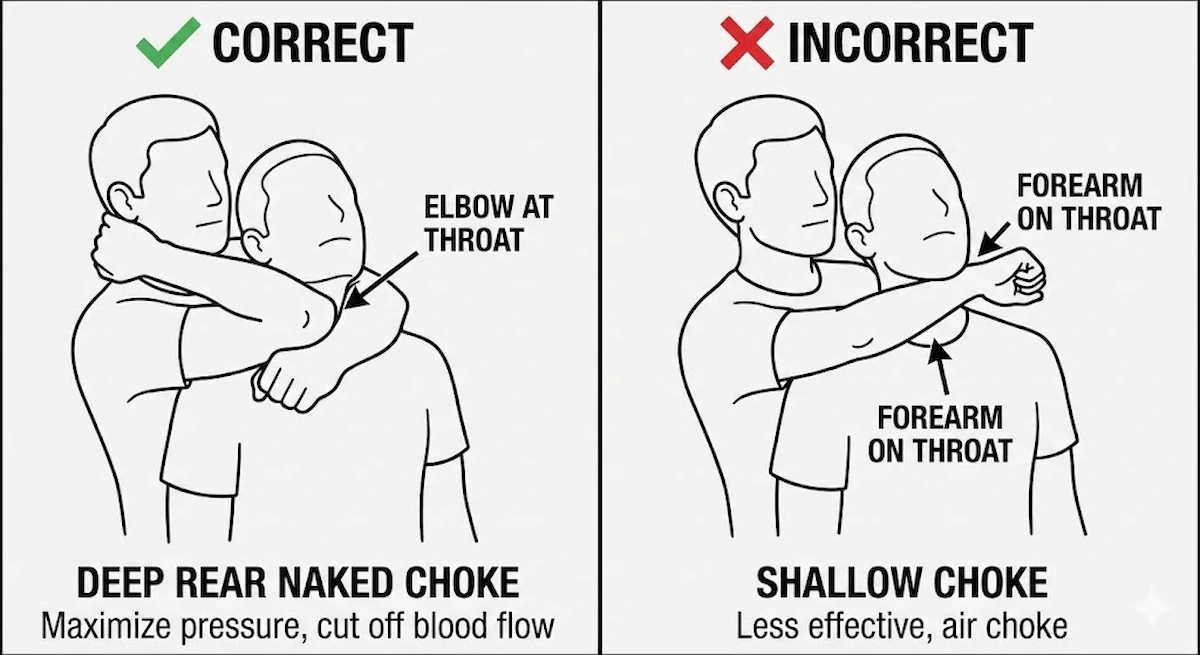
Elite grapplers know the key to a tight rear naked choke is arm positioning. Your choking arm should be deep enough that the crook of your elbow (the inside of your elbow joint) aligns with the front of your opponent’s throat. If the crook is positioned correctly, your bicep and forearm create perfect compression on both carotid arteries without relying solely on squeezing strength.
Why Size and Strength Don’t Matter
The rear naked choke is considered the “great equalizer” in combat sports because it works through leverage and position rather than brute force. A smaller, technically proficient grappler can successfully choke a much larger, stronger opponent.
The technique requires only 33 pounds of pressure applied to the carotid arteries to stop blood flow. This is well within the capability of even smaller fighters when proper positioning and leverage are used. The opponent’s own body weight and the attacker’s body positioning do most of the work—muscular strength is secondary.
How to Apply the Rear Naked Choke: Step-by-Step Breakdown
While the rear naked choke is considered a fundamental technique that beginners can learn, mastering its application takes years of dedicated practice. Here’s the classic technique breakdown used across Brazilian jiu-jitsu, judo, and MMA.
Secure Back Control
Establish a dominant position behind your opponent. The ideal position includes:
- Both “hooks” (legs) inside your opponent’s legs
- Your chest tight to their back
- Your hips positioned lower than theirs for base
- One hand controlling their upper body
Insert the Choking Arm
Slide your choking arm (usually your dominant arm) around your opponent’s neck. Key details:
- Aim to get the crook of your elbow aligned with the front center of their throat
- Your bicep should be against one side of their neck
- Your forearm should be against the other side
- Get your arm as deep as possible—shallow chokes are easily defended
Secure the Lock
Complete the choke structure with your non-choking hand:
- Bring your choking-arm hand to your opposite shoulder or bicep
- Place your other hand behind your opponent’s head
- Create a “figure-four” or “triangle” lock with your arms
Apply Pressure
Finish the submission by:
- Driving your head forward into the back of their head
- Expanding your chest
- Pulling your choking-arm elbow back slightly
- Squeezing your arms together
- Critical: Release immediately if your opponent taps or goes unconscious
⚠️ Safety Warning: Training the Rear Naked Choke
The rear naked choke is dangerous and should only be practiced under qualified supervision.
- Never practice this technique on untrained individuals or outside of a proper training environment
- Always tap immediately when caught in a choke during training—ego has no place on the mats
- Release the choke immediately when your partner taps or shows signs of distress
- Holding a choke after unconsciousness can cause serious brain damage or death
- If training with beginners, use controlled pressure and emphasize the tap
Defending the Rear Naked Choke: Prevention and Escapes
The saying among grapplers is clear: “The time to defend the rear naked choke is before it’s locked in.” Once a skilled opponent has secured the choke with proper positioning, escape becomes extremely difficult. However, understanding defensive principles can save a fight.
Prevention: Don’t Let Them Take Your Back
The best rear naked choke defense happens long before the choke itself. Preventing back control means:
- Protect your back during scrambles: Always face your opponent when possible, especially during transitions
- Defend the second hook: If one hook gets in, immediately focus on preventing the second hook from being secured
- Hand fighting: As soon as you feel an arm sliding toward your neck, use both hands to control that arm
- Posture awareness: Keep your chin tucked and hands high when in vulnerable positions
Escape Techniques When the Choke Is Sunk
If an opponent achieves back control and starts working for the rear naked choke, immediate defensive action is required. Common defenses include:
- The Two-on-One Hand Fight: Use both hands to grab the opponent’s choking arm and pull it away from your neck. This is a race against time—you must create space before the choke tightens.
- Tuck the Chin: Drive your chin down into the crook of their elbow. This isn’t a long-term solution but buys crucial seconds to work on other escapes. Never expose your neck or lift your chin.
- Address the Hooks: Clear one or both hooks (the opponent’s legs) to create space and begin escaping the back position entirely.
- The Shoulder Shrug: Aggressively shrug your shoulder (on the side of the choking arm) up toward your ear while pulling their arm down. This can prevent the arm from getting deep around your neck.
- Hip Escape: Create movement by shifting your hips and working to turn back into your opponent, transitioning from back control to a neutral or advantageous position.
🔍 Did You Know?
The “Grapevine” vs. “Hooks” Debate
In traditional judo, the rear naked choke position often uses a “grapevine” – weaving your legs around your opponent’s legs from the outside. In Brazilian jiu-jitsu and modern MMA, practitioners almost exclusively use “hooks” – inserting your feet inside your opponent’s legs. The hooks method provides superior control and makes it much harder for the opponent to escape or roll, which is why you’ll see it used in over 95% of UFC rear naked choke attempts.
The Rear Naked Choke in MMA History
The rear naked choke has defined some of the most important moments in mixed martial arts history. From its first documented use in competition to its modern championship victories, the RNC has proven effective across all eras of the sport.
1963: Gene LeBell vs. Milo Savage – The First MMA-Style Rear Naked Choke
On December 2, 1963, judo champion Gene LeBell accepted a challenge from boxer Milo Savage in what is now recognized as the first televised mixed martial arts bout in American history. The fight was a precursor to every MMA match that would follow—a grappler versus a striker, settling the eternal debate about which martial art was superior.
Despite Savage’s team allegedly greasing his body with Vaseline and possibly concealing brass knuckles in his gloves, LeBell closed the distance, took Savage down, and locked in a rear naked choke in the fourth round. The boxer went unconscious. When the referee hesitated to stop the fight, LeBell held the choke for a few extra seconds to ensure the message was clear.
This victory, 30 years before UFC 1, demonstrated that grappling—and specifically the rear naked choke—was a devastating weapon against pure strikers. Gene LeBell’s complete story as “The Godfather of Grappling” bridges judo, professional wrestling, and modern MMA in ways few other fighters can claim.
Today’s Rear Naked Choke Specialists
Several active UFC fighters have built their careers on elite rear naked choke execution, demonstrating the technique’s continued dominance in modern MMA:
- Islam Makhachev: The current dominant lightweight champion has finished multiple opponents with the RNC, combining Dagestani wrestling with elite grappling. His ability to take opponents down and transition to the back makes him one of the most feared finishers in the sport. Makhachev’s methodical approach to back control represents the evolution of the technique in the modern era. See our detailed analysis of Makhachev’s judo-based grappling style.
- Charles “Do Bronx” Oliveira: The former UFC lightweight champion holds the record for most submission victories in UFC history (16 finishes), with the rear naked choke being his signature weapon. Oliveira’s aggressive back-taking from any position—whether standing exchanges, guard, or scrambles—makes him dangerous throughout entire fights. His ability to finish elite-level opponents with the RNC proves the technique’s effectiveness even against world-class defensive grapplers.
- Brendan Allen: Currently one of the most dangerous submission artists in the middleweight division, Allen has accumulated an impressive submission rate that rivals any active fighter. His systematic approach to taking the back and hunting the rear naked choke has made him a nightmare matchup for strikers and grapplers alike. Allen represents the new generation of well-rounded mixed martial artists who seamlessly blend wrestling and jiu-jitsu.
- Jailton Almeida: A heavyweight submission specialist who has shocked the division with his ability to finish much larger opponents via rear naked choke. Almeida’s combination of explosive takedowns and relentless back attacks demonstrates that the RNC works at the highest levels across all weight classes. His rapid rise through the heavyweight ranks has been built almost entirely on his suffocating grappling and choke-hunting mentality.
- Gillian Robertson: The most prolific submission artist in women’s MMA history, Robertson has systematically dismantled opponents with her elite rear naked choke game. Her methodical approach to positional control and back-taking serves as a blueprint for women’s MMA grapplers. Robertson’s success proves that technical mastery of fundamental submissions like the RNC remains the most reliable path to victory, even in an era of increasingly well-rounded fighters.
Legacy: The Legends Who Perfected the Art
While today’s fighters continue to refine the rear naked choke, several retired legends established the technique’s reputation as MMA’s most reliable finish:
- Demian Maia: A Brazilian jiu-jitsu wizard who terrorized opponents for years with his methodical approach to taking the back and hunting the RNC. Maia proved that elite-level grappling remains relevant even against world-class strikers, finishing opponents across multiple weight divisions throughout his legendary career.
- Ronda Rousey: Before revolutionizing women’s MMA with her armbar, Rousey demonstrated exceptional judo-based back control and finished several opponents with the rear naked choke. Her ability to seamlessly transition from throws to back control to submission showed the technique’s effectiveness when combined with elite-level judo.
- Matt Hughes: The welterweight legend used his wrestling base to consistently take opponents’ backs, finishing numerous title defenses with the rear naked choke during his dominant championship reign.
- Antonio Rodrigo Nogueira: “Big Nog” brought Brazilian jiu-jitsu to the heavyweight division, demonstrating that technical submission grappling could overcome size and power. His rear naked choke victories over much larger opponents proved the technique’s universal effectiveness.
The Rear Naked Choke Across Different Martial Arts
While the mechanics remain consistent, different martial arts traditions have their own approaches to teaching and applying the rear naked choke.
Judo: Hadaka Jime (Naked Strangle)
In judo, the technique is called “hadaka jime,” which translates to “naked strangle”—naked because it doesn’t require using the gi (uniform) for leverage, unlike many other judo chokes. Judo practitioners typically apply the choke from a standing position during throws or immediately after a takedown.
The judo approach emphasizes explosive application during transitions, capitalizing on the momentum from throws. Many MMA fighters with judo backgrounds, like Ronda Rousey and Islam Makhachev, bring this aggressive transition game into the cage. Learn more about judo’s ranking system and training philosophy.
Brazilian Jiu-Jitsu: Mata Leão (Lion Killer)
Brazilian jiu-jitsu practitioners sometimes call the rear naked choke “mata leão,” Portuguese for “lion killer.” BJJ training emphasizes methodical positional control, with back control considered one of the most dominant positions in grappling.
BJJ schools typically teach the RNC as part of the fundamental curriculum from white belt onward. The focus is on achieving the position through systematic progression: establish guard, sweep or submit, take the back, secure hooks, and apply the choke. This positional hierarchy has become the blueprint for MMA grappling. Explore the complete BJJ belt ranking system to understand how the rear naked choke fits into progressive skill development.
Catch Wrestling and the “Sleeper Hold”
In catch wrestling and professional wrestling, variations of the rear naked choke are often called the “sleeper hold.” The mechanics are similar, though the no-gi environment of catch wrestling has always emphasized arm positioning over gi-based chokes.
Gene LeBell, who trained in both judo and catch wrestling, brought elements of both styles to his famous 1963 victory, demonstrating how cross-training martial arts can create devastating combinations.
Common Mistakes When Applying the Rear Naked Choke
Even experienced grapplers make errors that reduce the effectiveness of the rear naked choke. Recognizing these mistakes helps both attackers refine their technique and defenders exploit weaknesses.
- Not getting the arm deep enough: A shallow choke allows the opponent to tuck their chin and create defensive frames. The crook of your elbow should be centered on their throat.
- Relying only on arm strength: Squeezing with raw muscular power instead of using proper body mechanics leads to fatigue and gives opponents time to escape. Use your chest expansion, shoulder positioning, and body pressure.
- Forgetting the hooks: Attempting the choke without securing at least one hook allows the opponent to hip escape or roll to safety. Control the legs first.
- Not controlling the head: Your non-choking hand should be pressed firmly behind their head, driving it forward into the choke. Without this pressure, the choke loses significant effectiveness.
- Crossing feet (in some positions): While debate exists about this, many instructors warn against crossing your feet when you have both hooks in, as it exposes you to ankle locks and reduces control.
- Telegraphing the attempt: Good opponents recognize when you’re hunting for the choke. The best back-takers disguise their intent, using feints and alternate attacks to create openings.
Training the Rear Naked Choke Safely and Effectively
Mastering the rear naked choke requires thousands of repetitions under proper supervision. Whether you train Brazilian jiu-jitsu, judo, or MMA, these guidelines will help you develop the technique safely and effectively.
Solo Drilling and Visualization
- Shadow grappling: Practice the arm motions without a partner to build muscle memory for proper positioning
- Visualization: Mentally rehearse the sequence from back control to finished choke
- Flexibility work: Develop shoulder and arm flexibility to achieve deep, tight choke positioning
- Strength conditioning: While technique matters more than strength, developing core and grip strength helps maintain position
Partner Drilling Progressions
- Static drilling: Start with your partner offering no resistance, focusing purely on proper technique and positioning
- Progressive resistance: Gradually increase the level of resistance your partner provides
- Live situational sparring: Start from the back control position and work to either finish the choke or escape
- Full sparring: Incorporate the technique into full rolling/sparring sessions to develop timing and setups
💡 Pro Tip: The “Tap Early, Tap Often” Philosophy
Elite grapplers understand that tapping to chokes during training is how you learn. Every tap is data: your partner achieved better positioning than you defended. Protecting your ego by refusing to tap serves no purpose—you learn nothing, risk injury, and waste training time. Champions tap dozens of times per training session, learn from each mistake, and improve rapidly as a result.
Rear Naked Choke vs. Other Submission Techniques
The rear naked choke is one technique in a complete submission grappling arsenal. Understanding how it compares to other high-percentage submissions helps fighters develop well-rounded finishing skills.
RNC vs. Guillotine Choke
- Rear naked choke advantages: More control, less reliance on pure squeezing power, works from dominant back position
- Guillotine advantages: Can be applied from standing, works from guard, faster setup in scrambles
- Success rate: RNC has higher finish percentage in MMA due to superior positional control
RNC vs. Triangle Choke
- Rear naked choke advantages: Simpler mechanics, less flexibility required, works regardless of opponent’s size
- Triangle advantages: Can be applied from guard (defensive position), attacks arm and neck simultaneously
- Difficulty: Triangle choke requires more technical precision and favorable body proportions
RNC vs. Armbar
- Rear naked choke advantages: Maintains positional dominance throughout, no risk of positional loss if the submission fails
- Armbar advantages: Targets joint instead of cutting off blood flow, can be applied from more varied positions
- Escape difficulty: Properly locked RNC is harder to escape than a properly locked armbar
Explore our comprehensive guide to the top 10 chokes that define modern MMA to understand how the rear naked choke fits into the broader submission landscape.
Why the Rear Naked Choke Remains Dominant in Modern MMA
Despite decades of evolution in mixed martial arts training and defensive techniques, the rear naked choke continues to finish more fights than any other submission. Several factors explain its enduring dominance.
Back Control: The Supreme Position
In grappling hierarchy, back control is considered the most dominant position because:
- The opponent cannot strike you effectively
- You have multiple submission options (RNC, arm attacks, neck cranks)
- The opponent must completely escape to regain offensive capability
- Even elite defensive grapplers struggle to escape skilled back control
The rear naked choke is the natural culmination of achieving this dominant position, which is why grapplers invest countless hours learning to take and maintain the back. Understanding grappling control positions in MMA reveals why back control leads to so many finishes.
Universal Effectiveness Across All Fighters
Unlike some techniques that favor specific body types or athletic attributes, the rear naked choke works for everyone:
- Small fighters vs. large opponents: Proper technique overcomes size disadvantages
- Against pure wrestlers: Wrestling rarely trains specific RNC defense from back position
- Against strikers: Taking the back neutralizes striking entirely
- In all weight classes: From flyweight to heavyweight, the choke works identically
- Gi or no-gi: No clothing required, making it ideal for MMA
📚 Historical Context: The Evolution of Back Control in MMA
In early UFC events (1993-1995), many fighters had no answer for basic back control and rear naked chokes. Brazilian jiu-jitsu practitioners like Royce Gracie repeatedly demonstrated that superior positional grappling could defeat larger, stronger opponents who lacked submission defense.
As MMA evolved, fighters developed better takedown defense and submission awareness. Yet even with 30+ years of evolution, the rear naked choke remains the highest-percentage submission in the UFC. This isn’t because modern fighters lack skill—it’s because the fundamental mechanics of the choke, combined with the supreme dominance of back control, creates a nearly inescapable situation when executed properly.
The technique’s effectiveness has actually increased in modern MMA as fighters have developed more sophisticated methods of taking the back from standing exchanges, wrestling scrambles, and guard positions.
The Numbers: Rear Naked Choke Statistics in the UFC
Statistical analysis reveals why the rear naked choke stands apart from other submission techniques in professional MMA competition.
- Most common submission: The RNC accounts for approximately 40-45% of all submission victories in UFC history
- Success rate: When fully locked in with both hooks secured, the RNC has an approximately 80-85% finish rate (tap or unconsciousness)
- Average time to finish: From full back control to tap/unconsciousness averages 15-30 seconds in competition
- Weight class distribution: Unlike some submissions, the RNC shows consistent effectiveness across all weight divisions
- Round occurrence: RNC finishes occur most frequently in rounds 2 and 3, when fatigue reduces defensive capabilities
Compare these statistics to other submissions: guillotines finish approximately 20% of submission victories, armbars around 15%, triangle chokes roughly 8%, and all other submissions combined make up the remaining percentage. The RNC’s dominance is undeniable.
Where to Learn the Rear Naked Choke Properly
Reading about the rear naked choke builds understanding, but developing practical skill requires hands-on training under qualified instruction. Here’s how to find quality grappling instruction:
Brazilian Jiu-Jitsu Academies
BJJ gyms provide the most comprehensive instruction for developing submission grappling skills, including the rear naked choke. Look for academies affiliated with established organizations (Gracie family lineages, 10th Planet, etc.) and check instructor credentials.
Most BJJ schools offer beginner programs that systematically teach fundamental positions and submissions, with the RNC typically introduced within the first month of training. Discover the best BJJ gyms in North America or explore 10th Planet Jiu-Jitsu locations for no-gi focused training.
Judo Clubs
Traditional judo training includes the hadaka jime (rear naked choke) as part of its comprehensive curriculum. Judo clubs often provide excellent instruction at lower costs than commercial MMA gyms, making them accessible entry points for learning fundamental grappling.
Judo’s emphasis on explosive techniques and transitions from standing to ground creates a unique approach to the RNC that differs from BJJ’s methodical positional approach. Many successful MMA fighters blend both styles.
MMA Gyms
MMA training facilities teach submission grappling in the context of mixed martial arts, integrating striking, wrestling, and submissions. This provides the most complete picture of how the rear naked choke applies in actual fighting scenarios.
When evaluating MMA gyms, look for facilities with dedicated grappling coaches, not just striking instructors who dabble in groundwork. The best MMA gyms employ specialized BJJ or wrestling coaches for their grappling programs.
🔗 Level Up Your Fight IQ: Related Combat Sports Guides
Expand your combat sports knowledge with these essential guides from Ringside Report Network:
Grappling & Submissions
- The Art of the Finish: Top 10 Chokes That Define Modern MMA – Master the complete arsenal of MMA chokes
- MMA Submission Techniques: Why 20% of UFC Fights End in Tap Outs – Comprehensive submission breakdown
- Grappling in MMA: Takedowns, Clinches, Throws, and Ground Controllers – Complete grappling fundamentals
- Guard: A Defensive Ground Position in MMA – Essential positional guide
- Clinching in MMA: What Is the Standing Grappling Position? – Standing grappling fundamentals
Belt Systems & Training Paths
- Brazilian Jiu-Jitsu Belts 101: The Guide to the Ranking System – Complete BJJ progression guide
- 10th Planet Jiu-Jitsu’s Belt System Explained – No-gi ranking structure
- Judo Belts 101: The Complete Guide to the Ranking System – Traditional judo progression
- Losing the Gi: A Grappler’s Guide to No-Gi Jiu-Jitsu – Transitioning training approaches
Legendary Figures & History
- Gene LeBell: The Godfather of Grappling Who Bridged Judo, Pro Wrestling & MMA – The pioneer who made the RNC famous
- Makhachev Judo Breakdown: Why He’s Fighting a Different Fight – Modern RNC mastery analysis
- Georgian Judo MMA: How Bekauri’s Grip Fighting Will Dominate the UFC – Judo’s evolution in MMA
Training Resources
- Best BJJ Gyms in North America: Where Champions Actually Train – Find quality instruction
- Best 10th Planet Jiu-Jitsu Gyms: North America’s No-Gi Rebels Ranked – No-gi training facilities
- Jiu Jitsu vs. Judo: Key Differences and How to Choose – Select your training path
Frequently Asked Questions About the Rear Naked Choke
Is the rear naked choke dangerous?
When applied properly and released immediately upon tap or unconsciousness, the rear naked choke is relatively safe. It cuts off blood flow to the brain but causes no damage if released within seconds. However, holding the choke after someone goes unconscious can cause serious brain damage or death. The technique should only be practiced under qualified supervision in controlled training environments.
How long does it take to choke someone out with a rear naked choke?
A properly applied rear naked choke causes unconsciousness in approximately 8-13 seconds by cutting off blood flow to the brain through the carotid arteries. However, this can vary based on individual physiology, the tightness of the choke, and whether the opponent is actively resisting (which can speed up oxygen depletion).
Can you escape a fully locked rear naked choke?
Escaping a fully locked rear naked choke with both hooks secured is extremely difficult, even for high-level grapplers. Once the choke is tight and properly positioned, your options are very limited. The key is to defend before the choke gets fully locked—hand fighting to prevent the choking arm from getting deep, addressing the hooks, and creating movement before your opponent achieves complete control.
What’s the difference between a rear naked choke and a sleeper hold?
They are essentially the same technique with different names used in different contexts. “Rear naked choke” is the term used in Brazilian jiu-jitsu, judo (hadaka jime), and modern MMA. “Sleeper hold” is the term commonly used in catch wrestling and professional wrestling. Both refer to the same blood choke applied from behind, cutting off blood flow through the carotid arteries.
Why is it called a ‘rear naked’ choke?
The term ‘rear naked choke’ comes from the fact that it’s applied from behind (rear) and doesn’t require using the opponent’s clothing or gi for leverage (naked). In judo, where many chokes use the gi, the hadaka jime (naked strangle) stands out because it works with or without clothing, making it ideal for no-gi grappling and MMA.
Can the rear naked choke work in street self-defense?
Yes, the rear naked choke is considered one of the most effective self-defense techniques because it allows a smaller person to control and neutralize a larger attacker without striking. It works regardless of size or strength differences when properly applied. However, martial arts training for self-defense should always emphasize de-escalation, escape, and avoiding confrontation when possible. Taking someone’s back and applying a choke should be a last resort in genuine self-defense situations.
Do you need to be strong to apply a rear naked choke?
No. The rear naked choke works through proper positioning and leverage, not muscular strength. Technique and body positioning do most of the work—you’re using your arms to compress the carotid arteries, which requires only about 33 pounds of pressure when positioned correctly. Even smaller grapplers can successfully choke much larger, stronger opponents with proper technique.
What’s the best defense against a rear naked choke?
The best defense is prevention—don’t let your opponent take your back in the first place. Focus on keeping your opponent in front of you, protecting your back during scrambles, and immediately addressing any hooks (legs) they try to insert. If they start working for the choke, use both hands to control their choking arm, keep your chin tucked, and work to clear the hooks while creating movement to escape the position.
How is the rear naked choke different from an air choke?
The rear naked choke is a blood choke (strangulation) that compresses the carotid arteries, cutting off blood flow to the brain and causing unconsciousness in 8-13 seconds. An air choke blocks the windpipe, preventing breathing, which takes much longer to cause unconsciousness (several minutes) and is generally less effective and more dangerous. Blood chokes are preferred in sport grappling because they work faster and are safer when properly applied and released.
Can you get brain damage from being choked unconscious?
Brief unconsciousness from a properly applied and immediately released rear naked choke does not typically cause brain damage. The brain can survive short periods without oxygen. However, holding a choke after someone goes unconscious can absolutely cause serious brain damage or death. This is why tapping immediately when caught in training is crucial, and why the person applying the choke must release it the instant their partner taps or shows signs of unconsciousness.
Final Thoughts: The Timeless Effectiveness of the Rear Naked Choke
From Gene LeBell’s historic 1963 victory over Milo Savage to Islam Makhachev’s modern dominance in the UFC, the rear naked choke has proven itself as the most reliable submission technique in combat sports history. Its effectiveness transcends martial arts styles, weight classes, and eras of competition.
What makes the rear naked choke so special isn’t complexity—it’s the perfect marriage of simple biomechanics and dominant positioning. When you control an opponent’s back and cut off blood flow to their brain, size and strength become irrelevant—technique and position reign supreme.
Whether you’re a dedicated Brazilian jiu-jitsu practitioner working toward your black belt, an MMA fighter developing a complete submission game, or a martial artist seeking effective self-defense techniques, mastering the rear naked choke provides a foundation that will serve you for life. The journey from first learning the basic mechanics to developing the subtle positional awareness that makes you dangerous takes years—but every hour spent on the mats sharpening this skill pays dividends.
Remember: the rear naked choke is not just a submission technique. It’s a philosophy. It teaches that control beats aggression, position beats power, and technique beats strength. These lessons extend far beyond the mats into how we approach challenges in all aspects of life.
Train smart. Tap early. Keep learning. And always remember—the best time to defend the rear naked choke is before it’s locked in.
🥋 Ready to Level Up Your Grappling Knowledge?
The rear naked choke is just one piece of the combat sports puzzle. Explore our complete library of Fight IQ guides covering everything from BJJ belt systems to comprehensive choke techniques, from legendary fighters who shaped the sport to fundamental grappling positions.
Ringside Report Network is The Combat Sports Authority—your ultimate resource for MMA, Pro Wrestling, and combat sports knowledge that goes beyond surface-level analysis.