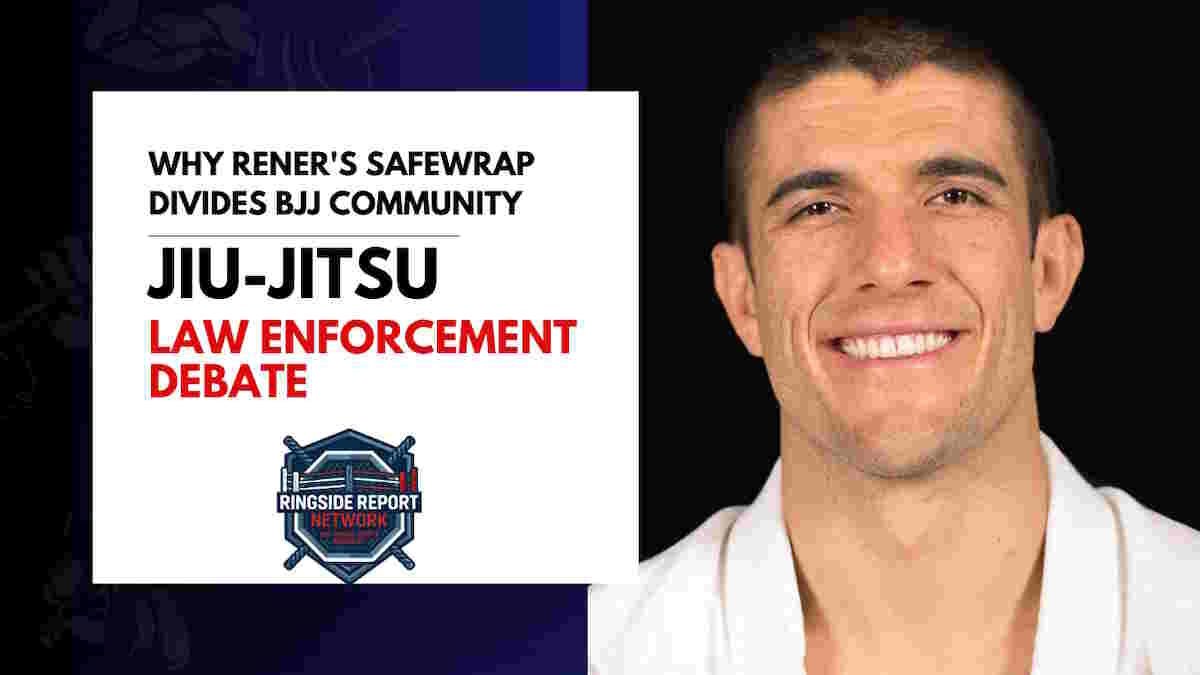
Rener Gracie just dropped a control technique called SAFEWRAP for law enforcement, and the BJJ community is doing exactly what you’d expect — splitting into camps faster than a poorly executed guard pass. Some are calling it revolutionary. Others are saying it’s watered-down jiu-jitsu that won’t work when things go sideways. Here’s the thing: they’re both right, and that’s precisely why this jiu-jitsu law enforcement debate matters more than people realize.
The technique itself is straightforward — it’s designed to control someone from behind without going to the ground, using a modified seat-belt grip and body positioning that keep officers on their feet. Rener’s pitch is simple: give cops a way to control resisting subjects without chokes, without going to the mat, and without the optics nightmare of knee-on-neck positions. On paper, it makes perfect sense. In reality, it’s exposing a fundamental divide in how we think about jiu-jitsu law enforcement training and practical application outside the competition mat.
The Sport BJJ Crowd Has a Point (Sort Of)
Why Competition Guys Are Skeptical
I get why competitive grapplers are raising eyebrows. If you’ve spent years perfecting your guard retention and studying the latest leg lock systems, SAFEWRAP probably looks like jiu-jitsu for beginners. And technically, that’s exactly what it is. The criticism isn’t wrong — this isn’t high-level grappling. It’s not supposed to be.
The competitive BJJ mindset says: Why teach a limited technique when you could teach proper fundamentals? Why create a specific “police version” when real jiu-jitsu already has answers for every position? These athletes have a valid concern. They’ve seen what happens when people learn isolated techniques without understanding the complete system. It creates false confidence.
The Reality Check Nobody Wants to Hear
But here’s where the sport guys miss the mark when criticizing jiu-jitsu law enforcement applications: law enforcement isn’t a grappling match. A cop responding to a domestic disturbance isn’t thinking about points or advantages. They’re thinking about going home to their family while keeping everyone else safe. That’s an entirely different psychological framework than competition, and it requires different tools.
What do you expect? You can’t hand a police officer a blue belt curriculum and say, “Good luck out there.” The average cop gets maybe 8-16 hours of defensive tactics training per year. That’s not enough time to develop real jiu-jitsu — it’s barely enough time to drill a few high-percentage techniques until they become reflexive.
The Gracie Self-Defense Philosophy Actually Makes Sense Here
Why Rener’s Approach Isn’t Crazy
This is where Helio Gracie’s original vision becomes relevant for jiu-jitsu law enforcement training. The Gracie family didn’t build their reputation on sport jiu-jitsu — they built it on practical self-defense for people who weren’t athletes. The whole point was: what’s the minimum effective technique that works under maximum stress?
Rener‘s taking that philosophy and applying it to law enforcement. SAFEWRAP isn’t trying to be comprehensive jiu-jitsu. It’s trying to be the one technique a cop can execute under adrenaline dump conditions, with limited training time, while wearing 20 pounds of gear and worrying about weapon retention.
I’ve covered enough combat sports to know this: the best technique isn’t always the most sophisticated one. Sometimes the best technique is the one that actually gets used when everything goes wrong. Brother, if you can’t execute it when you’re exhausted, scared, and someone’s trying to hurt you, it doesn’t matter how beautiful it looks in the gym.
The Training Time Economics
Let’s be honest about the numbers. Police departments don’t have the budget or time for extensive grappling programs. They’re not sending officers to train three times a week for years. SAFEWRAP is designed around that constraint — it’s a technique you can teach in a few hours and maintain with minimal refresher training.
Is that ideal? Of course not. Would comprehensive jiu-jitsu training be better? Absolutely. But we don’t live in a perfect world. We live in a world where departments are understaffed, budgets are tight, and officers need something they can actually use tomorrow, not after they earn their blue belt.
Where This Gets Complicated
The Gap Between Technique and Reality
Here’s my concern about jiu-jitsu law enforcement programs built around single techniques, and I’ll admit this is where my reasoning might fall apart: any single technique becomes dangerous when people believe it’s the complete answer. SAFEWRAP works great until it doesn’t — until you’re dealing with someone who knows how to fight, or someone so much bigger and stronger that technique alone won’t cut it.
The risk is creating a false sense of security. An officer learns SAFEWRAP, uses it successfully a few times on compliant-ish subjects, and then assumes it’ll work on everyone. That’s when people get hurt. The technique isn’t the problem — the overconfidence in limited training is.
What the Critics Are Missing
But the critics screaming “this won’t work” are ignoring the alternative: what are cops doing now? In many cases, they’re either going hands-off completely (which creates different problems) or escalating to impact weapons and tasers faster because they don’t have confidence in their empty-hand control options.
If SAFEWRAP gives officers one reliable option that keeps them engaged physically without going to the ground or using chokes, that’s a net positive even if it’s not perfect. The perfect is the enemy of the good here.
My Bold Take: This Reveals BJJ’s Identity Crisis
Here’s what this jiu-jitsu law enforcement controversy really exposes: the jiu-jitsu community doesn’t know what it wants to be anymore. Are we a martial art focused on practical self-defense? Are we a sport with athletes and championships? Are we a fitness program? We’re trying to be all three, and that creates these weird conflicts.
The sport guys look at SAFEWRAP and see dumbed-down jiu-jitsu. The self-defense guys see it as exactly what Helio intended. Both perspectives have merit, but they’re measuring success by completely different standards.
I think we’re going to see more of this division, not less. As jiu-jitsu continues to evolve as a sport — with flying submissions, inverted guards, and berimbolo variations — the gap between sport application and practical application will continue to widen. That’s not necessarily bad, but we need to stop pretending they’re the same thing.
What Happens Next
Rener’s going to keep pushing SAFEWRAP regardless of what the competition community thinks. That’s the thing about the Gracies — they’ve never particularly cared about sport BJJ validation. Their business model is built on practical application and self-defense, and law enforcement is a massive market.
Will it work? Depends on how you define success. If the measure is “does it give officers a better option than what they currently have,” probably yes. If the measure is “does it solve all the problems of police physical encounters,” obviously, no.
The real question isn’t whether SAFEWRAP is good jiu-jitsu — it’s whether limited training in specific techniques serves law enforcement better than no training at all. And brother, I know which side of that argument makes more sense when you’re the one who has to make a split-second decision on the street.
This debate isn’t going away. It’s going to force the jiu-jitsu community to confront some uncomfortable truths about what we’re actually teaching and why. And honestly? That conversation is long overdue.
Ringside Report Network’s Combat Sports Gym Finder
Find BJJ, Boxing, Muay Thai & more near you
All Countries
United States
Canada
United Kingdom
Australia
Brazil
Germany
France
Japan
Mexico
Netherlands
Ireland
New Zealand
Philippines
Poland
Russia
South Africa
South Korea
Spain
Sweden
Thailand
Please select at least one discipline to search for gyms.
Enter your location, select disciplines, then search to find combat sports gyms nearby
Gyms near
Tap any discipline above to view gyms on Google Maps
Resident Evil 2026 is a critics darling at 96%. Johnny North gives it 3.5 out of 5: scary, respectful of the games, but no Jill, no Chris and some weak jokes.
Roman Reigns vs LA Knight headlines Money in the Bank in New Orleans. Why WWE must take the title off Roman, plus both ladder match fields after a dismal week.
PAC AEW fans lost a legend one day after All Out 2026. Why Benjamin Satterley was the most precise high flyer ever, and why WWE never knew what it had in him.