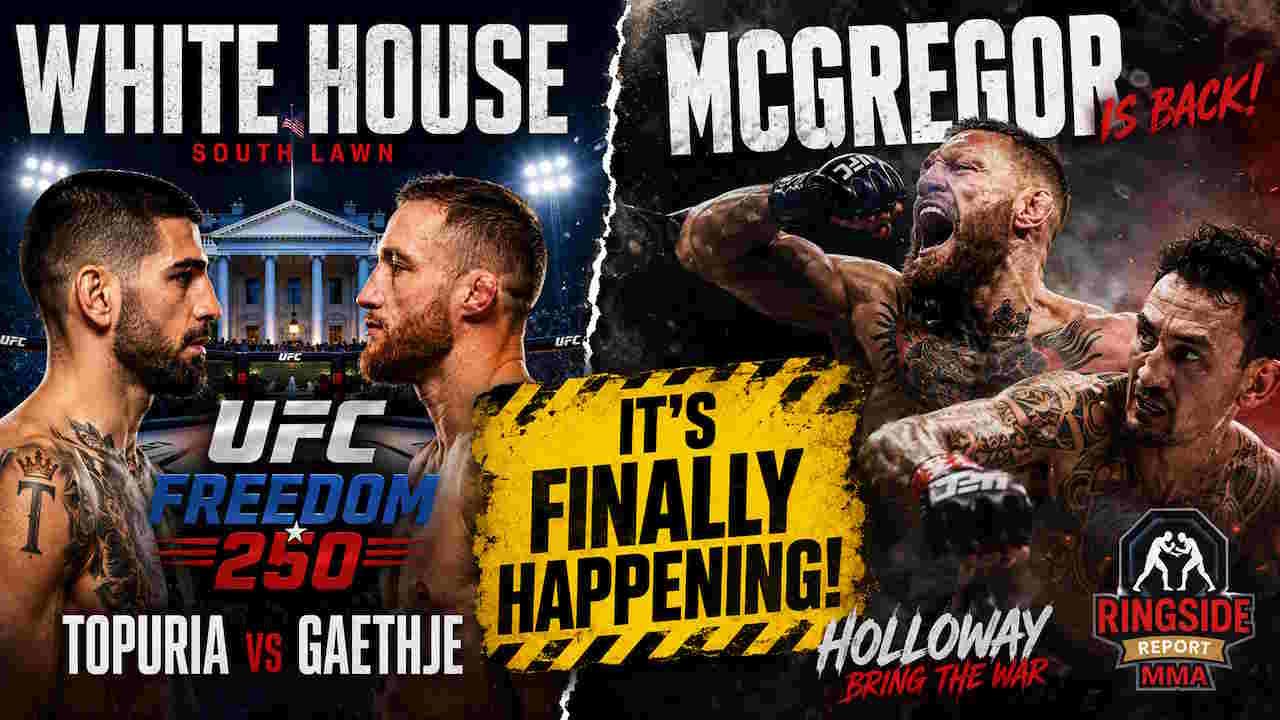

Mystic Mac is back. After five years away from the sport — the longest layoff of his career — Conor McGregor has an official fight date, an official opponent, and an official venue. July 11, 2026. T-Mobile Arena, Las Vegas. UFC 329. McGregor versus Max Holloway, a welterweight rematch thirteen years in the making. And if the timing of the announcement tells you anything, the UFC made sure to make it during the middle of MVP MMA 1 — a calculated counterpunch that landed cleaner than anything on that card.
The contrast between what MVP MMA delivered on Saturday night and what the UFC is building toward for the summer couldn’t be sharper. One was a sideshow dressed up as a sport. The other is the real thing. After watching MVP MMA 1 play out from start to finish, the gap between the fringe and the UFC has never looked wider.
Table of Contents
MVP MMA 1: Spectacle Without Sport
On paper, MVP MMA 1 had the ingredients. Former heavyweight champion Francis Ngannou. Former title contender Nate Diaz. Legends like Ronda Rousey and Junior dos Santos. A main event with a built-in Hollywood narrative. But cards aren’t fought on paper, and every single fight on that card told the same story: this was not a competitive sporting event.
The dos Santos fight was a mismatch. The Ngannou fight was a mismatch. The Diaz fight — entertaining in a chaotic, blood-soaked, Kimbo Slice-at-the-backyard kind of way — was not MMA at its highest level. The undercard didn’t offer any redemption. Every fight was short. The breaks between them were long. The broadcast, with its hokey production values and commentary that felt stitched together from another era, made the whole thing feel cheaper than it was.
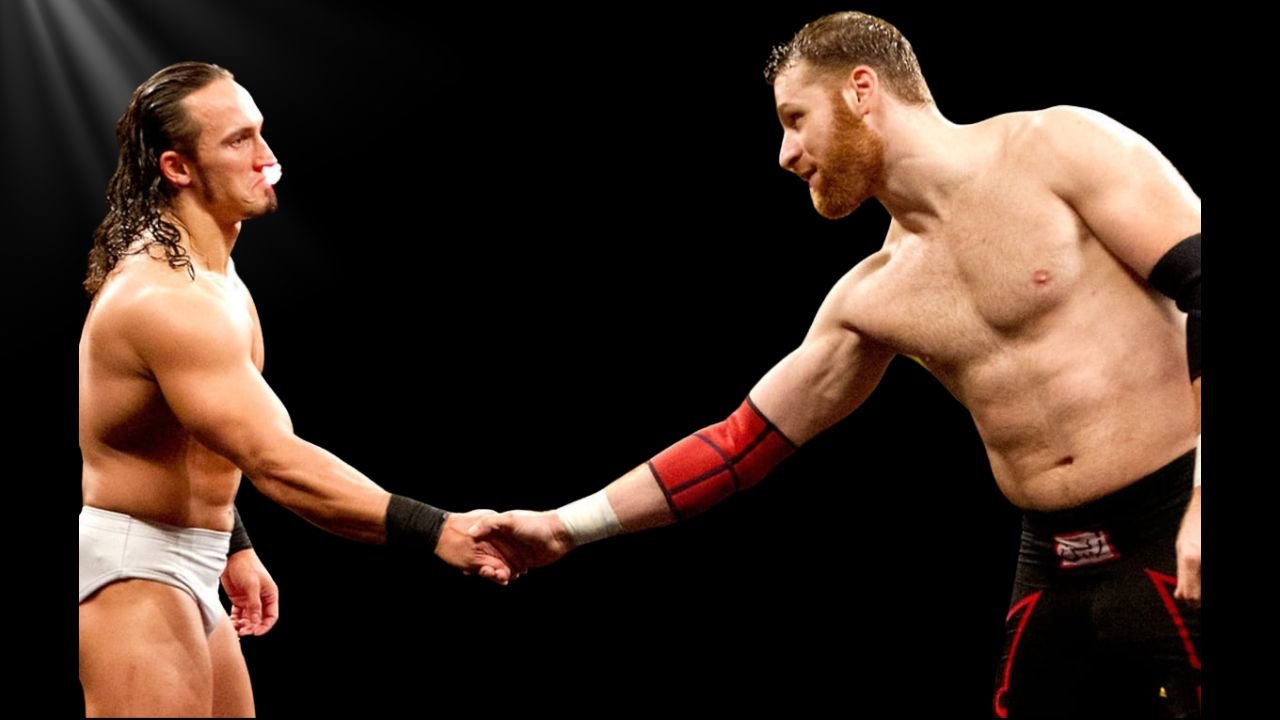
The only fight that carried any real intrigue was Mike Perry versus Nate Diaz, and that fight worked precisely because both men are brawlers who refuse to fight smart. That’s entertainment. But it’s bar-fight entertainment. You wouldn’t confuse it with the sport of mixed martial arts at its highest level.
The real organizational wound came from the main event. Ronda Rousey submitted Gina Carano with an arm bar in seventeen seconds. That’s it. That’s the fight. Rousey, to her credit, can do arithmetic — she knew she could put Carano away whenever she wanted, and she did. But seventeen seconds of action after months of buildup, a full Netflix promotional apparatus, and a main-event billing doesn’t just fail to deliver; it actively poisons the event. Jake Paul’s face said everything after that finish. He knew what he had.
And then Rousey walked to the microphone and announced she was never fighting again. She’s a mom. She’s expecting her third child. She’s done. Fine. Good for Ronda — genuinely. She got what she wanted: a win, a clean exit, and her arm still working. But for an organization trying to establish itself as a legitimate alternative to the UFC, having your headliner win in seventeen seconds and immediately announce retirement in the same breath is a catastrophic evening. Rousey played the game she needed to play. MVP MMA got left holding the bag.
There were smarter ways to build that card. Ngannou should have been the main event. Rosbellis de Souza — the man who knocked out Junior dos Santos like he was getting paid extra for speed — is the fight that makes sense opposite Ngannou: a legitimate heavyweight collision to crown an MVP MMA champion and give the organization something to stand on going forward. Instead, the card peaked on nostalgia and delivered nothing. If MVP MMA wants a second show to be taken seriously, it needs Ngannou in the main event against a real threat, and it needs to stop relying on names that stopped being active fighters years ago.
The broadcast didn’t help. The commentary came off as out of touch. The pacing was amateurish. And here’s the fundamental problem with all of it: many people who watched MVP MMA 1 don’t regularly watch MMA. Jake Paul’s audience followed him there. That audience got seventeen seconds in the main event, mismatched fights, and a production that felt nothing like the UFC. If that’s your introduction to the sport, you’re not coming back. You’re not seeking out a UFC card next weekend. And that’s a genuine disservice to a sport that, right now, is producing some of the most competitive and technically advanced fights in its history.
For a fuller look at where the Ngannou situation stands after this and what kind of fight would actually justify an MVP MMA heavyweight title, check out what’s next for Francis Ngannou.

The Only Unstoppable Force Left in MMA
One of the things MVP MMA 1 inadvertently illustrated is what made the UFC’s golden era so special and why the sport is now both more competitive and more unpredictable than it has ever been. For a long stretch in MMA history, there were men who seemed genuinely unbeatable: Anderson Silva running through middleweights, Georges St-Pierre turning welterweight into his personal kingdom, Demetrius Johnson at flyweight making every title defense look like a graduate-level seminar. Jon Jones at light heavyweight. Those records — most title defenses at a given weight — are not going to be broken. The era that produced them is gone.
Today’s MMA is defined by parity. The level of every fighter on every card has risen so dramatically that holding a belt for more than two or three defenses is an achievement rather than an expectation. You saw it in the Khamzat Chimaev–Sean Strickland fight: Chimaev went in as a heavy favorite, Strickland took a judge’s scorecard, and the conversation afterward was split. That’s how close every elite matchup is right now.
There is exactly one exception. Islam Makhachev is the only fighter in mixed martial arts who currently projects genuine invincibility. He’s the only champion who you look at and ask yourself: Who actually beats this man? Everyone else at the top of their division is beatable on a given night. Islam feels like a different category.
That matters for UFC Freedom 250, where Makhachev defends the lightweight title against Justin Gaethje on June 14th at the White House. More on that card in a moment.

Conor McGregor vs. Max Holloway: What This Fight Actually Is
The UFC dropped the McGregor–Holloway announcement during the Rousey–Carano main event, and the timing wasn’t accidental. It was a message. And it was the right message at exactly the right moment.
Here’s what we know: UFC 329, July 11, 2026, T-Mobile Arena in Las Vegas. Conor McGregor, 37 years old and three days away from 38, returns to the cage for the first time since breaking his leg in a TKO loss to Dustin Poirier in July 2021. Five years off. The longest layoff of his career. His opponent: Max “Blessed” Holloway, 34, coming off a unanimous-decision loss to Charles Oliveira at UFC 317 in March, where he was outwrestled from bell to bell. The fight is at welterweight — 170 pounds.
The last time these two shared a cage was in 2013. McGregor won a three-round unanimous decision over Holloway at featherweight — Connor’s second UFC fight, Max’s sixth. It was a completely different sport then, and both men have logged decades of violence since. This is not a sequel to that fight. This is something new.
The weight class matters. McGregor isn’t making 155 at this point in his career. He barely held that weight when he was active. At 170, he walks in with a genuine size advantage over Holloway, who can still make 145 if he wants to. That matters both for the fight itself and for Connor’s physical durability five years removed from competitive action. The betting market has Holloway at -400 and McGregor at +300, which is about right on paper — Holloway is the more recently active, technically sound fighter — but those odds don’t account for two things: Connor’s punching power at this weight, and the fact that Holloway just showed he’s vulnerable to physical pressure and takedowns. Connor isn’t shooting for double-legs, so Holloway’s wrestling liability is mostly irrelevant here. This fight gets fought standing, and standing is where McGregor has always lived.
The southpaw element is real. Holloway has problems with southpaws historically, and McGregor is about as dangerous a left-handed puncher as the sport has ever produced. Will five years of rust erase that power? Probably not. Power is the last thing to go. What could go away is the timing, the footwork, the ability to create angles under pressure. Those are the things you only maintain by fighting. We don’t know what the five-year layoff has cost McGregor until he’s standing across from someone trying to take his head off at elite speed.
This isn’t a tune-up. Holloway is a legitimate Hall of Fame–caliber featherweight who has pushed 155 and looked good there. He’s not a soft landing spot. But it’s also the right opponent for a 37-year-old returning fighter: a striker, not a wrestler, with a recognizable name, a shared history, and a fight style that allows McGregor to be McGregor. If Connor wins this, the sport changes overnight. If Holloway wins, the MMA conversation is exactly what it should be heading into the second half of 2026.
For more on how McGregor’s return has been building, and how the Max Holloway story has been developing, we covered both extensively — see the UFC 318 Holloway-Poirier breakdown and The Enigma of Conor McGregor’s Next Move.
UFC 329 Beyond the Main Event
The card surrounding McGregor–Holloway is legitimate. The lightweight title fight between Benoit Saint-Denis and Patty “The Baddy” Pimblett is the co-main event, and having Pimblett and McGregor on the same card in the same building is the kind of energy that makes Vegas feel alive. Saint-Denis is a hard, physical lightweight who has been quietly assembling a case for a title shot for the better part of two years. Pimblett brings the circus, the crowd, and the striking. That fight should deliver.
The card also features the UFC debut of Gable Steveson — Olympic gold medalist in wrestling and former WWE NXT competitor — in the heavyweight division. Steveson is the kind of talent that comes along once a generation. His wrestling credentials are beyond question. Whether he can make the translation to professional MMA is the question, and the UFC is betting that a debut slot on one of the highest-profile cards of the year accelerates that answer.
Robert Whittaker is moving up to light heavyweight to take on Nikita Krylov — a fascinating move for a man who has done everything possible at middleweight and might find more success with the size upgrade. Cory Sandhagen and Mario Bautista round out a deep card.
UFC Freedom 250 at the White House — June 14
Before McGregor week, the UFC is doing something nobody has done before. UFC Freedom 250 takes place on Sunday, June 14th at the White House lawn in Washington, D.C., celebrating America’s 250th birthday. Fighters walking out from the White House. The president is potentially in attendance. Seven fights are broadcast on a Sunday night. It is genuinely unprecedented, and the card they’ve built for it is serious.
Islam Makhachev defends the lightweight championship against Justin Gaethje in the main event. That fight works on every level: Gaethje brings the violence, Makhachev brings the inevitability, and the contrast in styles makes for something the crowd will feel even if the outcome seems foreordained. In the co-main event, Alex Pereira and Cyril Gane fight for the interim UFC heavyweight championship — a meaningful fight in a division that is still sorting out its hierarchy after Jon Jones’s extended absence.
Sean O’Malley and Aljamain Sterling are on the card, and so are Derrick Lewis, Josh Emmett, Mauricio “Shogun” Rua, Michael Chandler, Kyle Daukaus, Bow Nickal, and Diego Lopes versus Steve Garcia. For a seven-fight card on a Sunday night, that’s a lineup that justifies the stage. The only concern is the Sunday start — people work Mondays, and a late finish could cost viewership. An early main-card start would be the smart play.
Between now and Freedom 250, the UFC keeps rolling. May 30th, it’s in Macao, China — Sodiq Yusuff versus Davison Figueiredo headlines, with a legitimate heavyweight matchup between Sergei Pavlovich and Tai Tuivasa underneath. June 6th brings a Fight Night at the Apex, where Belal Mohammed takes on Gabriel Bonfim in the main event, Brendan Allen faces Edmund Shabazian in the co-main, and Bryce Mitchell versus Victor Henry rounds out the top of the card. Quiet on the surface, but the apex always punches above its weight.
For more context on where the McGregor-Holloway buildup fits into the broader UFC landscape this summer, revisit our coverage of UFC 318 and McGregor’s ongoing situation, and for a deeper dive on the Holloway story heading into 329, check our analysis of Holloway’s recent statement and the middleweight chaos.
The Legacy That Makes This Fight Worth Watching
The reason the McGregor return feels different from any other fighter’s comeback isn’t purely about fight analysis. It’s about what he built and when. The run from 2014 to 2016 — the Diego Brandão knockout in Dublin, the Dustin Poirier finish, the Dennis Siver stoppage in Boston, Chad Mendes at short notice, and then Jose Aldo in thirteen seconds at UFC 194 — that sequence didn’t just make McGregor famous. It changed what a fighter could be. It changed the economics of the sport. It changed what the pre-fight media tour was supposed to look like. Everything that came after, from his competitors’ self-promotion style to their social media presence to the way they engage with fans and the media, was shaped in part by watching Conor McGregor prove that the person who controls the narrative controls the sport.
And then he became the double champion. He went from 145 to 155, took the belt off Eddie Alvarez in the second round, and stood in Madison Square Garden holding both titles. That was the peak. Everything since — the Khabib loss, the Mayweather exhibition, the two Poirier fights, the broken leg — has been a story about trying to find that peak again, or at least something close to it. The jury is out on whether that’s still possible. But the fact that he’s 37 and walking back in, with a legitimate opponent and a legitimate venue, against a man who represents a different chapter of his own story — that’s a fight worth your Saturday night in July.
The MVP MMA 1 broadcast reminded everyone what a freak show looks like. UFC 329 is a reminder of what the sport looks like when it’s running at full power. Both happened within hours of each other on Saturday night, and the contrast was impossible to miss.
Key Takeaways
- UFC 329: McGregor vs. Holloway, July 11, T-Mobile Arena — welterweight, 170 lbs.
- The Odds: Holloway -400, McGregor +300 — Conor is catchable here.
- MVP MMA 1: Rousey won in 17 seconds, announced retirement immediately — a business catastrophe for Jake Paul’s organization.
- UFC Freedom 250: June 14 at the White House — Makhachev vs. Gaethje headlines, Pereira vs. Gane for interim heavyweight title.
- Makhachev: The only true unstoppable force in MMA right now — nobody else comes close.
When is Conor McGregor’s next fight?
Conor McGregor returns at UFC 329 on July 11, 2026, at the T-Mobile Arena in Las Vegas. He will fight Max Holloway in a welterweight rematch at 170 pounds. McGregor has not competed since breaking his leg in a TKO loss to Dustin Poirier in July 2021 — a five-year layoff.
Who is Conor McGregor fighting at UFC 329?
McGregor is fighting Max ‘Blessed’ Holloway in a rematch at welterweight (170 lbs). Their first fight was in 2013 at featherweight — McGregor won by unanimous decision in his second UFC appearance. The current odds have Holloway as the -400 favorite, with McGregor at +300.
What happened at MVP MMA 1?
MVP MMA 1 was widely criticized for its lack of competitive fights. The main event saw Ronda Rousey submit Gina Carano with an arm bar in just 17 seconds, after which Rousey announced she would never fight again. The card also featured Francis Ngannou and Nate Diaz in mismatched bouts. Most observers found it far below the standard of UFC-level competition.
What is UFC Freedom 250?
UFC Freedom 250 is a special UFC event scheduled for Sunday, June 14, 2026, held at the White House lawn in Washington, D.C., to mark America’s 250th birthday. The main event is Islam Makhachev defending the lightweight championship against Justin Gaethje. Alex Pereira vs. Cyril Gane is the co-main event for the interim heavyweight title.
Is Islam Makhachev the best fighter in MMA right now?
According to most analysts, Islam Makhachev is the only fighter currently operating at a level that could be called dominant or unstoppable. In a sport defined by parity — where title defense records from the Anderson Silva and GSP era will likely never be broken — Makhachev stands apart as the one champion whose reign appears far from over.