
Three stories are dominating the MMA conversation right now, and they have almost nothing to do with each other — except that they all say something unflattering about the state of the sport. Colby Covington is out of the UFC and spinning it as hard as he can. The writing has been on the wall since his loss to Joaquin Buckley, but the version of events Covington is selling doesn’t survive contact with the facts. Meanwhile, UFC Freedom 250 is weeks away, and the closer it gets, the more questions pile up about what exactly this White House lawn card is going to look like in practice. And Dana White opened his mouth in Time magazine this week and reminded everyone that the guy running the biggest MMA organization in the world has a very specific, very broken idea of what it means to be a man.
Key Takeaways
- Colby Covington is done with the UFC — not entirely on his terms, and conspicuously absent from the White House card he openly campaigned for.
- UFC Freedom 250 has real logistical and athletic concerns that nobody is fully answering: outdoor heat, insects, no independent government oversight, and a self-regulating promotion judging its own championship fights.
- Dana White’s mental health comments in Time magazine are the most dangerous kind of nonsense — delivered with confidence by a man who clearly needs help himself.
Table of Contents
Colby Covington’s Exit Story Doesn’t Add Up
Colby Covington is 38 years old and has fought once a year in the UFC for the last five years. That’s not the pace of a guy who’s relevant enough to be given big fights — it’s the pace of a guy the UFC is slowly phasing out. In 2020, he beat Tyron Woodley. In 2021, he lost to Kamaru Usman in a rematch. In 2022, he beat Jorge Masvidal. In 2023, he lost to Leon Edwards in a title fight. In 2024, he lost to Joaquin Buckley. Four losses in his last six fights over seven years. That’s the résumé of a guy winding down, not a guy the organization is dying to keep on the roster.
So when Covington shows up on a podcast saying he still has a great relationship with the UFC, that they want him around, that he’s a UFC fighter for life — but he just had to go pursue these amazing wrestling opportunities in the Real American Freestyle circuit — the story falls apart pretty quickly.
The truth is simpler and less flattering: the UFC moved on. They couldn’t get to a deal. They weren’t particularly motivated to try. And Covington, who has built his entire brand around being the loudest Trump supporter in combat sports, found himself locked out of the one UFC event that was literally at the White House.
That’s a painful thing to acknowledge. Covington wore the red hat before it was a standard MMA accessory. He talked about Trump while other fighters stayed quiet. He made the political persona the central pillar of his brand at a time when doing so was genuinely controversial.
And then, when Donald Trump is throwing a fight card on the White House lawn and handpicking the guest list, Covington isn’t on it. When someone asked Trump who his favourite UFC fighter was, he said Khabib Nurmagomedov. Not Colby. Khabib — a man from Dagestan who has never once campaigned for any American politician. That’s got to sting in a way that’s hard to overstate.
The RAF pivot has some logic to it, to be fair. The UFC’s contract prevents active fighters from competing against each other in wrestling promotions, which means Covington — now that he’s no longer under contract — can potentially face Khamzat Chimaev, Arman Tsarukyan, and Usman in a wrestling context.
That’s an interesting card to play. There’s a market for it, there’s legitimate competitive intrigue in those matchups, and at 38, the idea of competing in a format where nobody is throwing elbows at your face is not an unreasonable career choice.
But the framing is what’s dishonest. Saying you “had to” go to RAF because the UFC contract doesn’t allow for those matchups — when those same matchups are happening constantly among current UFC fighters in RAF without issue — is just spin. Arman Tsarukyan is wrestling in RAF while actively competing in the UFC. The restriction Covington cites doesn’t work the way he describes it.
The honest version of this story is: Covington is 38, coming off two straight losses, lost his political hook at the exact moment it should have mattered most, and is gracefully stepping away from MMA while calling it a strategic choice. There’s nothing wrong with that. The problem is he won’t say it straight.

UFC Freedom 250 Is Historic. It Also Has Real Problems.
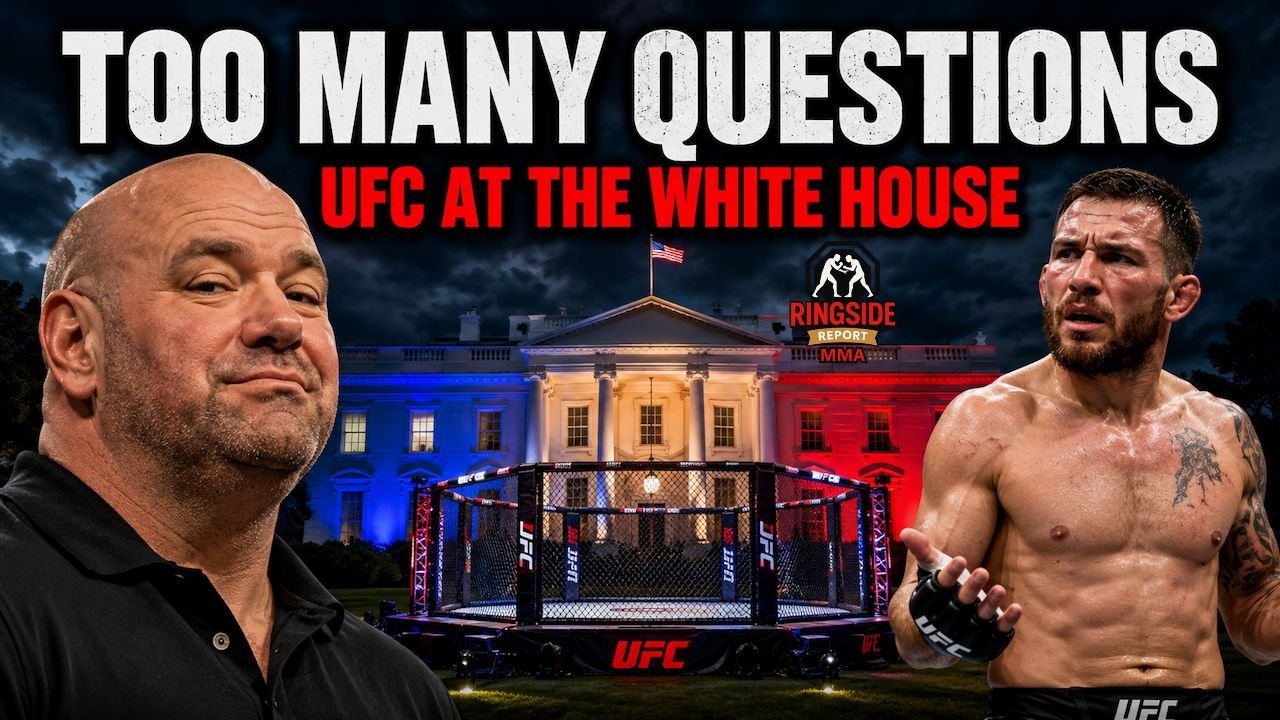
UFC Freedom 250 is set for June 14 on the White House lawn, and the card itself is genuinely good. Ilia Topuria is defending his featherweight title against Justin Gaethje. Alex Pereira vs. Cyril Gane for the light heavyweight championship. These are real fights with real stakes. Nobody should pretend otherwise.
And visually, the setup is going to be spectacular — the White House as a backdrop, the spectacle of it all, the production values that come with a UFC event of this size and profile. From an entertainment and marketing standpoint, this is exactly what Dana White and the UFC have been building toward: a moment that puts MMA in a context that no other sport has been in before.
But the closer June 14 gets, the more practical questions keep piling up, and right now, a lot of them don’t have clear answers. The most significant one is oversight. The UFC has had a complicated relationship with independent regulation for years, and at Freedom 250, that relationship gets more complicated. The event doesn’t fall under any state athletic commission’s jurisdiction — there’s no Nevada Athletic Commission, no California Athletic Commission, no Quebec oversight body.
The UFC is partnering with the Association of Boxing Commissions, which will handle licensing and sanctioning. But the judges and referees? That’s the UFC’s territory. The organization is, in a meaningful sense, running its own championship fights.
This doesn’t automatically mean the event will be corrupt or that results will be manipulated. The UFC has strong institutional incentives to put on a clean, credible show — especially one happening under this level of scrutiny. But the absence of independent government oversight creates a window for legitimate conspiracy theories, which tend to linger long after the event.
If Alex Pereira loses a close decision to Cyril Gane on judges appointed by the UFC, with no independent commission as a backstop, that controversy will follow the sport for years. These are championship fights. They matter. The structure around them should be airtight.
Did You Know?
The last time a major sporting event was held on the White House grounds was during the Abraham Lincoln administration. UFC Freedom 250 will be the first combat sports championship event in White House history — outdoors, in D.C. summer heat, with an estimated 50,000–60,000 fans watching on screens in the surrounding area.
Then there’s the weather. Washington, D.C., in mid-June, is not the indoor, climate-controlled environment that UFC fighters are used to. Arenas are air-conditioned. The White House lawn is not. Joe Rogan raised this publicly — noting that the bright lights used for an outdoor nighttime event will attract massive insect swarms, and that the heat and humidity of a D.C. June evening are not small variables when you’re asking two elite athletes to compete for a world championship. That’s not a small concern.
A bug flies into Ilia Topuria’s eye mid-combination, or Pereira is dripping sweat in the second round because the humidity is suffocating and the conditions are unlike anything he’s trained for — these are legitimate athletic concerns that have nothing to do with politics or spectacle.
There’s also the security dimension. Jon Jones is among the high-profile names slated for the event, and the assembled crowd — both inside the event and across the broader fan viewing area — will be enormous. The Trump administration’s Secret Service track record over the past few years has not been a model of precision, and having 50,000-plus people concentrated near the White House for a nationally televised event is a logistical challenge that goes well beyond what the UFC normally manages. Weigh-ins, press conferences, fighter movement — all of that is happening in a more politically charged and security-sensitive environment than any UFC event in history.
None of this means UFC Freedom 250 will be a disaster. It might be the greatest combat sports event anyone has ever seen. But the people treating every practical concern as an attack on the event, or as some kind of politically motivated wish for failure, are being naive. These are real variables that real fighters will have to navigate in real time on June 14. Hoping it goes well is not the same as pretending the concerns don’t exist.
Dana White’s Mental Health Take Is the Most Dangerous Thing He’s Said in Years
Dana White gave an interview to Time magazine this week and said that people who talk about their mental health struggles publicly are doing something harmful. His exact framing was that discussing mental health openly “opens the door to make young men think that it’s OK to just go, oh, I’m having mental health issues.” His advice: handle it behind closed doors. Don’t show that weakness to anyone. He described himself as “unapologetically masculine.”
This is dangerous. Not edgy, not controversial, not just wrong — dangerous. Combat sports has a serious problem with fighters suffering in silence, with head trauma going untreated, with the psychological weight of violence and failure and the brutal economics of the sport crushing people who have been told their whole careers that showing pain is weakness.
Dana White has a long history of conflating toughness with toxicity, but telling young men not to talk about suicidal ideation, depression, or mental health struggles because it looks weak is the kind of messaging that gets people killed. That’s not hyperbole. It is a documented, studied fact that reducing stigma around mental health conversations saves lives.
The irony is that White can’t even keep his own position consistent. Earlier this year, a UFC fighter told his post-fight audience that he had been contemplating ending his own life in the weeks before the fight. When Dana White was asked about it, his response was empathetic — he said they needed to get the fighter some help, that he didn’t know things were that bad. But if you want fighters to get help, they have to be able to talk about it.
If the culture you’re building says “show no weakness” and “handle it behind closed doors,” fighters don’t go get help — they go home and fall apart alone. You cannot simultaneously tell men not to talk about their struggles and then claim you care about their well-being.
What makes this harder to dismiss is the context Dana White is operating from. This is a man whose mother wrote a book describing him in unflattering terms and went on a press tour to promote it — including an appearance on this very program. His relationship with his own family is fractured in ways that are part of the public record. There is footage on TMZ of White hitting his wife in the face.
He has spoken openly about his gambling — the kind of high-stakes, system-believing casino gambling that looks, from the outside, like someone trying to fill a very large void with very large risk. None of that is said to pile on. It’s said because when a man with that specific history tells other men that real strength means suppressing everything painful and handling it behind closed doors, you understand why he believes it. And you understand exactly how well it has worked for him.
A man who is genuinely secure — who has genuinely dealt with whatever he’s carrying — doesn’t need to tell other men to suppress theirs. That’s not masculine. That’s fear wearing a tough-guy costume. Dana White isn’t unapologetically masculine. He’s unapologetically unexamined. And the platform he has makes that distinction matter.

The Bottom Line
Colby Covington’s story teaches you something about image versus reality in combat sports — the gap between what a fighter projects and what the business actually decides about them. UFC Freedom 250 teaches you something about the price of spectacle, and whether the sport is willing to ask hard questions about fighter welfare in order to protect a moment that looks great on television.
Dana White’s Time magazine interview teaches you something about the cost of leadership by performance — what happens when the most powerful person in a sport has defined his entire identity around never acknowledging weakness.
Three stories, three weeks out from the biggest UFC event in history, and none of them are reassuring. That doesn’t mean the sport is broken. It means the sport is complicated. It always has been. The question is whether the people running it are willing to sit with that complication honestly, or keep selling a version of events that sounds better than the truth.
What is UFC Freedom 250?
UFC Freedom 250 is a UFC championship event scheduled for June 14, 2026, on the White House lawn in Washington, D.C. The card features Ilia Topuria defending the featherweight title against Justin Gaethje, and Alex Pereira vs. Cyril Gane for the light heavyweight championship. It is the first UFC event ever held at the White House.
Who is regulating UFC Freedom 250 at the White House?
UFC Freedom 250 is not regulated by a state athletic commission. The UFC is partnering with the Association of Boxing Commissions (ABC) for licensing and sanctioning, but the UFC itself is responsible for appointing judges and referees. There is no independent government athletic commission overseeing the event.
Why did Colby Covington leave the UFC?
Colby Covington and the UFC parted ways after failing to reach a new deal. Covington, who lost four of his last six UFC fights over the past seven years — including losses to Leon Edwards and Joaquin Buckley — is now pursuing opportunities in the Real American Freestyle (RAF) wrestling circuit. Covington has framed his departure as a strategic career choice rather than a contract dispute.
What did Dana White say about mental health?
In a Time magazine interview, Dana White said that people who talk about mental health struggles publicly are making it too easy for young men to claim they have issues, and that such things should be handled behind closed doors. He described himself as ‘unapologetically masculine.’ The comments drew widespread criticism from mental health advocates and combat sports figures.
What fights are on the UFC Freedom 250 card?
The confirmed headline bouts for UFC Freedom 250 include Ilia Topuria vs. Justin Gaethje for the featherweight championship and Alex Pereira vs. Cyril Gane for the light heavyweight title. The event is scheduled for June 14, 2026, on the White House lawn.
Will there be outdoor conditions at UFC Freedom 250?
Yes. UFC Freedom 250 is an outdoor event on the White House lawn. Concerns have been raised about Washington D.C.’s summer heat and humidity, insect activity from bright outdoor lighting, and the overall physical toll of competing in non-climate-controlled conditions. These are factors fighters training in traditional indoor arenas would not normally deal with.