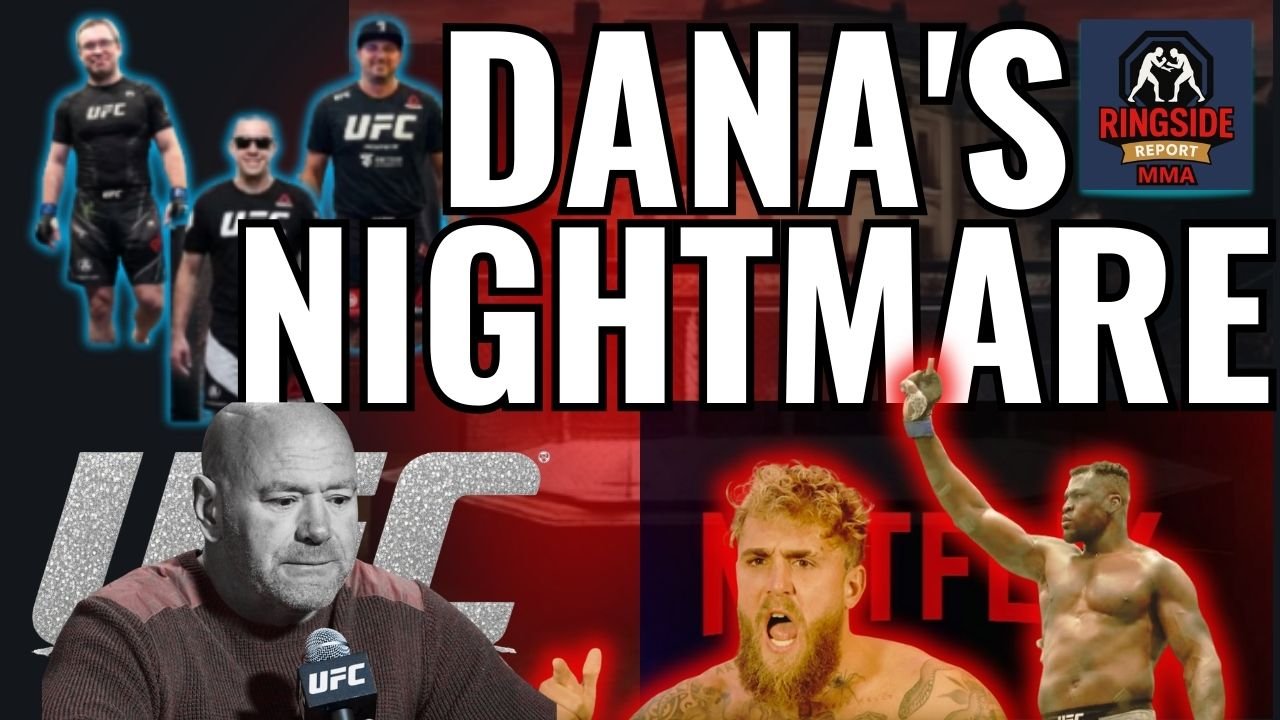

The UFC has a $7.7 billion Paramount deal, a boxing subsidiary that just handed an unknown British fighter $15 million for a single bout, and a heavyweight division with no active champion and no plan for getting one. Meanwhile, Sean Strickland walked into Houston as an underdog and put on what may be the finest performance of his career. None of these stories exists in isolation. They are all the same story: a promotion that has cashed the check, removed the urgency, and is now asking fight fans to pay $60 for a 10-fight UFC 326 predictions card headlined by a fight for a belt that Dana White invented. Ringside Report MMA broke all of it down on February 26.
Dave Simon and Fred Garcia covered the full landscape — the UFC 326 predictions, the fallout from UFC Houston, the Conor Benn signing, Ronda Rousey’s Paramount bombshell, the heavyweight crisis, and a UFC Mexico City card that exists primarily because Brandon Moreno is Mexican and Mexico City fills arenas. AJ D’Alesio was absent for the night, handling a personal matter, which meant a tighter two-man show that somehow covered more ground than usual. The thread running through all of it: the UFC is operating differently now, and the product is showing it.
🎯 Key Takeaways
- Sean Strickland dominant in Houston: Came in as an underdog against a 7-fight UFC winner, outboxed Hernandez from start to finish, and finished the fight in the third round. Dave Simon called it the best Strickland performance he has ever seen — including the Adesanya title win.
- Uroš Medić KO pays the parlay: 13–3 record with every single fight ending by finish. First-round KO of Geoff Neal in the Houston co-main. His post-fight speech made him a fan favourite overnight.
- Conor Benn gets $15M from Zuffa Boxing: The same parent company that owns the UFC paid a British boxer — virtually unknown in MMA — more for one fight than Islam Makhachev likely makes in a year. The implications for UFC fighter pay negotiations are enormous.
- UFC 326 predictions — weak card warning: Holloway vs. Oliveira is a real fight. The rest of the card, at 10 fights total, is not a $60 product. Caio Borralho vs. Reinier de Ridder as the co-main features two fighters coming off losses.
- Ronda Rousey’s Paramount truth bomb: With a $7.7B flat-fee deal in place, the UFC is legally obligated to minimize costs — not maximize fights. Dave Simon has been saying it for two years. Now the fighters are saying it too.
- UFC heavyweight division in freefall: Tom Aspinall has serious eye injuries. Jon Jones is retired. Ciryl Gane is sitting at No. 1 with nothing to fight for. Dave’s solution: Gane vs. Alex Pereira for the interim title, immediately.
Watch Ringside Report MMA on YouTube
Listen on Spotify
Watch on Rumble
Sean Strickland Puts On His Best Performance Ever — Now Give Him Chimaev
Anthony Hernandez came into UFC Houston on a seven-fight winning streak inside the Octagon. He was finishing people. He was the favourite. He was supposed to be the moment where a legitimate new contender announced himself at middleweight. Then the third round happened, Sean Strickland buried him under a flurry of punches he could not answer, and the story went a different direction entirely.
Strickland fought the perfect fight. He used his jab to keep Hernandez at the end of his punches for the entire bout, neutralising the grappling and the forward pressure that made Hernandez dangerous. Every time Hernandez tried to close the distance and get on the inside, Strickland reset. He was bigger, longer, and stronger on the night — and he was in the kind of shape you do not see from a fighter who has had a rough camp or a troubled build-up. The press conference leading into this fight was an absolute disaster. The fight itself was a thing of beauty. Those two things coexisting are quintessential Sean Strickland, and it is why he is impossible to write off, no matter how many times you want to.
“He looked like maybe the best version of Sean Strickland we’ve ever seen,” Dave Simon said on air, “which is saying something considering he beat a prime Israel Adesanya.” That framing is important. Strickland’s win over Adesanya at UFC 293 was one of the most shocking upsets in recent middleweight history — a unanimous decision over the champion in the champion’s backyard in Sydney. The version in Houston was better. More disciplined. More composed. More complete. If that is what Khamzat Chimaev gets when this fight eventually happens, Chimaev is in for a long, uncomfortable night.
The obvious next fight is Strickland challenging Khamzat Chimaev for the middleweight title. Dave pitched it for the White House card, and the objection raised — that Strickland’s press conference style might be too combustible for the venue — is both fair and irrelevant. The current president of the United States is not known for measured public discourse. A Strickland press conference fits the energy of that event better than anyone wants to admit. Nassourdine Imavov is ranked No. 1 and has a legitimate claim. Caio Borralho has won seven straight inside the UFC. But neither of them just dismantled the man who was supposed to be the top contender. Strickland earned this shot. Make the fight.
Uroš Medić Cashes the Parlay and Earns a Standing Ovation
Dave Simon’s parlay for UFC Houston was Carli Judice and Uroš Medić. Both came through. The Medić piece was the one that mattered most — he was the underdog against Geoff Neal in the co-main event, and he responded by knocking Neal out cold in the first round.
Medić now holds a 13–3 professional record, and every single one of those 16 fights has ended by stoppage. Eleven knockouts. Five submissions. Zero decisions. He has been knocked out twice and submitted once in the losses, which means even when he loses, the fight ends early. His post-fight speech at UFC Houston was remarkable — he told the crowd that he might not win every fight, but he will always go for the finish, because that is the deal he made with himself and with the fans. It was not a scripted line. It was a fighter telling you exactly who he is. Dave Simon, who had already backed him with money, became a full convert in that moment. “He’s never gone to decision. He means it when he says either I’m going to finish the guy or I’m going to get finished. It’s do or die in here.” At plus money in the co-main event of a numbered card, Uroš Medić is the kind of play that makes Thursday nights worth watching.
The Carli Judice situation deserves its own paragraph. She opened as a -400 favourite against Juliana Miller in the opening prelim. By fight week, she was sitting at -800 — a 400-point swing on a preliminary bout that drew almost no public attention. For context, the rest of the UFC Houston card saw line movements of 20 to 40 points in either direction. Nothing else moved like Judice. When that volume of money flows onto a prelim fighter at that speed, the market is almost always responding to information that has not been made public — an unreported injury in the opposing camp, a camp issue, something that leaked into the betting ecosystem before it showed up anywhere official. Dave flagged it on Thursday night, called it suspicious, and added her to the parlay. The fight went ahead. She won by unanimous decision. The line was right. “It’s like, if you know somebody’s going to win, you should bet all the money on them.” The UFC has not addressed the line movement. They should.
Conor Benn Gets $15 Million From Zuffa Boxing. UFC Fighters Are Watching.
Zuffa Boxing is the boxing division of TKO Group Holdings — the same corporate entity that owns the UFC. It recently signed British boxer Conor Benn, son of legendary British middleweight Nigel Benn, to a deal reportedly worth $15 million for a single fight. Conor Benn is coming off a doping suspension. He is not a household name in MMA. Dave Simon had not heard of him before the signing made news. Sean O’Malley — one of the UFC’s biggest current stars — made a video acknowledging publicly that he is not making $15 million per fight, and that he had never heard of Conor Benn either.
“If Conor Benn is making $15 million, the greatest of all time, Jon Jones — the Michael Jordan of our sport as close as we got — this guy should be making $100 million to fight. It’s Jon Jones. Who has Conor Benn ever beat?”— Dave Simon, Ringside Report MMA, February 26, 2026
Fred Garcia’s counterpoint was measured and reasonable: the Zuffa boxing budget and the UFC’s MMA budget are separate pools of money. Signing Conor Benn does not literally take money from Islam Makhachev’s next contract. That is technically true. But it misses what Dave is actually describing. When fighters and their teams sit down to negotiate contracts, they are not working from abstract figures. They are working from comparables — what the market paid for similar talent in similar situations. The moment Conor Benn’s $15 million number becomes public knowledge, it becomes a data point every fighter agent in the UFC uses. Conor McGregor, who hasn’t fought since 2021 and whose last performance ended with a broken leg, is now negotiating against a floor that didn’t exist six months ago. Dave’s estimate: McGregor is a $30 million minimum MMA fight now. “For me to fight the UFC, it’s double that. Conor McGregor now, at this point, has got to be a minimum of $30 million to have one MMA fight.”
The fighter pay argument in MMA has always been hampered by secrecy. Fred Garcia identified the solution clearly: baseball fixed its pay structure after players started publicly discussing their contracts. Once Juan Soto signs for $765 million, every other player in the league knows exactly what the market will bear. UFC fighters operate in near-total information darkness by comparison — the UFC’s contracts are notoriously opaque, disclosed figures are often show money rather than total compensation, and fighters who speak publicly about pay tend to find themselves in difficult matchmaking situations. The Conor Benn signing breaks the silence from the outside. Fighters now have a number to point to. What they do with it is up to them.
Ronda Rousey Explained the UFC’s Business Model Better Than Dana White Ever Has
Ronda Rousey broke into the news cycle this week with an explanation of why the UFC declined to promote a Rousey vs. Gina Carano fight. The competitive argument against the bout is straightforward — Carano has not fought professionally since losing to Cris Cyborg at Strikeforce in 2009, Rousey last competed in 2016, and neither woman is in the prime that made their names. Rousey’s explanation for why the UFC passed had nothing to do with any of that.
“They just made a $7.7 billion deal at Paramount,” she said. “So it’s in their best interest actually not to put on the best fights possible, but to spend as little money as possible so that they can keep it. They’re legally obligated to maximize shareholder value.” Dave Simon’s reaction on air was immediate: “Haven’t I been saying that?” He has. For most of the past two seasons on Ringside Report MMA, the argument that the UFC’s broadcast deal structure removes their financial incentive to spend on fights has been a recurring theme. What changed this week is that a former UFC champion with genuine insider knowledge said it on the record.
The Rousey vs. Carano fight itself is a secondary consideration. Both women wanted a one-fight deal — just this fight, at this stage of their careers, one time. The UFC’s standard operating procedure does not accommodate one-fight contracts; even CM Punk was signed to multiple bouts. So the fight ended up at MVP Promotions, Jake Paul’s company, on Netflix, announced for May 16, 2026 at the Intuit Dome in Inglewood. From a pure business standpoint, Rousey’s analysis of why the UFC passed is credible — the same promotion that dropped Francis Ngannou rather than pay his asking price and has since watched its heavyweight division fall apart is not going to cut a generous deal for two fighters who haven’t competed in years, regardless of the interest level.
UFC Heavyweight Division: Two Years of Waiting for Nothing
Tom Aspinall holds the UFC heavyweight title. He is not fighting. Jon Jones held the undisputed belt before Aspinall and vacated it. He is not fighting and reportedly needs hip surgery. The No. 1-ranked heavyweight in the world is Ciryl Gane, a former interim champion who has been available and active and is sitting on the sideline watching a division with no direction.
Aspinall’s eye situation is genuinely concerning beyond the fight context. Dave Simon addressed it directly: he has sustained serious damage to both eyes, the kind of damage that raises questions about his vision long after his career ends. The fact that fighters have competed effectively with serious eye conditions before — Dave referenced Mike Brown, who revealed on the Masvidal podcast that he had been legally blind in one eye his entire career due to a childhood BB gun accident and had someone cheat his eye exams to keep fighting — does not make Aspinall’s situation less serious. It means the human body is adaptable. But “might be able to fight with one damaged eye” is not a timeline, and the UFC heavyweight division cannot wait indefinitely for a medical situation to resolve.
Dave’s proposed solution has the virtue of being obvious: match Ciryl Gane against Alex Pereira for the interim heavyweight championship. Gane is ranked first, has already held the interim belt, and would be a credible champion. Pereira is the most devastating finisher in the light heavyweight division, has spoken about moving up, and a three-division championship would give him a legacy story the UFC could market for years. The matchup itself — Gane’s technical boxing and footwork against Pereira’s knockout power — is a compelling fight on its own terms. The winner holds a real belt, the division has a real champion, and the UFC has a real story to build toward an Aspinall return fight when and if it becomes possible. None of this is happening. “The UFC doesn’t seem to be in any type of hurry to crown a new heavyweight champion or even an interim heavyweight champion,” Dave said. “It doesn’t seem like they have a plan.”
📜 Historical Context
The UFC heavyweight division has been here before. After Brock Lesnar’s run ended, the division drifted for years until Cain Velasquez took over and established genuine dominance. That era ended not through competitive defeat but through altitude — Velasquez, the best-conditioned heavyweight alive, ran out of gas against Fabricio Werdum in Mexico City in 2015. The division then cycled through Stipe Miocic holding things together across multiple title reigns until Francis Ngannou arrived. When Ngannou left in 2023 rather than accept the UFC’s contract offer, the current dark period began. Every champion since has been either injured, inactive, or retired before they could establish themselves.
Reality Check: The UFC Already Cashed the Check
⚠️ The Reality
Ronda Rousey said it plainly, and she said it correctly. A $7.7 billion flat-fee broadcast deal means the UFC’s financial obligation runs to Paramount and to TKO shareholders, not to fight fans. The incentive structure that once pushed them toward making the biggest fights possible — because bigger fights meant bigger pay-per-view buys meant more money — no longer exists in the same form. Conor Benn gets $15 million from the same parent company while UFC champions negotiate in the dark. The heavyweight division has no active champion and no urgency to crown one. UFC 326 has 10 fights, a BMF title main event, and costs $60. This is not a promotion scrambling to compete. This is a promotion that knows the check will clear regardless of what’s on the card.
📋 UFC 326 Card Breakdown
Main Event: Max Holloway vs. Charles Oliveira — BMF Title, Featherweight
Co-Main: Caio Borralho vs. Reinier de Ridder — Middleweight
Main Card: Rob Font vs. Raul Rosas Jr. | Drew Dober vs. Michael Johnson | Gregory Rodrigues vs. Bruno Ferreira
Total Fights: 10 (2 early prelims / 3 TV prelims / 5 main card)
Dave’s Verdict: “Not a great card next weekend. Not a great card.”
Holloway versus Oliveira is a real fight and worth watching. Max Holloway is the most exciting featherweight of his generation. Charles Oliveira is one of the most dangerous finishers in UFC history across any weight class. They are fighting for the BMF title, which is not a divisional championship and does not have the same stakes as a real belt, but it is still two elite fighters competing at the peak of the sport. That fight alone justifies a Saturday night. Whether it justifies a full pay-per-view buy at current pricing is a different question, and Dave Simon’s answer was essentially no.
The co-main event is the problem. Caio Borralho is ranked sixth at middleweight and lost to Nassourdine Imavov in his last fight. Reinier de Ridder, the Dutch middleweight, is an intriguing prospect at 185 pounds who lost to Bo Nickal on the way up. Both men are capable fighters. Neither of them is in a position where a win meaningfully advances a title case. This is a fight that belongs on a fight night card, not on a numbered pay-per-view. It is there because the middleweight contender picture is messy, and the UFC needed a body for the co-main slot. Dave’s parlay decision — he passed entirely — reflects the card’s actual quality honestly.
UFC Mexico City: Altitude, Moreno, and Managing Your Expectations
The same weekend as UFC 326, the UFC runs a card in Mexico City with Brandon Moreno headlining against Lone’er Kavanagh — a Dana White Contender Series product who is 2–1 in the UFC and coming off a knockout loss. Moreno is in the main event because he is Mexican, because this card is in Mexico City, and because the UFC is very good at understanding what fills seats in specific markets. That is not a criticism. It is accurate. The fight itself, as a competitive matchup, is not why anyone is there.
The undercard has genuine appeal for the Mexican audience — Daniel Zellhuber, who fights out of Mexico, is on the card. Marlon “Chito” Vera headlines the co-main event against David Martinez, who is Mexican. Edgar Chairez is on the card. Undefeated Mexican prospects Santiago Luna (7–0) and Eminael Rodríguez (6–0) are both fighting. This is a card built for a specific crowd, and for that crowd it delivers. For the broader MMA audience watching on television, it is a thinner product.
The one factor that applies to every fighter on the card, regardless of nationality or record: altitude. Mexico City sits at 7,350 feet above sea level, and that number has ended careers and changed outcomes in ways no amount of preparation fully accounts for. The most dramatic example in recent UFC history is Cain Velasquez losing his heavyweight title to Fabricio Werdum in that same city in 2015. Velasquez was renowned as the best-conditioned heavyweight in MMA. He ran out of gas in the third round. “If that fight happens in Vegas, Cain Velasquez wins that thing 10 times out of 10,” Dave said. “The cardio king ran out of breath. It’s crazy.” Fighters who have not specifically trained at altitude — running, drilling, sparring in thin air — are at real risk, and the betting markets often underestimate how much that matters when the rounds get late.
The Bottom Line
Three stories are going to define the UFC’s 2026 season, and all three showed up on this episode. The first is Sean Strickland, who just made the clearest case any fighter has made all year for a title shot. He dismantled the man who was supposed to take that slot, and he did it while looking like the best version of himself anyone has seen. Give him Khamzat Chimaev. Stop manufacturing reasons to delay it.
The second is fighter pay, which is no longer an abstract debate. Conor Benn’s $15 million Zuffa Boxing payday is a public number that every UFC fighter’s team is now using as a reference point. Ronda Rousey just explained the structural reason the UFC will resist paying that kind of money to its own fighters. The gap between those two positions — what the market will bear and what the UFC’s business model incentivizes paying — is where the next major fighter exodus will come from. It’s where Francis Ngannou’s departure came from. It will happen again.
The third is the heavyweight division, which has been a slow-motion crisis for two years and has no visible resolution. Ciryl Gane vs. Alex Pereira for the interim title is the fight the division needs. It is available. It has not been made. The reason it has not been made is the same reason none of the big fights that could be made are being made — and Ronda Rousey gave you the explanation this week, free of charge. The check has already cleared. The urgency left with the pay-per-view model. Welcome to the new UFC.
UFC 326 Predictions: Holloway vs Oliveira FAQs
What are the UFC 326 predictions for Holloway vs Oliveira?
Max Holloway vs. Charles Oliveira is a legitimate fight between two elite finishers, but it is contested for the BMF title — not a divisional championship. Dave Simon considers the overall card underwhelming at the pay-per-view price point, with only 10 fights compared to the typical 14–15. Both Holloway and Oliveira are capable of finishing the fight at any moment. Dave passed on building a parlay for this card.
How did Sean Strickland beat Anthony Hernandez at UFC Houston?
Strickland used his jab to control distance the entire fight and prevent Hernandez from working on the inside. He was bigger, longer, and in exceptional shape. The fight ended in the third round with a flurry of punches Hernandez couldn’t answer. Dave Simon called it the best performance Strickland has ever delivered — more complete than the Adesanya title win.
Why is Conor Benn’s $15M Zuffa Boxing deal a problem for UFC fighter pay?
Conor Benn is a British boxer, virtually unknown in MMA circles, coming off a doping suspension. His reported $15 million payday from Zuffa Boxing — owned by the same TKO Group Holdings that owns the UFC — gives every UFC fighter’s management team a public comparable to negotiate against. Dave Simon argues that it makes Conor McGregor a $30 million minimum for an MMA fight and raises legitimate questions about what champions like Islam Makhachev and Jon Jones are actually worth.
What did Ronda Rousey say about the UFC and the Paramount deal?
Rousey stated that with the UFC’s $7.7 billion Paramount deal in place, the promotion is legally obligated to maximize shareholder value — meaning minimizing costs takes priority over booking the best possible fights. She used this to explain why the UFC declined to promote Rousey vs. Gina Carano, which ended up going to Jake Paul’s MVP Promotions on Netflix for May 16, 2026.
What should the UFC do about the heavyweight division?
With Tom Aspinall sidelined by serious eye injuries and Jon Jones retired, Dave Simon recommends matching No. 1-ranked Ciryl Gane against Alex Pereira for an interim heavyweight title immediately. A Pereira win would make him a three-division champion and provide the division with an active, marketable champion. The UFC has not moved in this direction despite both fighters being available.
Why is altitude important for the UFC Mexico City card?
Mexico City sits at 7,350 feet above sea level. The most famous example of altitude’s impact in the UFC was Cain Velasquez — considered the best-conditioned heavyweight in MMA history — losing his title to Fabricio Werdum at the same venue in 2015 when his cardio gave out in the third round. Fighters who have not specifically trained at high altitude are at real risk in the later rounds, and the betting markets tend to underestimate this factor.
🎙️ Ringside Report MMA is live every Thursday at 8 PM ET on YouTube, Rumble, Twitch, DLive, and Kick.
🎧 Listen on Spotify and all major podcast platforms.
🎰 All betting odds via Bet99. Please gamble responsibly.
🌐 More at RingsideReport.net — The Combat Sports Authority.