
Fight IQ — MMA Fundamentals
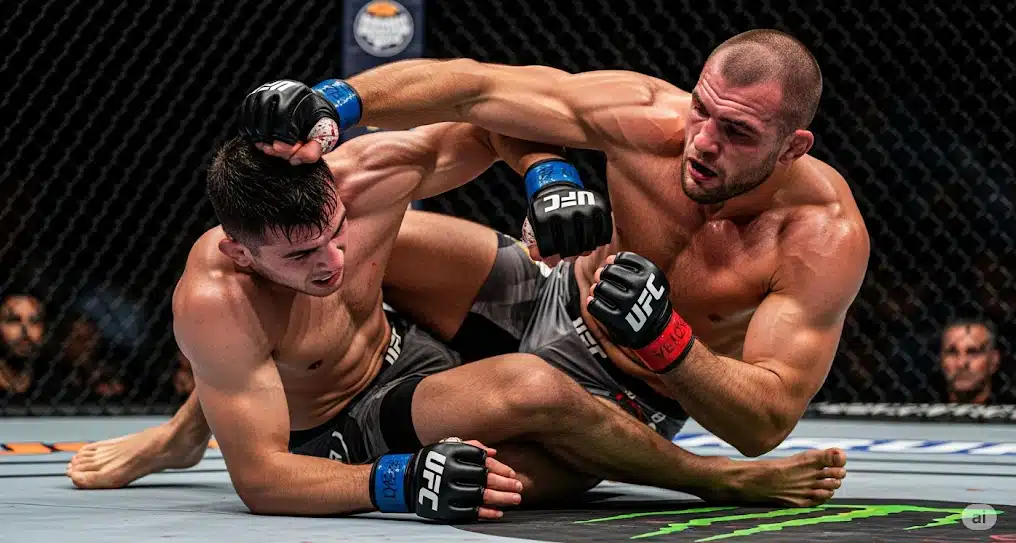
Ground and pound in MMA is the strategy that proved wrestlers could beat anyone: take the fight to the mat, secure a dominant position, and deliver strikes until the opponent quits or the referee stops it.
This guide covers the origins, the technical mechanics, the positional variations, the strategic depth, and the fighters who mastered it — from Mark Coleman in the early UFC to Khabib Nurmagomedov’s era-defining control game.
In This Guide
What Is Ground and Pound in MMA?
Ground and pound in MMA refers to the strategy of securing a takedown, establishing a dominant position on the ground, and delivering repeated strikes — punches, elbows, and forearms — until the opponent submits, is finished by strikes, or the referee intervenes. The name is straightforward: control the ground, then pound. In practice, it is one of the most sophisticated and physically demanding strategies in all of combat sports.
What made ground and pound in MMA historically significant was what it proved: that a wrestler with modest striking ability could defeat elite strikers by simply dictating where the fight took place. The early UFC was widely expected to showcase which striking art was superior. Ground and pound answered a different question entirely — that taking a fight to the mat and neutralising the standing game was often more valuable than winning the striking exchange on the feet.

Grappling in MMA provides the foundation on which ground and pound is built — the takedowns, the positional transitions, the guard passing — but ground and pound adds the striking threat that makes top control genuinely dangerous rather than merely limiting. Without the ability to threaten meaningful strikes from dominant positions, grappling control alone scores points but rarely finishes fights. Ground and pound is what converts positional dominance into real damage.
Origins: Mark Coleman and the Wrestler’s Revolution
The history of ground and pound in MMA is inseparable from Mark Coleman, the NCAA Division I All-American and Olympic freestyle wrestler who brought this strategy into early UFC competition and earned the nickname the “Godfather of Ground-and-Pound” for what he demonstrated there. Coleman’s insight was tactical rather than technical: by using elite wrestling to take opponents down and smother them against the mat, he could deliver strikes to opponents who had no effective answer because they could neither escape nor stand.
This was genuinely revolutionary in the mid-1990s context. Early MMA attracted competitors who were specialists — karate champions, sumo wrestlers, boxers, and Brazilian jiu-jitsu practitioners. The assumption was that the sport would determine which discipline was superior. What Coleman and the wrestlers who followed him demonstrated was that the answer was not about which striking or submission art was best — it was about who controlled the physical space of the fight. Ground and pound gave wrestlers the offensive output to finish fights, not just to outpoint them.

The style spread rapidly through the heavyweight and light heavyweight divisions, then eventually throughout the entire sport as more wrestlers transitioned to MMA. By the early 2000s, ground and pound in MMA had become a standard element of any competitive fighter’s game plan, and the sport’s defensive evolution — better sprawl-and-brawl, improved takedown defence, guard-based submission threats — developed largely in response to it.
Technical Mechanics: How It Actually Works
The technical execution of ground and pound in MMA is considerably more demanding than it appears to a casual viewer. The challenge is that conventional striking mechanics — hip rotation, weight transfer, full extension of the kinetic chain — are largely unavailable when a fighter is on top of an opponent on the ground. A standing right cross derives its power from pushing off the rear foot, rotating the hip, and delivering through the target. A punch from mount is generated almost entirely from the shoulder and core, with limited access to the leg-driven mechanics that generate knockout power in standing exchanges.
Effective ground and pound practitioners compensate through several adjustments. Posture and base are foundational — the top fighter must maintain a stable, weight-forward position that pins the opponent’s hips and limits their ability to frame, escape, or roll without giving up elbows and forearms that arrive from close range. Collapsing posture to reach for a punch creates the opportunity for a guillotine or upkick; maintaining too much distance reduces strike output to ineffective arm punches.
Elbows become the primary finishing weapon in ground and pound in MMA because they solve the power generation problem. A short elbow travelling four inches can open a cut or deliver a concussive impact that a punch from the same distance cannot match. The elbow requires no hip rotation, no wind-up, and very little space — making it ideally suited to the close-quarters geometry of top control. Significant-cut elbows from the mount have ended more fights via TKO than any other ground weapon, and referees are trained to watch for their cumulative effect on a grounded opponent.
Angle creation is the other critical technical skill. A flat, symmetrical position gives the bottom fighter a predictable defensive target. Top fighters who shift their weight laterally, push an arm across the body, or use a knee-ride to create an angular attack line force the bottom fighter to defend an asymmetric threat, which is considerably harder to do. Khabib Nurmagomedov was a master of this — using his body position to pin one of the opponent’s arms while attacking the exposed side, making defence and offence simultaneously impossible for the man underneath.
Ground and Pound from Different Positions
Ground and pound in MMA is not a single positional strategy — it manifests differently depending on which dominant position has been achieved, and each has distinct advantages and risk profiles.
Mount is the highest-value position for ground and pound. The top fighter sits on the opponent’s hips or chest, both arms are free, and the bottom fighter’s ability to generate defensive frames is significantly limited. The primary risks from mount are the upa escape (bridge and roll) and the elbow-knee escape, both of which are harder to execute against a heavy, experienced top fighter who maintains forward pressure. Ground and pound from mount can be delivered with the full arsenal — punches, elbows, hammerfists — and the psychological pressure of being unable to escape drives many submission attempts, creating openings for further strikes or positional advancement.
Side control offers less offensive access than mount but is typically easier to maintain against a skilled defensive grappler. Ground and pound from side control is delivered mostly from short punches and elbows to the head and body, with the top fighter’s chest weight pinning the opponent’s near arm and limiting their ability to frame. The primary strategic use of ground and pound in MMA from side control is not necessarily to finish the fight directly, but to prevent the opponent from relaxing enough to execute an escape, keeping them defensive so the top fighter can attempt to advance to mount or take the back.
Guard is the most technically demanding position for effective ground and pound. The bottom fighter’s legs are a constant threat — not only for sweeps and positional reversals, but for triangle chokes, armbars, and armbar-to-omoplata combinations that can be set up off attempted punching sequences. Ground and pound in MMA from inside the guard requires constant posture management: staying upright enough to avoid being pulled into submission range while still delivering enough offensive output to discourage active guard play. Many significant UFC finishes have come from guard-based ground and pound, but many losses have also come from fighters breaking their posture to throw punches and finding themselves caught in a triangle or armbar mid-sequence.

The Strategic Dimension: More Than Just Damage
Understanding ground and pound in MMA only as a damage-accumulation strategy misses most of what makes it effective at the highest level. The strikes themselves are one element; the strategic functions they serve are often more important than the immediate physical impact they deliver.
Posture breaking is perhaps the most important strategic function. A grounded opponent who maintains good posture — head up, arms framing, hips active — is difficult to strike, difficult to submit, and difficult to keep controlled. Ground and pound forces the bottom fighter to cover up and protect their head, which collapses their posture, removes their frame, and makes the top fighter’s position more stable while simultaneously opening the submission game. Many ground and pound sequences that appear to be working toward a TKO are actually setting up an armbar or a rear naked choke by forcing the defensive collapse that makes those submissions available.
Psychological pressure compounds the physical difficulty. A fighter absorbing repeated strikes from a dominant position is simultaneously managing pain, the threat of a stoppage, the cognitive effort of finding an escape route, and the mounting physical exhaustion of defending against a heavier opponent’s weight. Experienced ground and pound in MMA practitioners understand this accumulated pressure and often vary their rhythm deliberately — delivering an intense flurry, then pausing, then attacking again — to prevent the bottom fighter from settling into a defensive rhythm that allows systematic escape attempts.
Scoring control is the third strategic dimension. MMA judging rewards effective striking and effective grappling, and a fighter who maintains top control while delivering consistent ground and pound is almost guaranteed to win any round in which they achieve it. This creates a situation where the grappler does not need to finish the fight via ground and pound to benefit from deploying it — the threat alone, and the sustained scoring it produces, can determine the outcome of a decision-bound fight over fifteen or twenty-five minutes.
Ground and Pound vs. Submission Defence
The interaction between ground and pound in MMA and submission defence is one of the sport’s most tactically interesting dynamics. A skilled submission grappler lying on their back under a heavy top fighter is not defenceless — but their defensive options depend entirely on maintaining the posture and framing that ground and pound is specifically designed to destroy.
Elite submission specialists have developed guard games that weaponise the top fighter’s striking attempts. A fighter posting on an arm to deliver a punch creates the same mechanical vulnerability as an arm isolation attempt — and a skilled guard player can transition between defending strikes and attacking that arm within the same physical response. This is why ground and pound from guard in MMA demands such careful posture management: the offence and the defensive vulnerability it creates are inseparable.
The broader answer to the question of whether ground and pound beats elite submission grapplers is evident in the records of elite practitioners. Fighters like Khabib Nurmagomedov, who faced multiple Brazilian jiu-jitsu black belts across their careers, neutralised submission threats primarily through constant positional pressure — never allowing the space or the relaxation that a submission setup requires. Ground and pound in MMA at this level is not just striking; it is a continuous positional demand that makes effective submission attacks structurally impossible to organise.
The statistical picture from MMA submission data reflects this: while submission finishes account for roughly 23 percent of all MMA victories, the rate drops significantly in fights where one fighter dominates top position throughout. Sustained ground and pound control does not eliminate submission risk, but it dramatically reduces the bottom fighter’s ability to create the conditions under which submissions become available.
The Best Ground and Pound Practitioners in UFC History
Several fighters stand out as the definitive practitioners of ground and pound in MMA across the sport’s history, each representing a different dimension of the strategy.
Mark Coleman established the template. His UFC 10 and UFC 11 performances in 1996 — using Division I wrestling to take down and maul opponents who had no answer to sustained top pressure — defined what ground and pound in MMA could be and motivated an entire generation of wrestlers to pursue the sport.
Tito Ortiz refined it at light heavyweight through the early 2000s, adding explosive athleticism and a higher volume of strikes to Coleman’s smothering template. Ortiz’s ground and pound was designed to overwhelm rather than outmanoeuvre — he used his physical superiority to make escape structurally impossible rather than technically complex.
Randy Couture demonstrated the Greco-Roman dimension — clinch-to-takedown-to-top control sequences anchored by exceptional positional awareness and the ability to deliver meaningful strikes from every position, including positions most fighters would consider purely transitional.
Georges St-Pierre represented the evolution of ground and pound in MMA toward calculated precision. GSP did not fight to finish with ground and pound; he fought to dominate and score. His top control was methodical, his striking output consistent rather than explosive, and his positional advancement continuous. Opponents who survived his first round increasingly faced the prospect of doing it again four more times.
Khabib Nurmagomedov is the apex of the strategy. Retiring undefeated, Khabib combined Sambo-based takedowns with a ground control game that neutralised every submission specialist, counter-wrestler, and defensive grappler he faced. His ground and pound was not the most powerful in the sport’s history, but it was delivered from positions of such complete control that opponents spent their energy surviving the position rather than defending the strikes. The combination produced one of the most dominant careers in MMA history and redefined what complete ground and pound in MMA looks like.
Jon Jones added exceptional reach and elbow accuracy from top positions, making his ground and pound uniquely effective at cutting opponents and accumulating damage even from transitional control positions that other fighters would not have been able to convert into offensive output.
Level Up Your Fight IQ
Ground and pound connects to every other dimension of MMA strategy:
Frequently Asked Questions
Is ground and pound effective against opponents with strong submission skills?
Ground and pound in MMA is highly effective against submission specialists when executed with proper positional discipline. The key is that sustained top pressure — maintaining forward weight, controlling the opponent’s hips, and delivering consistent strikes — prevents the posture, framing, and space that submission setups require. Elite ground and pound practitioners like Khabib Nurmagomedov defeated multiple Brazilian jiu-jitsu black belts throughout their careers by making the positional environment so hostile that organised submission attempts became structurally impossible. The risk is real — guard-based submissions specifically exploit the openings created by punching mechanics, which is why posture management from inside the guard is one of the most technically demanding skills in MMA. Disciplined ground and pound that prioritises positional control over maximum strike output consistently neutralises elite submission games.
What are the best training drills for ground and pound?
The most effective ground and pound in MMA training combines position-specific striking drills with live resistance. Heavy bag work from mount, side control, and guard develops the non-standard mechanics required for generating power without conventional hip rotation — three-minute rounds from each position, maintaining base throughout. Positional sparring with a resisting partner who is actively attempting escapes and submissions is essential for developing the simultaneous awareness of striking output and positional maintenance that ground and pound demands. Core conditioning — bridging, hip escapes, explosive extensions — develops the foundational strength that supports effective top control under fatigue. The final layer is live grappling with a striking component: full-resistance rounds where the top fighter attempts meaningful strikes while the bottom fighter attempts meaningful escapes, creating the realistic pressure that drills alone cannot replicate.
How do referees decide when to stop ground and pound?
Referees apply the standard of intelligent defence throughout a ground and pound sequence in MMA. A fighter who is actively working — framing, moving their hips, attempting escapes, covering their head with purpose — is considered to be defending intelligently even if they are absorbing damage. The stoppage threshold is reached when a fighter can no longer defend themselves with purpose: no longer blocking, no longer moving, simply absorbing strikes without the physical capacity to respond. Unconsciousness or visible incapacitation triggers an immediate stoppage. Ringside physicians can recommend stoppages for suspected neurological injury or significant facial damage. The referee’s primary obligation is fighter safety, and ground and pound stoppages are reviewed seriously because the cumulative damage from ground strikes is sometimes less visually dramatic than a standing knockout while being equally dangerous.
Can ground and pound be used effectively from the guard position?
Ground and pound in MMA from inside the guard is both effective and technically demanding. It has produced many significant finishes across UFC history — fighters who maintain proper posture while delivering damaging strikes force their opponents into a purely defensive position, limiting escape options and creating openings for positional advancement. The fundamental challenge is that the same arm mechanics that create punching opportunities also create submission vulnerabilities: posting on a straight arm for power creates an armbar threat; dropping the head to generate leverage creates a triangle threat. Effective guard-based ground and pound requires posture management as a continuous technical priority — staying upright enough to avoid submission range while still delivering enough output to discourage active guard play. Fighters who master this balance find the guard a viable platform for finishes; those who neglect it find it a submission-rich environment that punishes careless striking.
Which UFC fighters are considered the best at ground and pound?
The definitive ground and pound specialists in UFC history span several eras and stylistic approaches. Mark Coleman established the strategy in the sport’s formative years and is legitimately credited as its originator. Tito Ortiz refined it at light heavyweight through explosive athleticism and overwhelming physical pressure. Randy Couture demonstrated the Greco-Roman dimension — clinch-based control leading to surgical positional ground and pound. Georges St-Pierre perfected the calculated, scoring-focused version of the strategy: consistent, methodical, and designed to accumulate over five rounds rather than finish in one. Khabib Nurmagomedov is widely considered the apex practitioner — his combination of wrestling control and relentless top pressure neutralised every grappling game he encountered across a 29-fight undefeated career. Jon Jones added elite elbow precision and length to the toolkit, delivering damaging ground and pound in MMA from positional angles most fighters cannot access.