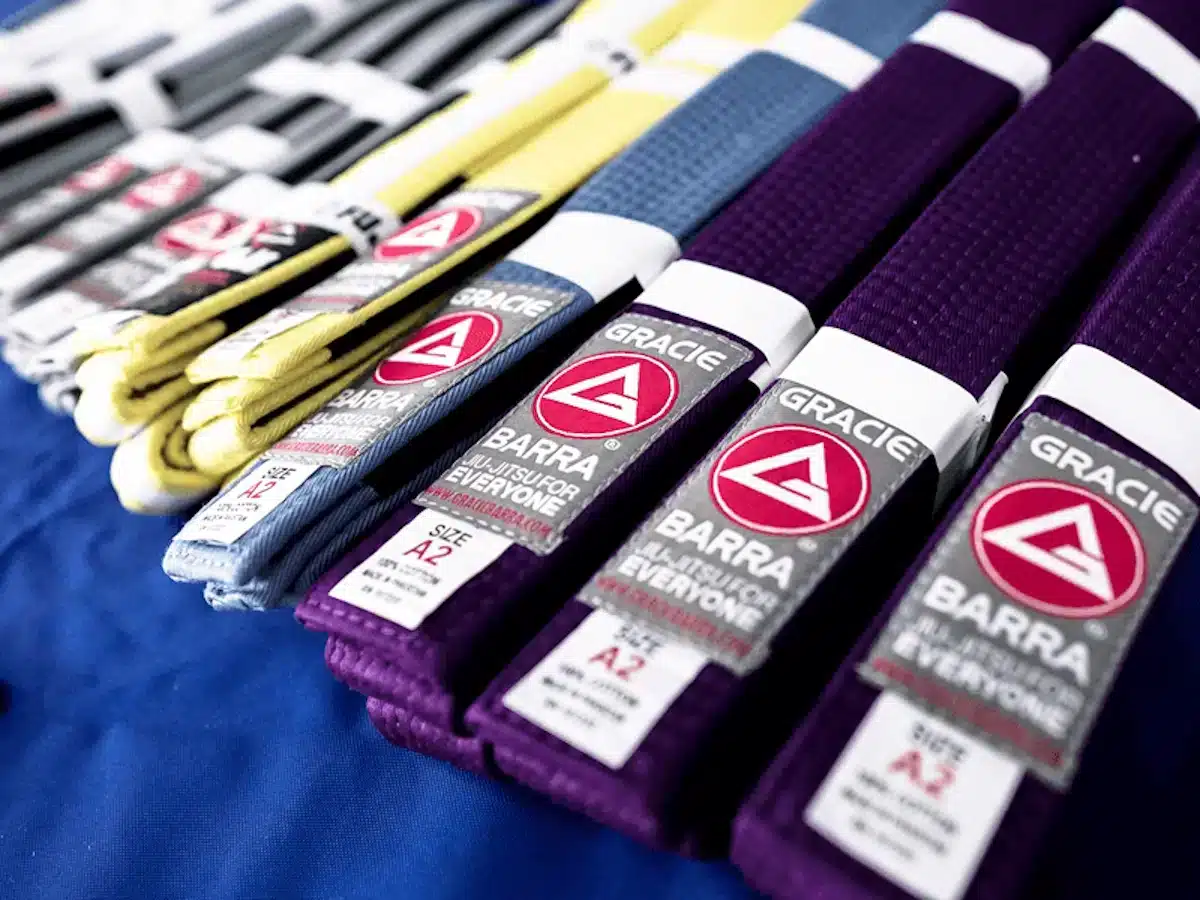

Brazilian Jiu-Jitsu (BJJ) is often called “human chess,” a martial art where technique and strategy allow a smaller person to overcome a larger one. Central to the BJJ journey is its unique and demanding belt ranking system — one of the slowest and most respected progressions in all of martial arts. But what does each belt represent, how long does it take to progress, and what skills are expected at every level?
This comprehensive guide covers the complete BJJ belt order and ranking system, detailing the progression requirements for each rank, the approximate timeline between promotions, essential techniques at every level, and the responsibilities associated with each belt. Whether you are considering your first class or preparing for your next promotion, this is the definitive BJJ belt order resource.
BJJ Belt Order
Key Takeaways
- The Slowest Belt System: BJJ has one of the longest progressions in martial arts. It typically takes 8 to 12 years of dedicated training to earn a black belt — significantly longer than karate (3-5 years) or taekwondo (3-5 years).
- Five Adult Ranks: The standard adult belt progression is White → Blue → Purple → Brown → Black. Each belt has up to four stripes to mark progress within the rank.
- Beyond Black: Like judo, BJJ has advanced “Coral” and “Red” belts for high-level masters who have dedicated their lives to the art.
- Sparring Is King: Promotion is based almost entirely on practical skill, especially live sparring (“rolling”) performance. You cannot earn a BJJ belt through forms or written tests alone.
- No Universal Testing: Unlike most traditional martial arts, BJJ has no standardized exam. Your instructor decides when you are ready based on mat time, skill, and character.
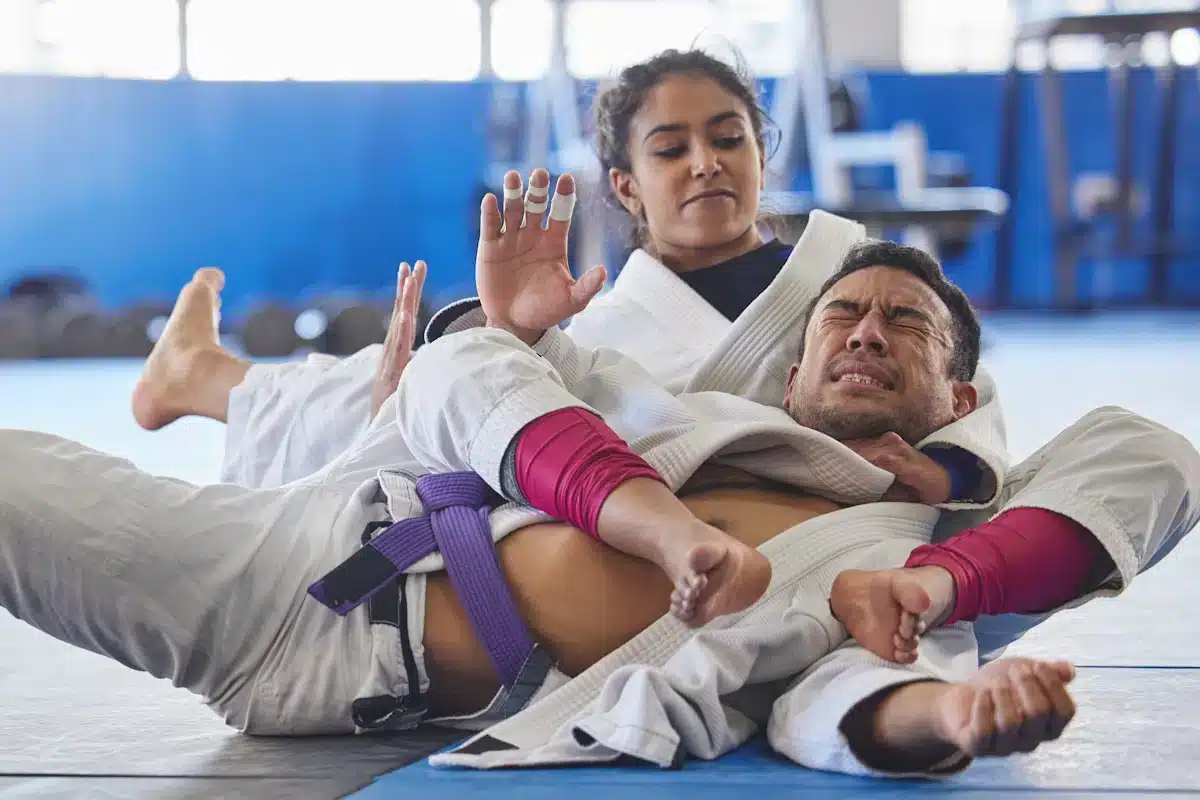
- Gi and No-Gi: BJJ is practiced in two distinct formats. Gi training uses the traditional uniform, while No-Gi uses shorts and a rash guard. Both follow the same belt system.
BJJ Belt Order: The Complete Visual Guide
The Brazilian Jiu-Jitsu belt progression follows a five-color system for adults, with additional master ranks beyond black belt. Here is the complete BJJ belt order at a glance:
BJJ Belt Progression
The Beginning — Survival & Fundamentals
Solid Foundation — Defensive Awareness
Advanced Practitioner — Offensive Development
Expert Level — Refinement & Teaching
Mastery — 8-12+ years total training
Master Ranks
Brazilian Jiu-Jitsu Belt Progression — White Belt to Red Belt Grandmaster
The History of BJJ’s Belt Ranking System
The BJJ belt system is a direct descendant of the judo ranking system created by Jigoro Kano in the 1880s. When Mitsuyo Maeda — a Kano judo student — traveled to Brazil and taught the Gracie family, they adapted his techniques and eventually his ranking structure to suit their evolving art. The key difference was in the standards: the Gracies and subsequent BJJ pioneers insisted on much longer intervals between promotions and placed the emphasis squarely on live sparring ability rather than forms or kata.
This philosophy — that a belt must reflect real fighting ability — is what separates the BJJ belt order from most traditional martial arts. While a karate practitioner might demonstrate katas and break boards for promotion, a BJJ student must prove their skill against resisting opponents on the mat every single class. This is why the BJJ black belt is widely regarded as one of the hardest belts to earn in any martial art, and why the system has gained enormous respect in the MMA and grappling communities.

The Adult BJJ Belt Ranks (Ages 16+)
The adult journey in BJJ is long and deeply rewarding, with each belt signifying a distinct level of maturation, technical knowledge, and competitive ability. Below is a detailed breakdown of every rank in the BJJ belt order and what is expected at each level.
White Belt — The Beginning
The white belt is where every BJJ practitioner starts, regardless of their background in other martial arts. The primary goal at white belt is simple: survival. A white belt learns to accept being in uncomfortable positions and to move efficiently rather than muscling through exchanges.
Key focus areas: Understanding the fundamental positions — guard, mount, side control, and back control. Learning basic submissions like the armbar, rear-naked choke, and triangle choke. Developing hip movement (shrimping), breakfalls, and learning how to tap safely. Most critically, learning to relax and breathe while under pressure.
Typical time at white belt: 1 to 2 years of consistent training (2-3 sessions per week).
Blue Belt — The Foundation
The blue belt is the first significant milestone in a practitioner’s BJJ journey and is where many students unfortunately quit — a phenomenon so common it has earned the nickname “the blue belt blues.” A blue belt has a solid defensive foundation and a working knowledge of the most common positions and submissions. They are no longer complete beginners and have enough skill to handle untrained opponents of any size.
Key focus areas: Developing a reliable escape from every major position. Beginning to chain techniques together (e.g., armbar to triangle to omoplata). Understanding sweeps from guard. Recognizing common submission setups before they are locked in. Starting to develop personal preferences for positions and techniques.
Typical time at blue belt: 2 to 3 years before promotion to purple.
Purple Belt — The Transition to Expert
The purple belt represents the transition from competent practitioner to genuine expert. At this level, students have logged thousands of hours on the mat, and their technique begins to flow instinctively. A purple belt has developed a more sophisticated and offensive game. They begin to chain attacks from multiple positions and often create a specific “A-Game” — a set of interconnected techniques they are particularly dangerous with.
Key focus areas: Developing a personal style and signature techniques. Understanding how to control the pace and direction of a roll. Beginning to experiment with more advanced positions such as the rubber guard, deep half guard, and leg-lock systems. Starting to teach and mentor lower belts effectively.
Typical time at purple belt: 1.5 to 3 years before promotion to brown.
Brown Belt — The Refined Expert
The brown belt is the final stage before the black belt and represents a bona fide expert in the art. A brown belt has a deep understanding of nearly all positions and submissions and is excellent at troubleshooting weaknesses and refining techniques. At this level, the practitioner is not learning many new techniques but is perfecting their timing, transitions, and ability to adapt to any opponent’s style. Brown belts are often leaders and assistant instructors in the gym.
Key focus areas: Eliminating weaknesses across all positions. Refining timing and efficiency in transitions. Developing the ability to roll effectively with anyone, regardless of size or style. Contributing to the academy through teaching and mentoring. Competing at a high level (for competition-focused practitioners).
Typical time at brown belt: 1 to 2 years before promotion to black.
Black Belt — Mastery of the Art
Earning a BJJ black belt is one of the most prestigious achievements in all of martial arts. It signifies over a decade of dedicated training and a profound, instinctual understanding of jiu-jitsu. A black belt can effectively teach, innovate, and perform at a high level. The International Brazilian Jiu-Jitsu Federation (IBJJF) requires practitioners to be at least 19 years old to receive a black belt.
However, the black belt is not the end of the journey — it is often described as the point where the real learning begins. Black belts continue to refine their game, develop new techniques, and deepen their understanding for the rest of their lives.
Black belt degrees: After receiving the black belt, practitioners earn degrees (1st through 6th) based on continued time, contribution, and influence in the art. Each degree requires a minimum of three years at the lower degrees, increasing at higher levels.
How Long Does Each BJJ Belt Take? The Complete Timeline
One of the most common questions new practitioners ask is “How long until my next belt?” Understanding the BJJ belt order timeline helps set realistic expectations. The honest answer is that it varies enormously based on training frequency, natural aptitude, competition experience, and your instructor’s standards. However, here are the generally accepted timelines for dedicated practitioners training 3 to 4 times per week:
BJJ Belt Timeline
| Belt | Min. Age (IBJJF) | Time at Belt | Cumulative |
|---|---|---|---|
| White | 16 | 1-2 years | 0-2 years |
| Blue | 16 | 2-3 years | 2-5 years |
| Purple | 16 | 1.5-3 years | 4-7 years |
| Brown | 18 | 1-2 years | 6-9 years |
| Black | 19 | Lifetime | 8-12+ years |
Average timeline for practitioners training 3-4 times per week. Individual results vary.
It is worth noting that these timelines are significantly longer than most other martial arts. A taekwondo black belt can be earned in 3 to 5 years, and a karate black belt in a similar timeframe. The extended timeline in BJJ reflects the art’s emphasis on live sparring proficiency over memorization of techniques or forms.
The Master Ranks: Coral and Red Belts
After the black belt, the BJJ belt order continues with master ranks awarded for decades of practice, teaching, and contributions to the art. These master ranks mirror the structure found in judo’s highest degrees and are extremely rare.
Coral Belt (Red and Black) — 7th Degree
The first coral belt is awarded to 7th-degree black belt holders. Reaching this rank requires a minimum of 31 years as a black belt. The red-and-black pattern signifies the practitioner’s bridge between technical mastery (black) and a lifetime of contribution (red).
Coral Belt (Red and White) — 8th Degree
The second coral belt — red and white — is awarded to 8th-degree holders. This requires at least 38 years after earning the black belt. Only a handful of living practitioners hold this rank, and they are widely regarded as among the most important figures in the art’s history.
Red Belt — 9th and 10th Degree (Grandmaster)
The red belt represents the absolute pinnacle of Brazilian Jiu-Jitsu. The 9th degree requires a minimum of 48 years beyond black belt and is reserved for those whose contributions to the art are immeasurable. The 10th degree red belt has been awarded exclusively to the founding pioneers of BJJ — the Gracie family members and their most senior students who built the art from the ground up. It is not a rank that can be “earned” through progression; it is a recognition of historical significance.
The Kids’ BJJ Belt Ranks (Under 16)
BJJ has a separate, more detailed belt system for children, providing more frequent motivation and milestones on what would otherwise be an extremely long journey for young practitioners. The kids’ BJJ belt order offers more color options and intermediate stages to keep children engaged and progressing.
The kids’ belt progression is: White → Grey → Yellow → Orange → Green. Each of these belts has a white-striped variant (e.g., grey-white, solid grey) to mark intermediate progress, effectively doubling the number of visible milestones. When a child turns 16, they transition to the adult system — typically at blue belt if they have been training consistently for several years.
How Do BJJ Belt Promotions Work?
Unlike many traditional martial arts such as karate or taekwondo, BJJ has no formal, universal testing system. There is no written exam, no standardized kata to perform, and no board to satisfy. Advancement through the BJJ belt order is decided solely by the head instructor of a school, and standards can vary between academies. However, instructors generally evaluate three core factors:
Sparring Performance (“Rolling”): This is far and away the most critical factor. Can you consistently and effectively apply your techniques against training partners who resist fully, including those at your rank and above? A BJJ belt must reflect real ability on the mat.
Technical Knowledge: Do you understand the techniques and concepts appropriate for your level? This includes not just knowing moves but understanding when and why to apply them.
Character and Mat Time: Have you demonstrated dedication, respect, and consistent attendance over an extended period? Have you contributed positively to the gym culture and helped your training partners improve?
Stripes as milestones: Most instructors award up to four stripes on each belt as intermediate progress markers. These white tape strips are wrapped around the belt’s black bar (or red bar for black belts) and provide visible, motivating checkpoints between each belt color.
Understanding Gi vs. No-Gi BJJ
Brazilian Jiu-Jitsu is practiced in two distinct formats, and understanding the difference is essential for anyone entering the art. Both formats follow the same BJJ belt order, but the technical approach differs significantly.
Gi BJJ is practiced in the traditional uniform (a heavy cotton jacket and pants), which can be gripped for chokes, throws, and sweeps. The gi slows the pace of rolling and allows for a more methodical, grip-based game. Many traditional academies consider the gi essential for the proper development of technique and patience.
No-Gi BJJ is practiced in shorts and a rash guard, removing all fabric grips. This creates a faster-paced, scramble-heavy style that relies more on underhooks, overhooks, and body-lock controls — grips more similar to catch wrestling. No-Gi training is generally considered more applicable to MMA, where fighters do not wear a gi.
The 10th Planet Jiu-Jitsu system, founded by Eddie Bravo, is the most prominent No-Gi-only BJJ organization. It uses the same belt colors but has its own unique approach to techniques and progression. For a deeper comparison, see our guide to Jiu-Jitsu vs. Judo.
BJJ’s Influence on Modern MMA and Combat Sports
The effectiveness of Brazilian Jiu-Jitsu at the highest level of combat sports is undeniable. When Royce Gracie dominated the early UFC tournaments in the 1990s using BJJ against much larger opponents from other disciplines, it fundamentally changed how the world understood fighting. Today, every serious MMA fighter must have at least a working knowledge of BJJ — the most popular submissions in MMA are almost all rooted in Brazilian Jiu-Jitsu.
The UFC is filled with elite grapplers who use their BJJ skills to dominate opponents. Understanding the belt system helps fans appreciate just how accomplished these fighters are on the ground. For a deeper dive into how grappling shapes MMA, see our guides on grappling in MMA and the top 10 chokes that define modern MMA.
Prominent BJJ Practitioners in the UFC
- Charles “Do Bronx” Oliveira: The UFC’s all-time submission leader, Oliveira‘s aggressive Brazilian Jiu-Jitsu has been the cornerstone of his championship success. His ability to threaten finishes from every position makes him one of the most dangerous grapplers in MMA history.
- Gilbert “Durinho” Burns: A multiple-time BJJ world champion at black belt level, Burns has seamlessly translated his world-class grappling into a formidable MMA career, proving that elite competition BJJ directly transfers to the cage.
- Aljamain “Funk Master” Sterling: The former bantamweight champion built his title reign on a unique grappling style, using his BJJ foundation to become one of the most effective controllers in the sport — proving that positional dominance is just as devastating as submissions.
- Rodolfo Vieira: An ADCC and five-time IBJJF World Champion, Vieira is one of the most credentialed grapplers to ever compete in MMA, possessing a formidable submission game that has translated to finishes inside the octagon.
- Ilia Topuria: The featherweight champion has demonstrated elite-level BJJ throughout his career, with his ground game serving as a constant threat that opens up his devastating striking. His arm-triangle choke victory over Bryce Mitchell showcased his grappling credentials on the biggest stage.
These fighters are instrumental in pushing the boundaries of what is possible when world-class BJJ meets the demands of MMA competition, inspiring the next generation of BJJ talents to pursue excellence in both the sport and the art.


Explore More Belt System Guides
The BJJ belt order is just one part of the rich tapestry of martial arts ranking traditions. Each combat sport has developed its own unique approach to measuring skill and progress. Explore our complete collection of belt system guides:
- Judo Belts 101: The original martial arts belt system that inspired BJJ’s ranking — from white to the rare 10th-degree red belt.
- Karate Belt Order: What each rank means across Shotokan, Kyokushin, and other major styles — the kyu and dan system explained.
- Taekwondo Belts 101: Meaning, order, and progression through the dynamic kicking art’s ranking system.
- 10th Planet Jiu-Jitsu’s Belt System: How Eddie Bravo’s No-Gi revolution handles ranking differently from traditional BJJ academies.
- Jiu-Jitsu vs. Judo: Key differences between these closely related grappling arts and how to choose the right one for you.
Brazilian Jiu-Jitsu Belt Ranking: Frequently Asked Questions
How long does it take to get a black belt in BJJ?
The average time for a dedicated practitioner training 3 to 4 times per week is between 8 and 12 years. This makes the BJJ black belt one of the slowest to earn in any martial art, significantly longer than karate (3-5 years) or taekwondo (3-5 years).
What are the stripes on a BJJ belt?
An instructor awards stripes (up to four per belt) to signify progress within a specific belt rank. They are white tape strips wrapped around the belt’s bar and serve as visible milestones on the way to the next color. Not all academies use stripes, but most do.
What is the BJJ belt order from lowest to highest?
The adult BJJ belt order is: White, Blue, Purple, Brown, and Black. Beyond black belt, the master ranks continue with Coral Belt (Red and Black) at 7th degree, Coral Belt (Red and White) at 8th degree, and Red Belt at 9th and 10th degree.
Is BJJ good for self-defense?
Yes. BJJ is widely considered one of the most effective martial arts for one-on-one, unarmed self-defense. It teaches practitioners to control and submit a larger, stronger opponent without relying on striking—using leverage, technique, and positional dominance.
What is the difference between Gi and No-Gi BJJ?
Gi BJJ is practiced with the traditional uniform (a heavy cotton jacket and pants), which can be gripped for chokes, sweeps, and throws. No-Gi BJJ is practiced in shorts and a rash guard and uses different grips, similar to wrestling, resulting in a faster-paced, scramble-heavy style. Both formats use the same belt ranking system.
Can you get a BJJ black belt without competing?
Yes. While competition experience can accelerate promotions, it is not required at most academies. Many practitioners earn their black belt solely through consistent training, technical knowledge, gym sparring, and years of dedication. Your instructor evaluates your readiness, not a tournament record.
What is the hardest belt to get in BJJ?
Many practitioners consider the blue belt the hardest to earn because it requires the longest single jump in skill from a complete beginner to a competent grappler. However, the purple belt is often considered the most technically demanding transition, as it marks the shift from defensive survival to sophisticated offensive jiu-jitsu.
How does the BJJ belt system compare to judo belts?
BJJ’s belt system descended directly from judo’s ranking structure, but with a significantly slower progression. Judo typically has more belt colors in the kyu (student) ranks and a faster path to black belt (5-7 years vs. 8-12 for BJJ). Both arts share the Coral and Red Belt Master ranks at the highest levels.
What are the kids’ belt ranks in BJJ?
Children under 16 follow a separate, more detailed system with more frequent milestones: White, Grey, Yellow, Orange, and Green. Each color has a white-striped intermediate variant. When a child turns 16, they transition to the adult system — typically at blue belt level if they have been training consistently.