Fight IQ: MMA Fundamentals
Grappling in MMA transforms a fight into a strategic chess match of leverage, timing, and positional control: where a wrestler who can finish submissions or a jiu-jitsu practitioner who can close the distance holds a decisive advantage over any pure striker.
This guide covers every layer: wrestling takedowns, clinch work, judo throws, ground control positions, and submissions, and how they connect into a complete grappling system.
In This Grappling in MMA Guide
What Is Grappling in MMA?
Grappling in MMA refers to the full range of techniques used to control, take down, and submit an opponent through wrestling, Brazilian jiu-jitsu, judo, and Greco-Roman wrestling, the disciplines that determine where the fight takes place and who dictates its outcome. While striking captures headlines with spectacular knockouts, grappling determines who controls the fight’s pace, location, and ultimate trajectory.
The fundamental purpose of grappling in MMA is positional: to move from a neutral standing position into a situation where one fighter has a clear advantage over the other. That advantage might be achieved by taking the fight to the ground, pinning an opponent against the cage, or transitioning through a series of positions that progressively limit the opponent’s options until a submission becomes available. Understanding these interconnected elements is what separates a knowledgeable MMA viewer from someone who only follows the highlight reel.

Grappling in MMA merges techniques from wrestling, judo, and Brazilian jiu-jitsu into a detailed system that can neutralize strikers, create pathways to victory through submission, and allow smaller or slower fighters to overcome physically dominant opponents through leverage and technique. Wrestling and judo form the foundation of most successful takedown approaches. Double-leg and single-leg takedowns remain among the highest-percentage entries for bringing fights to the ground, with level changes and timing proving as important as raw strength for successful execution.
Wrestling Takedowns: The Entry Points
Takedowns are the primary entry point for grappling in MMA: the techniques that shift a fight from the standing position where strikers are most dangerous to the ground where grapplers thrive. The two most foundational takedowns in the sport are the double-leg and the single-leg, both inherited directly from amateur wrestling.
The double-leg takedown involves lowering the level, driving into both of the opponent’s legs simultaneously, and using forward momentum to drive them to the mat. It is the most practiced takedown in wrestling and carries directly into MMA competition, though the presence of submissions means the follow-through, maintaining control without giving up the back, is more technically demanding than in pure wrestling.
The single-leg takedown targets one leg rather than two, offering more flexibility for setups and counters. It can be executed from a wider range of angles and distances, making it a versatile tool against opponents with a strong double-leg sprawl defense. High-level MMA grapplers often chain these entries together: shooting a double-leg to draw the sprawl, then switching to a single-leg as the opponent’s hips come back, or vice versa.
Takedown defense is equally critical to grappling in MMA, and fighters with elite defensive wrestling often demonstrate some of the most complete games in the sport. The sprawl, driving the hips back and down while forcing the opponent’s head toward the mat, is the primary counter to wrestling-based takedown attempts. Combining an effective sprawl with the ability to return to the feet or take the back of a shot opponent creates a complete defensive grappling system that effectively neutralizes most single-discipline wrestlers.
Beyond pure wrestling, trips and foot sweeps borrowed from judo and Greco-Roman wrestling significantly expand the takedown vocabulary. A well-timed inside trip in the clinch or a foot sweep from a collar tie can bring a fight to the ground without the explosive commitment of a double-leg, making them valuable tools particularly for fighters who prefer to initiate from a more upright posture.
Clinch Work: The Bridge Between Striking and Grappling
Clinch work serves as the bridge between striking and grappling phases: the standing grappling range where takedowns are set up, where knees and short elbows are exchanged, and where the fight’s location is continuously negotiated. Understanding the clinch is essential to understanding grappling in MMA, because it is where many fights are decided before they ever reach the ground.
Fighters utilize several core clinch positions. Underhooks, where one arm passes under the opponent’s arm to grip behind the back or shoulder, provide leverage for trips, body locks, and takedown setups while disrupting the opponent’s ability to generate striking power. Overhooks (the whizzer) provide a counter to underhook attempts and create opportunities for hip tosses and defensive scrambles. Wrist control allows a fighter to steer their opponent’s posture and limit their opponent’s striking output without full-body contact.
Against the cage, clinch control takes on additional strategic significance. Pinning an opponent against the fence while controlling their posture allows a fighter to wear them down physically: the cage prevents the opponent from circling away, dramatically limiting their options. From this position, fighters can work dirty boxing (short punches and elbows at close range), short-range knees to the body and thighs, or persistently attempt takedowns until the opponent’s energy to defend them is exhausted.
Effective grappling in MMA clinch exchanges demands constant technical adjustment: the dominant position shifts rapidly, and a fighter who loses their underhook or allows their posture to be broken can find themselves suddenly reversed against the cage rather than the one doing the pinning. Transitional awareness, the ability to recognize which position is being established and respond before it is fully secured, is the core skill in high-level clinch grappling.
Throws and Trips: The Judo Dimension
Throws and trips add another dimension to grappling in MMA: techniques that can produce explosive positional shifts from standing while carrying less counter-strike risk than a committed double-leg shot. The influence of judo on modern MMA is substantial, particularly through fighters who have made hip throws and foot sweeps central to their grappling identity.
Hip throws, the core of classical judo, use the hips as a fulcrum to rotate an opponent over and onto the mat. In MMA, they are most effective when initiated from clinch positions where the fighter already controls the opponent’s posture, since the commitment required for a clean hip throw leaves the legs potentially vulnerable to counter-wrestling if the throw is stuffed. Fighters with elite judo backgrounds, however, can make this risk manageable through the speed and precision of their execution.
Body lock takedowns, popularized through Greco-Roman wrestling, involve controlling the opponent from behind with both arms locked around the waist, then using momentum and leverage to drive them to the mat or execute a suplex-style technique. These are particularly dangerous against the cage, where the Greco-Roman fighter can pin the opponent and repeatedly attempt body lock throws until one succeeds.
Foot sweeps and trips offer a lower-commitment entry point for grappling in MMA. An inside trip, hooking the opponent’s leg with your own from the inside, disrupts their base without requiring full commitment and can be initiated naturally from collar tie or clinch positions. These techniques are particularly valuable for fighters who want to initiate ground exchanges without telegraphing a full takedown shot that an experienced sprawler might be waiting for.
Ground Control: Positional Dominance
Once grappling in MMA reaches the mat, positional dominance determines who controls the fight’s next phase and who is working to survive it. Professional MMA judging rewards control positions significantly, meaning that even without a submission attempt, maintaining dominant ground positions contributes directly to winning rounds.
Side control, lying perpendicular across the opponent with chest-to-chest pressure, is typically the first dominant position achieved after a takedown or guard pass. It restricts the opponent’s ability to frame, escape, or attack, and lays the foundation for transitioning to a more dominant mount or for ground-and-pound strikes.
Mount, sitting on the opponent’s hips or chest while they are on their back, is one of the most powerful positions in grappling in MMA. From mount, a fighter can deliver unanswered ground-and-pound, attack both arms for armbar setups, and transition to rear mount if the opponent rolls to escape. Maintaining mount against a skilled opponent requires constant adjustment, as most defensive grappling training centers on escaping this exact position.
Rear mount, controlling the opponent from behind with hooks in, is the highest-value position in the sport. It combines complete offensive access (both arms free to strike or choke) with near-total defensive security (the opponent cannot effectively strike back). The rear naked choke is most reliably finished from this position, making back control the primary target of most high-level ground grappling strategies.
Guard, the position in which the bottom fighter controls the top fighter’s posture with their legs, is the central concept of Brazilian jiu-jitsu’s ground game. Being in someone’s guard is not automatically a dominant position in MMA, as skilled guard players can threaten sweeps, submissions, and framing escapes that prevent ground-and-pound from landing cleanly. Passing the guard to achieve a dominant position, such as side control or mount, is a key objective for any top-position grappler.
Submissions: The Definitive Grappling Victory
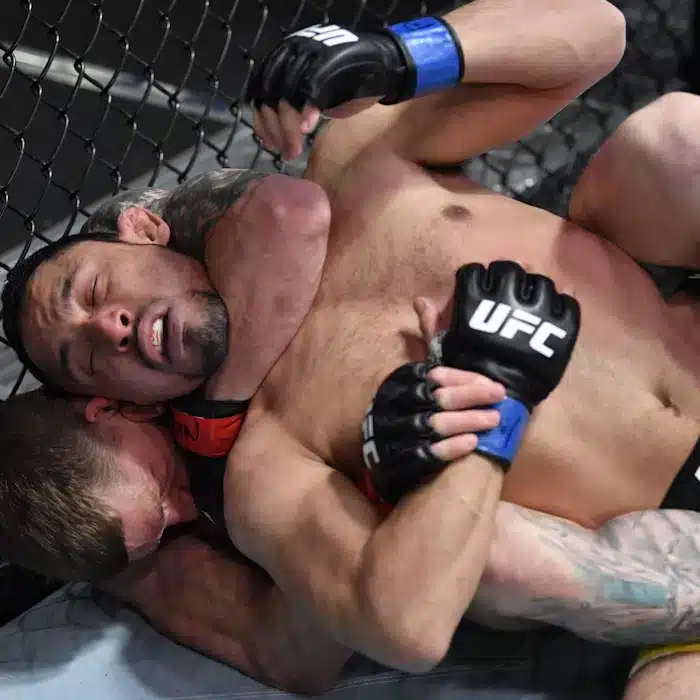
Submissions represent the most definitive outcome grappling in MMA can produce: a finish that requires no judges, no decision, no interpretation. When an opponent taps, the fight is over, and positional grappling has achieved its ultimate purpose.
The rear naked choke is the most successful submission in UFC history by a significant margin, with hundreds of victories across all weight classes and eras. Its dominance reflects the position it requires: rear mount. A fighter who achieves back control with both hooks in has already won the positional battle so comprehensively that the submission frequently follows as a matter of execution rather than additional skill. The choke itself is mechanically simple: forearm across the throat, second arm securing the head, but achieving the position that makes it available is the genuine challenge.
The armbar attacks the elbow joint by hyperextending the arm across the hip. It can be executed from multiple positions: mount, guard, back control, and various scramble positions, making it the most versatile submission in grappling in MMA. Guard-based armbars require precise timing and hip movement to prevent the opponent from posturing out; mount armbars require a controlled transition that skilled opponents can disrupt; armbar finishes from scrambles require the kind of opportunistic awareness that only develops with high-level competition experience.
The guillotine choke is one of the few submissions readily available from the standing position, making it a natural counter to takedown attempts. A fighter defending a double-leg who can secure a guillotine before being taken down has reversed a defensive situation into an offensive one, and the front headlock position that enables the guillotine is also a platform for defensive wrestling scrambles and back takes.
Submission victories account for approximately 23 percent of both male and female MMA wins, though success rates vary significantly by weight class, style, and era. Heavier weight classes trend toward knockout finishes, while lighter weight classes show a higher proportion of submission victories, likely reflecting the reduced knockout power relative to the physical demands of holding down a skilled grappler. Grappling-centric fighters demonstrate meaningfully different winning method profiles compared to striker-focused opponents, with positional control and submission attempts defining the strategic approach that the wrestling and jiu-jitsu disciplines bring to mixed martial arts.
Level Up Your Fight IQ
Grappling is one piece of the MMA puzzle. Explore the rest:
Frequently Asked Questions
How long does it take to develop effective grappling skills for MMA?
Developing effective grappling in MMA requires approximately three to five years of consistent training before a fighter can be considered genuinely competitive in this dimension of the sport. The first eighteen months focus on fundamental positions, basic escapes, and the core takedown entries from wrestling and judo. The intermediate phase, from one to three years, emphasizes advanced positional transitions, guard passing, and submission setups from dominant positions. Advanced proficiency, the kind required for high-level competition, typically emerges after three or more years, when fighters have enough mat time to apply techniques fluidly under resistance rather than in controlled drilling environments. Training frequency, prior martial arts experience, and access to high-quality instruction all significantly influence the timeline.
What is the best martial arts background for MMA grappling?
Wrestling provides the strongest single foundation for grappling in MMA due to its emphasis on takedown mastery, scrambling ability, and top-position control: the skills that determine where the fight takes place. Wrestlers excel at dictating fight locations and maintaining dominant positions once they achieve them. However, Brazilian jiu-jitsu is essential for submission skills and guard work, providing the finishing techniques and positional awareness from the bottom that wrestling does not address. Modern MMA grapplers are almost uniformly hybrid practitioners: wrestlers who have developed BJJ submission games, or jiu-jitsu players who have added wrestling-level takedown ability. A Judo background adds elite throwing technique to this foundation.
How important is strength compared to technique in MMA grappling?
Both strength and technique are essential components of grappling in MMA, and neither fully compensates for a deficiency in the other. Superior technique enables energy conservation and leverage maximization: a technically elite grappler can control and submit physically stronger opponents by using positioning and body mechanics rather than muscular force. However, certain grappling actions require baseline levels of strength and explosive power that technique alone cannot provide: bridging to escape a heavy opponent in mount, breaking a seatbelt grip for a back take, or maintaining a choke against a powerful opponent defending it all require some combination of strength and technique. Peak grappling performance integrates both, with strength training designed to support technical application rather than replace it.
What are the most common grappling injuries in MMA?
The most common injuries in grappling in MMA training and competition include knee strains and ligament injuries from takedown mechanics and submission defenses, shoulder injuries from submission attempts (particularly armbar and kimura defenses), and various joint overuse injuries from the repetitive demands of drilling and sparring. Neck injuries are a risk in guillotine and choke defenses. Prevention requires structured warm-ups emphasizing joint mobility, proper drilling mechanics that teach technique before resistance, protective equipment where appropriate, and, critically, training partners and coaches who understandstand the difference between productive resistance and reckless sparring intensity. Tap early and tap often is not a weakness; it is the practice that allows consistent long-term training.
Should beginners focus on offensive or defensive grappling first?
Beginners learning grappling in MMA should prioritize defensive fundamentals first. Learning takedown defense, the sprawl, basic positional escapes (bridge and roll from mount, elbow-knee escape from side control), and guard retention prevents every sparring round from ending within 30 seconds, which is both demoralizing and limits learning opportunities. Once defensive fundamentals establish a foundation of survivability, offensive techniques such as takedowns and guard passes can be progressively integrated. The most effective beginner curriculum, however, does not treat these as fully separate phases: offensive and defensive principles reinforce each other, and training that addresses both within each session produces more complete development than sequential compartmentalization.