
Fight IQ: MMA Fundamentals
Striking in MMA is not one discipline: it is four weapons systems combined into a single stand-up game: punches from boxing, kicks from Muay Thai and kickboxing, elbows from the clinch, and knees from the infighting range.
This guide covers each weapon in depth: the mechanics, the tactical purposes, the ranges, and the defensive skills that complete the picture, so you understand what you’re watching when the fight stays on the feet.
In This Striking in MMA Guide
What Is Striking in MMA?
Striking in MMA refers to the full arsenal of stand-up offensive weapons permitted under the Unified Rules: punches, kicks, elbows, and knee strikes. Unlike boxing, which restricts competitors to punching, or traditional kickboxing, which typically allows punches and kicks but not elbows, MMA permits all of these simultaneously, creating a striking environment that draws from boxing, Muay Thai, kickboxing, karate, and other stand-up martial arts within a single rule set.
The result is a striking game that operates across multiple ranges and from multiple angles. A fighter who controls the striking exchanges in MMA must manage the threat of punches at mid-range, leg kicks targeting their base, body kicks to the ribs and liver, head kicks at full extension, elbow cuts in close, and knees to the body and head from the clinch, all simultaneously, all from an opponent who may also be threatening a takedown. This complexity is what makes the stand-up game in MMA distinct from any single striking sport and rewards fighters with genuinely diverse, well-integrated striking systems.
Punches: The Foundation of MMA Stand-Up
Punches are the primary striking tool in MMA and the most direct inheritance from boxing. The basic punch vocabulary, jab, cross, hook, and uppercut, applies fully in MMA, though the presence of kicks, takedowns, and clinch work means boxers adapting to MMA must modify their stance, footwork, and guard to account for threats that pure boxing never presents.
The jab is the most strategically important punch in MMA striking. It establishes and maintains range, disrupts the opponent’s rhythm, sets up combinations, and lands quickly enough to avoid significant commitment. Jab volume is one of the clearest indicators of a fighter controlling the pace and distance of a stand-up exchange. Fighters who land their jab consistently force their opponent into reactive positioning, making every subsequent strike, a cross, a kick, or a takedown, more effective because it arrives after the opponent has already been moved or distracted.
The cross is the primary power punch: a rear-hand straight that travels the longest distance of any punch but generates the most force through full hip rotation and weight transfer. Crosses knock opponents out in MMA at every level of the sport, and the mechanics of generating a powerful cross (rotating the rear hip fully through the shot) are the foundation of every punch that follows. The overhand, a looping variation of the cross that arcs over the opponent’s guard, is a common MMA finisher because it attacks an angle that straight punches cannot reach.
Hooks attack from the side rather than straight ahead, making them harder to see and block than straight punches. The lead hook is the punch most responsible for knockouts in MMA because it arrives from the opponent’s peripheral vision, targeting the chin or temple with rotational force that the head cannot roll with as effectively as a straight shot. Uppercuts attack upward from below the opponent’s line of sight, exploiting gaps in guard and targeting the chin from an angle that the defensive shell cannot fully cover.
Power generation in MMA punching requires the same fundamentals as boxing: pushing off the rear foot, rotating the hips, transferring weight through the punch, and following through rather than pulling back prematurely. Punches thrown with arm strength alone, without hip drive, are dramatically less powerful and more telegraphed. Fighters who develop genuine punching power in MMA do so by drilling the kinetic chain mechanics until hip rotation into punches becomes automatic rather than conscious. For a complete breakdown of punch mechanics from stance through all six fundamental punches, see our boxing basics guide.
Kicks: Range, Power, and Leg Damage
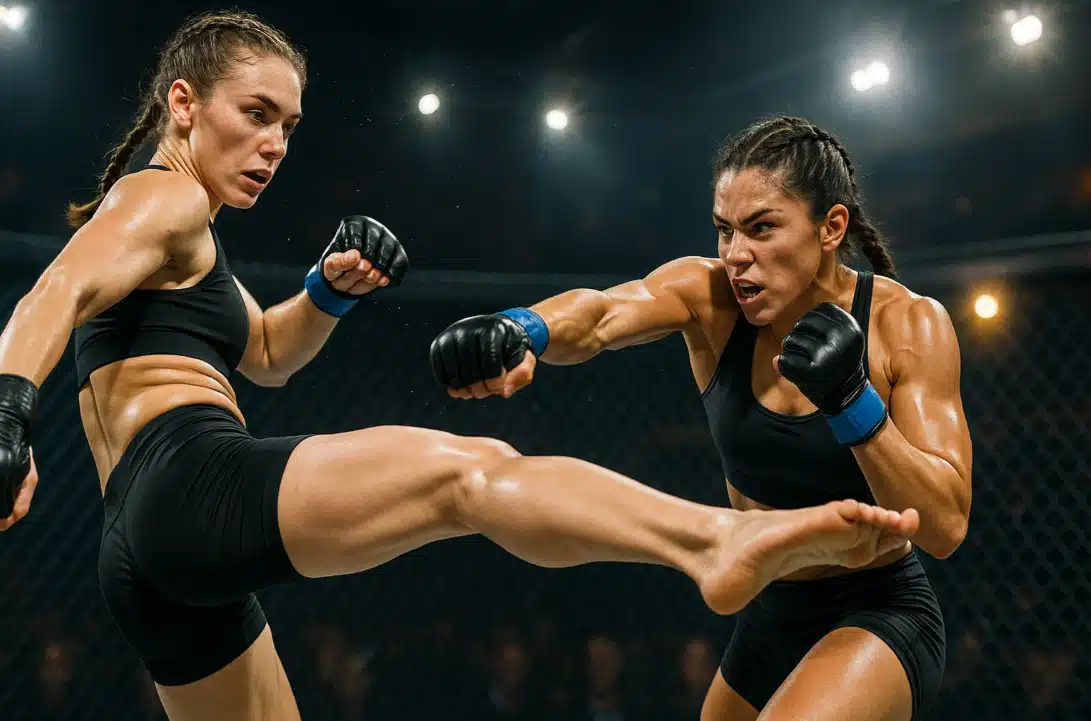
Kicks extend striking in MMA well beyond the range of punches and add a weapon system capable of producing damage that no punch can replicate: specifically, repeated low kicks targeting the thigh and calf that accumulate over a full fight to impair an opponent’s movement and base. Muay Thai and traditional kickboxing provide the technical foundation for MMA kicking, though the presence of takedown threats in MMA means kick mechanics are adapted to allow faster weight recovery and improved balance against wrestling.
The leg kick, a Muay Thai-style roundhouse targeting the thigh or calf, is one of the most consequential single-fight weapons in MMA. It typically does not produce immediate knockdowns, but accumulated leg-kick damage progressively destroys an opponent’s mobility, destabilizes their base, and forces them to modify their footwork and stance to protect the damaged leg. Fighters who cannot check leg kicks, blocking them with the shin, absorb damage with every connection. By the later rounds of a fight, a well-leg-kicked fighter is moving on compromised legs, which affects every other aspect of their performance. Contact with the shin rather than the foot maximizes impact and minimizes injury risk to the kicker.
Body kicks target the ribs, liver, and midsection. A clean liver kick, connecting on the right side of the opponent’s body, produces a sharp, nauseating pain that can drop a fighter who has never been hurt by anything else in the fight. Body kicks also serve a strategic function beyond immediate damage: they force the opponent to lower their guard to defend against the body, creating openings for head attacks. Fighters who can convincingly threaten both head and body with the same kick mechanics keep their opponent in a defensive dilemma with no good solution.
Head kicks are the most spectacular striking in MMA finishers . A clean high kick to the temple or jaw delivers rotational force that knockouts cannot be defended against once it lands clean. The mechanical difficulty, generating full rotational power while placing the kick precisely on a moving target, means head kicks are less common than body and leg kicks, but fighters who have consistently demonstrated clean head kick power in their backgrounds (particularly those with Muay Thai or taekwondo experience) change opponents’ defensive priorities simply by possessing the threat.
Elbows: The Close-Range Finishing Weapon
Elbow strikes are the weapon in MMA striking that most clearly has no direct parallel in any single-discipline striking sport outside of Muay Thai. They are used primarily at close range, inside the distance where punches lose power because there is not enough space to extend, and they solve the power-generation problem of close-quarters combat that punches cannot.
A short elbow traveling four or five inches produces more cutting damage and more concussive impact than a punch from the same distance because the elbow is bone contacting bone or bone contacting soft tissue without the cushioning of a gloved fist. This is why elbows are responsible for a disproportionate share of TKO stoppages caused by cuts in MMA: the cut they produce typically opens wider and bleeds more immediately than a punch cut, which can lead to a medical stoppage even when the recipient is not otherwise hurt.
Horizontal elbows travel laterally across the target, similar in angle to a hook but at a much shorter range. Upward elbows rise from below the opponent’s line of sight, attacking the chin from beneath the guard. Spinning elbows add rotational force by committing the body to the strike: a high-risk, high-reward technique that generates significant power but requires the opponent not to be moving laterally at the moment of contact. Timing and leverage determine elbow effectiveness more than raw strength: a well-timed short elbow from a clinch position can cut or stagger an opponent who has not been noticeably damaged by anything earlier in the fight.
Elbows are particularly important in the ground and pound context, where the close proximity of top control makes conventional punching mechanics difficult. From mount or side control, a short elbow can deliver the kind of damage that accumulates into a referee stoppage without the top fighter needing to abandon their base to reach full punching extension.
Knees: Clinch-Range Power Strikes
Knee strikes in MMA striking are predominantly a clinch-range weapon, used when fighters are in close enough proximity that kicks and punches have reduced effectiveness, but where the knee can travel a short distance and arrive with significant power. The Muay Thai tradition of knee striking from the Thai plum, a double-collar tie grip that controls the opponent’s head and neck, is the most refined expression of this technique, and fighters with strong Thai boxing backgrounds are typically the most dangerous knee strikers in MMA.
Effective knee striking requires controlling the opponent’s posture before delivering the strike. A fighter who has secured an underhook or a collar tie can bend the opponent’s posture downward, bringing their head or body into the knee’s travel path. The knee itself generates power through explosive hip extension: driving the hip forward and upward into the strike rather than simply lifting the knee. Full core engagement and the ability to pull the opponent’s weight into the knee simultaneously are what separate devastating Muay Thai-style knees from the less effective lifting-knee technique that fighters sometimes attempt without proper control.
Flying knees are a transitional technique that bridges the gap between striking range and clinch range, with the fighter leaping forward to drive the knee into an opponent who is backing away or who has lowered their level. They produce spectacular knockouts when they connect, because the combination of the fighter’s forward momentum and the opponent’s backward movement significantly multiplies the impact force. The commitment required, leaving the ground entirely, makes flying knees high-risk against opponents who may shoot for a takedown in response, which is why they are most effective as counters or as surprise techniques against opponents who have shown a pattern of backing straight away.
Knee strikes to a standing opponent’s body during clinch work are a constant threat in MMA, forcing the opponent to maintain a defensive posture and limit their offensive output while attached. Body knees alone, repeated strikes to the midsection from control positions, are capable of breaking an opponent’s will to continue even without producing visible damage, by accumulating an internal punishment that compounds over rounds.
Defense: The Other Half of Striking
Striking in MMA is not only about what a fighter can deliver; it is equally about what they can avoid, absorb selectively, and turn into counter-attack opportunities. A fighter with a complete striking game has both an effective offensive arsenal and a defensive system that limits their exposure.
Footwork is the primary defensive tool for stand-up striking in MMA. Moving off the attack line, stepping laterally or at angles rather than straight back, takes a fighter out of the opponent’s optimal striking path while maintaining their own offensive position. Fighters who move straight back give away the counter-attack angle and eventually back into the cage, which removes footwork as a defensive option entirely. Lateral movement and angular exits force the opponent to reset, which creates defensive value without requiring the fighter to block or absorb anything.
Head movement, slipping, rolling, and bobbing, evades strikes at close range by moving the target rather than blocking the attack. A fighter who slips a cross to the outside and counters with a left hook has converted a defensive response into immediate offense, which is the ideal outcome of every defensive action. Head movement requires anticipating the attack pattern, reading the opponent’s setup to know which side to move, and when, which is why it develops through sparring experience more than any other defensive skill.
Checking leg kicks, raising the lead knee to intercept a roundhouse kick with the shin, is an essential defensive technique against the leg kick game. A properly executed leg kick delivers the impact back into the kicker’s shin, which is painful enough to discourage further attempts and can lead to a stress fracture in the kicking leg over multiple checks. Fighters who do not check leg kicks consistently cannot survive against high-volume leg kickers without their movement deteriorating by the middle rounds.
Clinch positioning is both offensive and defensive in MMA striking: entering the clinch neutralizes the opponent’s striking range while creating opportunities for elbows and knees. Fighters who are getting outpointed on the feet frequently use clinch entries to reset, break the opponent’s rhythm, and transition to a phase of the fight where their own skills are stronger. Managing the clinch defensively, preventing the opponent from establishing control while protecting against knees and elbows, is a distinct technical skill that determines whether the clinch phase favors the initiating fighter or their opponent.
Illegal Strikes Under the Unified Rules
Not all strikes are permitted in MMA. The Unified Rules prohibit a specific set of techniques either because they target vulnerable areas, create disproportionate injury risk, or have been evaluated as providing no sporting value relative to the harm they cause.
Strikes to the back of the head and spine, rabbit punches, are prohibited because of the proximity to the brainstem and the spinal cord. Eye gouging and throat strikes are prohibited as targeted attacks on acutely vulnerable anatomy. Groin strikes are illegal as a targeted technique, though incidental contact may be warned rather than immediately penalized, depending on referee judgment.
Head kicks and knee strikes to a grounded opponent are among the most consequential prohibitions in MMA because they directly affect fight strategy. A “grounded” fighter, one with anything other than the soles of their feet touching the mat, cannot be kicked or kneed in the head. This rule significantly influences cage-side game plans: fighters who are badly hurt standing sometimes drop to the canvas deliberately to remove the threat of finishing strikes, and strikers who want to use high kicks must ensure their opponent remains standing rather than going to a knee to avoid them. Soccer kicks and stomps to a grounded opponent’s head are similarly prohibited.
The 12-6 elbow, a downward vertical elbow striking from the 12 o’clock position to the 6 o’clock position, is prohibited under the Unified Rules, though diagonal and horizontal downward elbows are permitted. This specific prohibition is a legacy rule from early MMA regulation that has been debated but not removed. All elbows to the back of the head are prohibited.
Level Up Your Fight IQ
Striking connects to every other part of the MMA game: