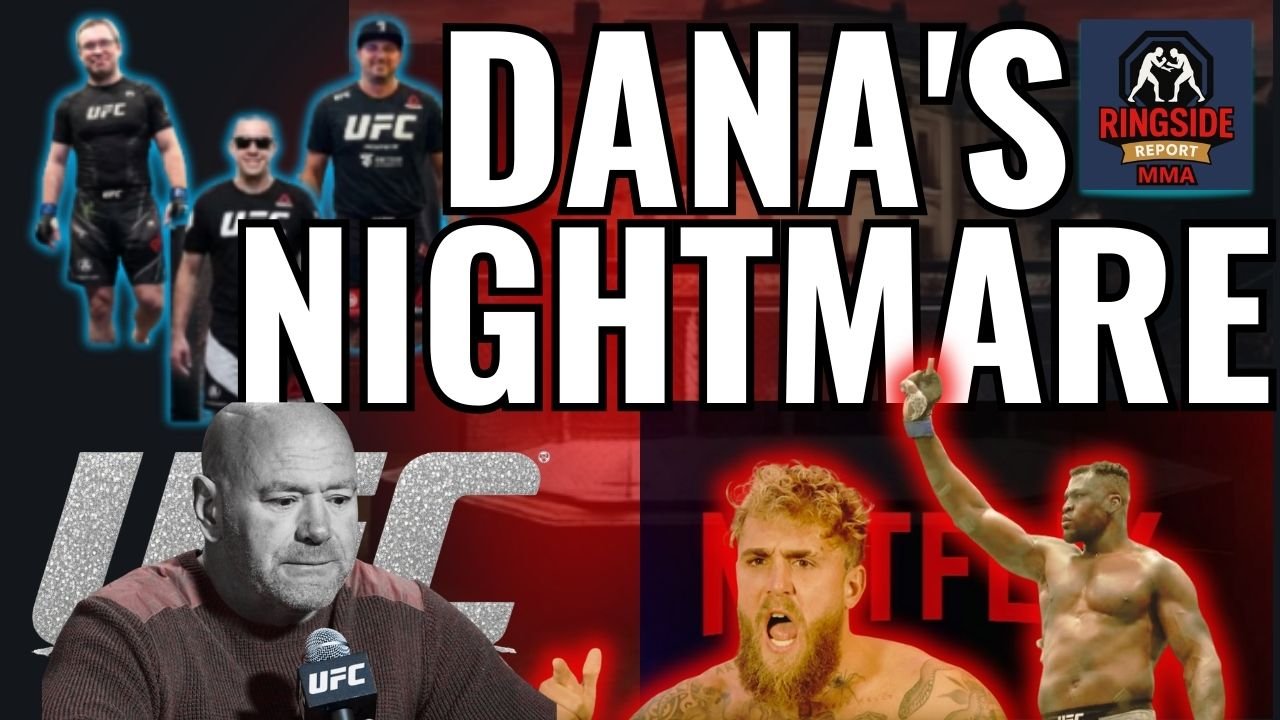
Dana White wants to put the Octagon on the White House lawn. The UFC White House card is officially the most talked-about rumour in combat sports, with names like Conor McGregor, Jon Jones, and even Francis Ngannou being floated for what could be the most ambitious event in UFC history. But while the promotion dreams of presidential real estate and supercard stacking, the reality of their 2026 booking strategy tells a very different story.
“There’s not a single fucking fight that they’re doing that I care about,” Dave Simon declared on this week’s Ringside Report MMA. “The UFC has not booked anything serious in 2026. They have not given us a single real fight where it is the champion versus the number one contender.”
That’s not hyperbole. That’s the math. And when Kayla Harrison announced she underwent neck surgery and is out indefinitely—cancelling her bantamweight title defence against Amanda Nunes—the UFC lost the only legitimate high-stakes fight they had scheduled for the first quarter of the year.
The Harrison-Nunes Cancellation: More Than Just One Fight
Kayla Harrison versus Amanda Nunes at UFC 324 wasn’t just another title fight. It was the collision of two Olympic-level judokas, two of the most decorated female combat sports athletes in history, fighting for the UFC Bantamweight Championship. For many fans, it was the main event of the January card, regardless of what the UFC officially billed it.
“In how many sports do you see women on top of that card where people are more excited than the men’s?” AJ D’Alesio asked during the show. “I was looking forward to Harrison fighting Nunes. That, to me, was the fight I wanted to see to start 2026, and it’s a shame.”
The cancellation hit particularly hard because of what it represents. Harrison’s neck surgery is legitimate—she released a video apologizing to fans and explaining the situation. Nobody’s questioning her professionalism or commitment. The problem is what her absence exposes about the UFC’s current approach to matchmaking.
Leor, a member of the Ringside Report community, put it perfectly in the live chat: “The Harrison Nunes fight cancellation is a good example of why I don’t watch UFC anymore. It’s such a waste of energy to get excited about fights that inevitably get cancelled. This was probably the biggest UFC fight in a long time. The rest of the cards lately are not great.”
Dave didn’t disagree. “Leor, right on the money there, 100%. He’s right.”
The 2026 Booking Problem Nobody Wants to Address
Here’s the uncomfortable truth about UFC’s first quarter of 2026: there isn’t a single numbered event featuring a legitimate champion versus the actual number one contender. Not one.
What are we getting instead? Paddy Pimblett versus Justin Gaethje for an interim lightweight championship. Let that sink in for a moment.
“Topuria is the real champion. Islam is the real champion. And Arman Tsarukyan is actually the number one contender,” Dave explained. “And you want to tell me to get excited about Paddy Pimblett and Justin Gaethje? That’s why guys like Leor aren’t watching the UFC anymore.”
The interim title epidemic has been a growing problem in the UFC for years, but 2026 seems to be taking it to new levels. When the promotion can’t—or won’t—book the fights that actually matter, they paper over the gaps with manufactured title stakes that mean nothing to anyone paying attention.
Is Paddy Pimblett the number one contender? No. Is Justin Gaethje? Also no. How many title shots has Gaethje had without ever capturing gold? The answer isn’t flattering for a supposed championship bout.
“How many shots at the belt has this guy had and never come up winning?” Dave asked rhetorically. It’s a fair question that the UFC hopes casual fans won’t think to ask.
The TKO Problem: Sizzle Without Steak
Dave Simon didn’t limit his criticism to the UFC alone. He identified a pattern that spans the entire TKO Group portfolio—the parent company that owns both the UFC and WWE.
“TKO has a model of giving you stuff but not actually giving you any meat. It’s a lot of sizzle, zero steak.”
This observation cuts to the heart of modern combat sports entertainment under corporate ownership. Both the UFC and WWE have been criticized for similar issues: big names, flashy production, constant content, but a lack of meaningful progression or stakes that reward long-term investment from fans.
“I’m seeing the same shit in both companies,” Dave continued. “And guess what? They’re owned by the same people. They have the same bosses. So what’s the common thread here?”
The answer, according to Dave, is a content-churning model that prioritizes quantity and brand recognition over competitive integrity. You get the stars. You get the pyro. You get the sizzle. But when you watch week after week, waiting for something meaningful to happen, you realize you’re being sold entertainment without substance.
“Do they have stars? Yeah. Sometimes. Are they doing anything meaningful? No. And that is across the board in the UFC and the WWE.”
AJ’s Defence: The Entertainment Value Argument
To his credit, AJ D’Alesio offered a counterpoint. While acknowledging the Harrison-Nunes loss hurts, he argued that the upcoming cards still feature recognizable talent worth watching.
“If you look on the card, man, you’re being a bit hard,” AJ pushed back. “We’re seeing guys like Justin Gaethje fighting, Paddy Pimblett, Sean O’Malley, Song Yadong. You got even Acosta, that’s really making his way to the top.”
AJ’s argument is essentially the entertainment-first perspective: these are known names, proven action fighters, and the cards will deliver violence even if they don’t deliver championship-level stakes.
“I think Dana knows, and Dana knows right. I think this is going to be an amazing card,” AJ said. “It’s going to be entertaining. And I think Dana knows right. I think this is going to be an amazing card.”
The question is whether entertainment without stakes is enough to sustain fan interest in the long term. For casual viewers who tune in occasionally, recognizable names might be sufficient. For dedicated fans who follow rankings, buildups, and championship implications? The current product feels hollow.
UFC White House: The Supercard That Could Change Everything
Against this backdrop of booking criticism, the UFC White House card represents something genuinely different. The rumours suggest Dana White isn’t just planning another pay-per-view—he’s planning a statement event that could feature multiple megastars on a single night.
The names being thrown around are staggering: Jon Jones, Conor McGregor, Alex Pereira, and potentially Francis Ngannou if his PFL contract is truly finished.
“Do you think there’s a chance they do a Jon Jones fight and a Conor McGregor fight on the same card?” Dave asked.
AJ’s response was emphatic: “100 percent. That would be the fight of all fights, and I can see that happening. If you’re going to go on the UFC White House, it’s got to be big. That will never happen again. It’s going to be something that will be like in the history books.”
The logic makes sense. A UFC event at the White House is unprecedented. It may never happen again, regardless of the political landscape. If you’re going to do it, you stack everything you have onto one night and create a spectacle that transcends the sport.
“You bring Jon Jones, you bring in Conor McGregor, and you bring in all the legends, man. You bring in Khabib, you bring Georges St-Pierre, you bring in Brock Lesnar, you get them ringside. You turn it into a madhouse at the White House.”
How the Paramount Deal Changes the Economics
Here’s where the business analysis gets interesting. Under the old pay-per-view model, the UFC had a strong incentive to spread stars across multiple cards. Each numbered event needed enough drawing power to justify the $80 price tag. Stacking everyone onto one card meant cannibalizing future revenue.
But the Paramount Plus deal fundamentally changes that calculus.
“The old way of thinking is you don’t want to pack one card because you don’t have anything left for the other cards, and you still have to sell pay-per-views,” Dave explained. “But they don’t have to sell pay-per-views anymore. With the Paramount deal, they’re getting paid no matter what.”
Under the streaming model, the UFC’s priority shifts from per-event revenue to subscriber acquisition and retention. If one supercard can drive a million new Paramount Plus subscriptions, it doesn’t matter if the next three events are relatively weak. The subscription revenue is already locked in.
“If they can get a million extra subscribers just based on some supercard that the UFC is going to do on one night that everybody in the world has to see, only on Paramount Plus, I think they’re going to be happy,” Dave said.
This means the UFC White House card could legitimately feature multiple championship fights and megastar attractions on a single night. The economic disincentive to stack cards no longer exists in the same way.
“They could theoretically do something nuts, like Jon Jones versus Pereira as the main event and Conor McGregor versus Nate Diaz as the co-main event. Like, they could. They could.”
The Conor McGregor Question: Who Does He Fight?
If Conor McGregor returns at the UFC White House card—and all signs suggest he wants to—the opponent question becomes critical. Dana White has already shot down the Michael Chandler fight that’s been teased for years.
“Dana White shot down the idea of Conor versus Michael Chandler,” Dave reported. “He said he was into that a few years ago, but he’s not anymore. But he didn’t shoot down the idea of Conor McGregor fighting at the White House.”
So if not Chandler, then who? Dave has a clear preference.
“To me, the clear answer is, and always has been, Nate Diaz. The trilogy fight is one that can always happen, always works. They’re one and one.”
The Conor-Nate rivalry is arguably McGregor’s most iconic. Their first fight at UFC 196 saw Diaz submit McGregor in one of the biggest upsets of the modern era. Their rematch at UFC 202 was a five-round war that McGregor won by majority decision. A trilogy fight at the UFC White House, with the added narrative of America versus Ireland, writes itself.
“I think Nate is Conor’s greatest rival,” Dave said. “So I think the Nate Diaz fight is really what you need to make.”
AJ offered an alternative perspective, suggesting Conor needs an opponent from Dagestan to recreate the tribal rivalry that made the Khabib fight so compelling. But Dave dismissed that as too volatile for a UFC White House setting.
“Those guys fight everybody everywhere,” Dave laughed. “Imagine those guys going bananas on the White House lawn.”
Other names floated during the discussion included Jorge Masvidal and even Anderson Silva, who has remained surprisingly active. But the Nate Diaz trilogy remains the fight that makes the most sense from both a competitive and narrative standpoint.
Francis Ngannou: The Wildcard Nobody Expected
Perhaps the most surprising development discussed was Francis Ngannou’s apparent availability. The former UFC Heavyweight Champion, who left the promotion in a contract dispute and signed with the PFL, is reportedly done with his PFL commitment.
“Francis Ngannou is saying his PFL deal is over,” Dave reported. “Could he be back?”
Ngannou fought only once for the PFL—a knockout victory over Renan Ferreira—before his contract apparently concluded. The circumstances are unusual, and it’s unclear exactly how a multi-fight deal ended so quickly.
“I just don’t understand how Francis is done his contract when he fought once for the PFL,” Dave admitted. “He was supposed to do all this stuff for the PFL and in the end, like, not really.”
AJ’s assessment was blunt: “It’s like a Coke can that’s been open for days. It loses its fizz. That’s exactly what happened with Francis. He’s not marketable anymore. No one knows him. And the only people that know him is us in the UFC.”
At 39 years old, Ngannou’s window is closing rapidly. Jon Jones is 38. If there was ever a time to make the Jones-Ngannou superfight that the UFC fumbled years ago, it’s now—and the White House card might be the only venue prestigious enough to justify bringing Ngannou back into the fold.
“Maybe we see Francis Ngannou versus Jon Jones at the White House,” Dave speculated. “They make that happen, I apologize to Uncle Dana for sure. For all the things I’ve said.”
Reality Check: Can Dana Deliver?
The Reality: The UFC White House card sounds incredible on paper. Multiple champions, returning legends, historic venue. But Dana White has a long track record of promising spectacles and delivering something considerably less. Until contracts are signed and fighters are in camp, every rumour should be treated as exactly that—a rumour designed to generate headlines and social media engagement.
The UFC’s 2026 booking problems don’t disappear just because one supercard might happen in the summer. Fans are frustrated, checking out, losing interest. A single great event doesn’t fix a systematic approach to matchmaking that prioritizes content volume over competitive integrity.
Moreover, the UFC White House card faces logistical and political challenges that normal events don’t. Security requirements alone could limit what’s actually possible. The date isn’t even confirmed—AJ asked if it’s July 4th, but Dave suggested June.
“Let’s hope he’s listening to the show because a lot of times when you say shit, he kind of does it,” AJ joked.
Maybe. But hoping Dana White delivers on his most ambitious promises requires ignoring years of evidence that suggests caution is warranted.
The Bigger Picture: What Does UFC Want to Be?
The tension between entertainment and sport lies at the heart of every criticism leveled at the UFC in 2026. Dana White has always positioned MMA as both a legitimate athletic competition and an entertainment spectacle. But when the entertainment packaging starts overshadowing the athletic competition, fans notice.
Interim titles for non-contenders. Champions fighting down the rankings. Superfights that prioritize name recognition over competitive merit. These aren’t isolated decisions—they’re a pattern that suggests the UFC has made a choice about what it wants to be.
“As a sport, and as a fan of the sport of MMA, I look at the major leagues of the sport, and I go, ‘Well, what is this now?'” Dave asked. “It’s not exciting. It’s not exciting.”
The hardcore fans want Islam Makhachev versus Shavkat Rakhmonov. They want Khamzat Chimaev to fight anybody with a pulse. They want champions tested by the best available challengers, not the most marketable.
“Give me Islam Makhachev against Shavkat Rakhmonov for the Welterweight title,” Dave demanded. “Do not give me Kamaru Usman bullshit.”
Whether the UFC listens depends on whether its metrics align with fan complaints. If pay-per-view numbers were the only measure, declining buy rates would force change. But under the Paramount streaming model, engagement is measured differently. As long as subscribers aren’t cancelling en masse, the current approach might be working exactly as intended—from the UFC’s perspective, if not from the fans’.
What Happens Next
The UFC returns to action next week with a card that, despite the loss of Harrison-Nunes, still features recognizable names and potential violence. Dave will be attending a WWE show in Montreal instead—a choice that says something about where his entertainment priorities currently lie.
“I will be attending a TKO event next week while the UFC is going on,” Dave noted. “I’ll be attending a different TKO event, a WWE Saturday Night’s Main Event show in Montreal.”
The UFC White House card remains in the rumour phase, with names being thrown around but nothing confirmed. Conor McGregor has tweeted about returning in 2026, which AJ interprets as more meaningful than previous years’ promises.
“In all the years that have passed, this is the year I’m confident Conor will be back,” AJ said.
Francis Ngannou’s situation remains fluid. If his PFL deal is truly over and bridges with Dana can be mended, the Jones-Ngannou fight becomes possible in a way it hasn’t been since 2023.
And somewhere, Kayla Harrison is recovering from neck surgery, her return timeline uncertain, the fight that should have headlined 2026’s opening quarter now indefinitely postponed.
The UFC’s sizzle continues. The steak remains elusive.
Watch Ringside Report MMA live every Thursday at 8 PM ET on YouTube, Rumble, Twitch, DLive, and Kick. Follow Dave Simon on Twitter/X @davesimonmma and AJ D’Alesio @danebruk.
Join the Ringside Report community at membership.ringsidereport.net and help support independent combat sports analysis.