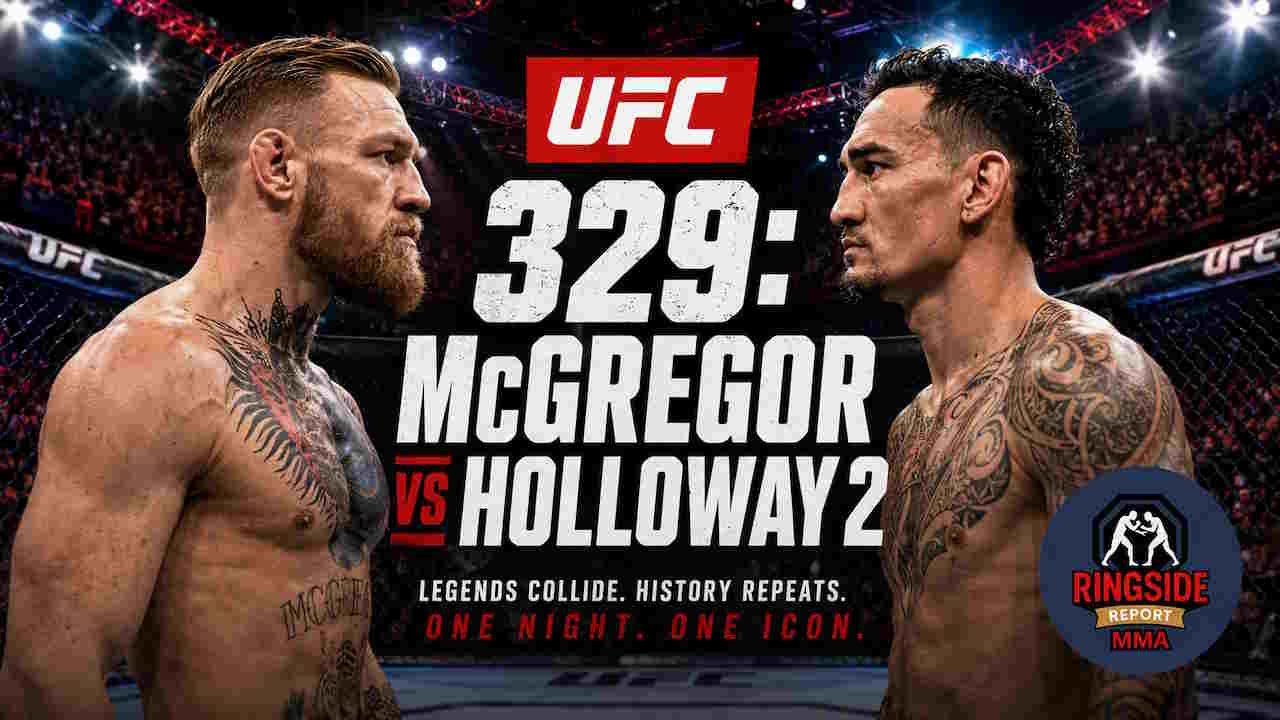

When the UFC announced UFC 329 McGregor vs. Holloway for July 11, 2026, at T-Mobile Arena in Las Vegas, the promotion framed it as a sequel thirteen years in the making. The original meeting in 2013 was a developmental bout between prospects. This rematch is something else entirely: a referendum on legacy, relevance, and whether either man can reclaim the throne he once held.

We have seen this pattern before. The UFC loves to resurrect old grudges and unfinished business, especially when star power has dimmed, and the company needs a jolt of nostalgia. But UFC 329: McGregor vs Holloway 2 is not simply a cash grab. Both fighters have traveled arcs that make the second chapter more compelling than the first.
The Weight of History
Conor McGregor won their first encounter by decision in Boston in August 2013. Holloway was twenty-one, still raw, still learning. McGregor was the brash Irishman on the rise, months away from his first title shot.
Everything that followed rewrote the sport. McGregor became the first simultaneous two-division champion, headlined the biggest pay-per-views in UFC history, and turned combat sports into a global spectacle. Holloway won the featherweight belt, defended it three times, and built a reputation as one of the most durable and technical strikers in the game.
By 2026, both men will no longer be champions. McGregor has not held a belt since 2016. Holloway lost his featherweight crown and has bounced between weight classes, chasing one more defining win. The rematch is not about who is better today. It is about who can prove they still belong in the conversation.
What the Rematch Reveals
McGregor’s return to the Octagon has always been a calculated gamble. He has fought sporadically since 2018, choosing opponents and moments that maximize spectacle and minimize risk. Holloway represents a different kind of test: a fighter who has evolved, absorbed losses, and adapted, who will not fold under pressure or to trash talk.
Holloway’s path has been the opposite. He has fought everyone, taken every challenge, and worn the miles on his face and record. His striking is sharper now, his defense more refined, his ability to adjust mid-fight unmatched. But the question remains whether his body can sustain another war, another five-round battle against a southpaw sniper who has built a career on finding the perfect counter.
The UFC has positioned this fight at T-Mobile Arena, the same venue that has hosted some of the sport’s biggest moments. The date, July 11, 2026, places it in the summer slot traditionally reserved for marquee events. The promotion knows what it has: two former champions, one rematch, and a narrative that writes itself.
The Stakes Beyond the Cage
Neither man needs this fight for financial security. McGregor has transcended the sport; Holloway has earned his place in the Hall of Fame conversation. What they need is validation. McGregor needs to prove he can still compete at the highest level, that his name is not just a relic of a bygone era. Holloway needs to prove he can beat the one man who has always loomed in the background of his career, the fighter who handed him his first UFC loss.
The broader context is equally important. The UFC has struggled to build new stars with the same crossover appeal McGregor once commanded. The sport has become more technical, more strategic, and in some ways less accessible to casual fans. A McGregor fight still moves the needle, still generates headlines, still reminds the world why mixed martial arts matters.
But nostalgia only carries so much weight. If the fight is a one-sided beatdown, if McGregor looks slow or Holloway looks shot, the rematch will feel like a mistake. If both men rise to the occasion, if the fight delivers the drama and skill the first one lacked, then UFC 329 will justify its existence.
We do not expect perfection. We expect honesty, effort, and a fight that respects what both men have accomplished. The UFC has given us the rematch; now McGregor and Holloway must give us a reason to care.