Judo, “the gentle way,” is a globally respected martial art and Olympic sport with a deep history and a structured path to mastery. Central to this path is its belt ranking system—a pioneering method that countless other martial arts have since adopted. But what do the different judo belt colors signify, and how does judo compare to similar grappling arts?
This guide will explain the complete judo belt system, created by its founder, Jigoro Kano. We’ll cover the student-level “Kyu” grades, the expert-level “Dan” grades, the meaning behind each belt, and how a practitioner, or “judoka,” advances through the ranks. Whether you’re a new student or a curious fan, this is your definitive resource for understanding every color in the judo belt hierarchy.
Judo Belts 101

Key Takeaways
- The Original Belt System: Jigoro Kano, the founder of Judo, created the first martial arts belt ranking system in 1883 to visually represent a student’s progress.
- Two Tiers of Ranks: The judo belts system is divided into Kyu grades (colored belts for students) and Dan grades (black belts for experts).
- Progression Through Knowledge: Advancing requires not only proficiency in throws and groundwork but also an understanding of judo’s philosophy, kata (forms), and a demonstration of character.
- Beyond Black: Judo is renowned for its advanced Dan ranks, which include the iconic red-and-white striped belt and the solid red belt reserved for the highest masters.
Judo Belt System at a Glance
The History: An Invention of Modern Martial Arts
The idea of a colored belt to denote rank is the invention of Judo’s founder, Jigoro Kano. Before he established the system, there was no external way to signify a student’s level. Kano wanted a way to structure learning and motivate his students. He began by awarding black belts to his most senior students, signifying their mastery of the fundamentals.
The Kodokan Judo Institute, which Kano founded in 1882, remains the world headquarters for Judo and the ultimate authority on judo belt ranking standards. The International Judo Federation (IJF) now governs Olympic and international competition.
Later, Kano developed the colored Kyu grades for the students below black belt, creating the tiered system that has become the standard for martial arts around the world. This structure influenced later grappling arts, including catch-as-catch-can wrestling and modern Brazilian Jiu-Jitsu, which developed its own distinct belt system.
Judo Belt Order: The Complete Visual Guide
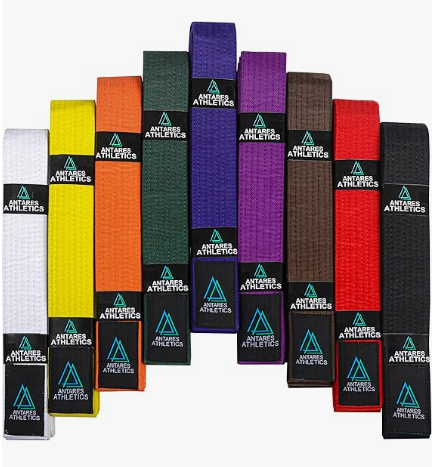
The following chart shows the complete judo belt order at a glance — from the white belt of a brand-new student all the way to the red belt of a grandmaster. Each color in the judo belts progression represents a distinct stage of technical and personal growth.
The Kyu Ranks: The Student’s Journey
The path for every judoka begins with the Kyu (級) grades. This is the student level of the judo belts system, where the focus is on learning fundamental principles, breakfalls (ukemi), throws (nage-waza), and grappling (ne-waza). While the specific order of colors can vary by country and organization, a typical progression in North America is:
White Belt (Rokkyu – 6th Kyu): The start of the journey, symbolizing purity and a clean slate. The focus is entirely on safety, fundamentals, and learning the dojo’s rules and etiquette.
Yellow Belt (Gokyu – 5th Kyu): The first promotion. The student has a grasp of basic movements, breakfalls, and a few simple throws.
Orange Belt (Yonkyu – 4th Kyu): The student demonstrates more control and a better understanding of leverage and balance (kuzushi).
Green Belt (Sankyu – 3rd Kyu): A stage of significant technical development. The student can execute a wider variety of throws and has a foundational understanding of pins and holds on the ground.
Blue Belt (Nikyu – 2nd Kyu): An advanced student level. The judoka’s movements are becoming more fluid, and they begin to develop combinations and tactical thinking in sparring (randori).
Brown Belt (Ikkyu – 1st Kyu): The final step before black belt. The brown belt is an expert in all the fundamental aspects of judo and is polishing their skills in preparation for the Dan-level examination.
Ringside Report Network’s Combat Sports Gym Finder
Find BJJ, Boxing, Muay Thai & more near you
Enter your location, select disciplines,
then search to find combat sports gyms nearby
The Dan Ranks: A Lifetime of Mastery
Achieving the rank of black belt, or Dan (段), is a sign of expertise, but in the philosophy of Judo, it signifies that one’s real journey is just beginning. The Dan ranks represent the most recognizable stage of the judo belts hierarchy.
- Black Belt (Shodan – 1st Dan): It typically takes 3-6 years of dedicated training to earn a Shodan. The judoka has mastered the core curriculum and is now considered a serious student, ready to delve deeper into the art.
- 2nd Dan (Nidan) to 5th Dan (Godan): These are advanced black belt ranks achieved through years of continued training, coaching, and contributions to the Judo community. Practitioners at this level have a profound understanding of technique and philosophy.
- The Master Ranks (6th to 10th Dan): These ranks represent the pinnacle of Judo.
- 6th (Rokudan) to 8th (Hachidan) Dan: Practitioners may wear the iconic red-and-white paneled belt. This signifies a master teacher who has made significant contributions to the art of Judo.
- 9th (Kudan) and 10th (Judan) Dan: These masters are permitted to wear a solid red belt. This rank is exceptionally rare and represents a lifetime of complete dedication to the art and its principles. Only a handful of individuals have ever been promoted to 10th Dan by the Kodokan, the world headquarters for Judo.

Notable 10th Degree Red Belt Holders
The 10th degree red belt represents the absolute pinnacle of judo achievement, awarded to those whose contributions have shaped the art itself. Only a handful of practitioners outside Japan have ever earned this distinction — the highest honor in the judo belts ranking system.
Gene LeBell stands as one of the most remarkable American judokas to achieve this rank. Known as “Judo Gene,” LeBell won back-to-back AAU National Judo Championships in 1954 and 1955, capturing both heavyweight and overall titles. He trained extensively at the Kodokan in Japan and was ultimately awarded the 10th degree red belt—a recognition of his lifelong dedication to the art and his immeasurable contributions to spreading judo and grappling arts throughout the United States.
LeBell’s significance extends beyond competitive achievement. He bridged the gap between traditional judo and modern mixed martial arts, training champions like Ronda Rousey (whose mother, AnnMaria De Mars, was also an elite judoka) and influencing generations of fighters. His 10th-degree rank acknowledges not just technical mastery but also a lifetime spent advancing the art. Today, judo’s influence on MMA is undeniable—fighters like Islam Makhachev use their judo base to dominate at the highest levels, and Georgian judoka are rapidly emerging as a force in the UFC.
How Judoka Get Promoted
Promotion through the judo belts is a formal process. It’s not just about winning in competition. A grading exam typically includes:
- Technical Demonstration: Executing specific throws, pins, chokes, and armlocks with precision.
- Kata: Performing pre-arranged forms that contain the fundamental principles of Judo. The Nage-no-Kata (Forms of Throwing) is a common requirement for the first black belt.
- Randori (Sparring): Demonstrating effectiveness and composure in live, unscripted sparring against a resisting partner.
- Knowledge: Understanding the Japanese terminology and the principles of Judo.
How Long Does Each Judo Belt Take?
One of the most common questions about judo belts is how long it takes to progress through the ranks. The timeline below shows approximate durations for dedicated adult practitioners training 2-3 times per week. Competitive judoka who enter tournaments regularly may advance through the Kyu ranks faster.
Competitive judoka may advance faster through the Kyu ranks. · Ringside Report Network
How Do Belt Colors Differ Between Organizations?
Not all judo belts follow the same color sequence. The order can vary depending on the country and governing body. Here are the key differences:
- Japan traditionally uses a simpler system with just white and black belts for adults
- Some organizations, like Judo Canada, incorporate half-belts (e.g., white-yellow, yellow-orange) to show intermediate progress
- The USA has multiple governing bodies (USJA, USJF, USA Judo) with slightly different systems
- The IJF does not standardize Kyu ranking belt colors across countries and organizations
| Organization | 6th Kyu | 5th Kyu | 4th Kyu | 3rd Kyu | 2nd Kyu | 1st Kyu |
|---|---|---|---|---|---|---|
| Kodokan (Japan) | White | White | White | White | White | White |
| IJF Europe | White | Yellow | Orange | Green | Blue | Brown |
| USA Judo | White | Yellow | Orange | Green | Blue | Brown |
| British Judo | Red | Yellow | Orange | Green | Blue | Brown |
| Judo Canada | White | Yellow | Orange | Green | Blue | Brown |
| Australian Judo | White | Yellow | Orange | Green | Blue | Brown |
| French Judo | White | Yellow | Orange | Green | Blue | Brown |
| German Judo | White | Yellow | Orange | Green | Blue | Brown |
Note: Some organizations may use additional intermediate belts or stripes between these main colors. Dan grades (black belt and above) are standardized across all organizations.
Judo’s Growing Influence on Modern MMA
Understanding judo belts and the depth of training they represent helps explain why judo-trained fighters are increasingly dominant in mixed martial arts. The throws, trips, and ground control techniques that judoka spend years perfecting translate directly into the cage.
Ronda Rousey famously used her judo background to become the first women’s UFC champion, and today a new wave of judo-based fighters is reshaping MMA strategy. Islam Makhachev’s judo-influenced grappling has made him one of the most dominant champions in UFC history, while Georgian judoka like Lasha Bekauri are bringing elite-level grip fighting into the sport. The growing trend of combat sports cross-training means understanding the judo belt system gives fans a deeper appreciation of the skill levels these fighters bring to MMA.
Summary
The judo belt system is a comprehensive and structured pathway for judokas, guiding them from the initial stages of learning to advanced mastery. Each belt color represents a unique stage of development, reflecting the judoka’s growth in both technical skills and personal values. From the white belt, symbolizing a clean slate, to the black belt, indicating deep mastery and commitment, the journey through the judo belts is one of continuous learning and improvement.
The impact of the judo belt system extends beyond the dojo, fostering discipline, respect, and camaraderie among practitioners. As judokas progress through the ranks, they enhance their martial arts skills and grow as individuals, embodying the principles and philosophy of judo.
Frequently Asked Questions
How long does it take to get a black belt in Judo?
For a dedicated student training consistently, the average time to achieve the rank of Shodan (1st-degree black belt) is 3 to 6 years.
What is the main difference between Judo and BJJ belts?
While BJJ’s system was derived from Judo, there are key differences. BJJ has fewer colored belts before the black belt (typically white, blue, purple, brown). Also, the time spent at each rank in BJJ is generally much longer, and it often takes 8-12 years to earn a black belt. See our complete BJJ belt guide for more details.
What is Randori?
Randori is the term for “free practice” or live sparring in Judo. It’s a crucial part of training where judoka attempt to apply their techniques against a fully resisting partner.
Is Judo effective for self-defense?
Yes. Judo is highly effective for self-defense, as it uses an attacker’s own momentum to throw, unbalance, and control them on the ground with pins and submissions.
Who are some notable 10th-degree red belt holders?
Gene LeBell is one of the most famous American judokas to earn the 10th degree red belt. He won back-to-back AAU National Judo Championships (1954-1955), trained at the Kodokan in Japan, and spent his lifetime spreading judo and grappling arts throughout the United States while training champions like Ronda Rousey.
What’s the difference between Judo and Jiu-Jitsu?
Judo emphasizes standing throws and takedowns, while Jiu-Jitsu (particularly Brazilian Jiu-Jitsu) focuses more on ground fighting and submissions. Both share common roots in traditional Japanese Jujutsu. Read our detailed Judo vs Jiu-Jitsu comparison to understand which might be right for you.
What color belt is the highest rank in Judo?
The highest rank in the judo belt system is the solid red belt, worn by 9th and 10th Dan holders. Only a handful of people have ever been awarded 10th Dan by the Kodokan. Below that, the red-and-white paneled belt is worn by 6th through 8th Dan masters.
Continue Your Martial Arts Education
Explore more belt systems and combat sports fundamentals:
Belt System Guides:
- Karate Belt Order: What Each Rank Really Means
- Brazilian Jiu-Jitsu Belts 101: The Complete Ranking Guide
- 10th Planet Jiu-Jitsu’s Belt System Explained
- Taekwondo Belts 101: Meaning, Order, and Progression
Grappling & Technique Guides:
- Before MMA: A Guide to Catch-As-Catch-Can Wrestling
- The Art of the Finish: Top 10 Chokes That Define Modern MMA
- The Great Escape: How to Survive the 5 Most Common MMA Chokes
- Submission Techniques: Most Popular Choices in MMA
- Grappling in MMA: Takedowns, Clinches, Throws, and Ground Control
- Why Combat Sports Cross-Training Is No Longer Optional in 2026
Legends:
- Gene LeBell: The Godfather of Grappling — The story of the man who earned judo’s highest honor while bridging traditional martial arts and modern MMA.