
The UFC has never had a week quite like this one. Ten days out from the biggest spectacle in the company’s history, its reigning middleweight champion is publicly attacking the event, trading insults with one of its main eventers, and getting himself frozen out of the guest list entirely. Sean Strickland versus the White House card is a story with no precedent in UFC history — and it’s somehow only the second most consequential thing happening this week.
Because on Saturday night at the Apex, Belal Muhammad vs Gabriel Bonfim headlines a card that will quietly decide whether a former welterweight champion still belongs at the top of the division, or whether another young Brazilian lion takes his place. And buried under all of it: pay-per-view in Canada just got a death date.
Sean Strickland Banned From the White House? UFC Vegas 118 Picks & PPV Dies in Canada
Key Takeaways
- Sean Strickland — the newly crowned two-time middleweight champion — says he’s blacklisted from UFC Freedom 250 at the White House, and his social media war with Justin Gaethje is the ugliest public feud between a champion and a main eventer in memory.
- Belal Muhammad vs Gabriel Bonfim at UFC Vegas 118 is a true crossroads fight: oddsmakers are split almost down the middle, and a third straight loss would put the former champion’s future in real question at 37.
- Pay-per-view is dead in Canada as of January 2027 — every numbered UFC event moves to Paramount+, the same deal American fans already have.
No UFC Champion Has Ever Done What Sean Strickland Is Doing
Let’s get the context straight first, because it matters. Sean Strickland is not some fringe contender popping off for attention. He is the UFC middleweight champion — a two-time champion now — after handing Khamzat Chimaev the first loss of his career at UFC 328. Strickland has been written off before and made people pay for it, and you can make a legitimate argument that the man is the best active middleweight on the planet right now. He holds the belt. That’s how this works.
And yet, with UFC Freedom 250 set for the White House lawn on June 14, the champion of the company’s marquee division says he’s not allowed to attend. Not left off the card — not allowed to go. Strickland has been calling himself blacklisted, and rather than quietly taking it, he’s been doing the most Sean Strickland thing imaginable: posting through it, loudly, daily, and at everyone — the event, the main eventers, the government hosting it, all of it.
That’s where Justin Gaethje enters the picture. Gaethje, who challenges Ilia Topuria for the featherweight title in the Freedom 250 main event, took exception to Strickland invoking his name and responded with some of the most vicious language we’ve ever seen one elite fighter aim at another in public — calling Strickland a coward, questioning his patriotism, and telling him he and his associates are, to sanitize it considerably, relentlessly dumb. Strickland fired back that Gaethje should switch flags.
Gaethje countered that Strickland bashes America every chance he gets and shouldn’t expect to set foot on White House grounds. This is the UFC middleweight champion and the company’s featherweight title challenger, ten days before the biggest event in promotional history, conducting a public flame war about patriotism, foreign policy, and who is or isn’t a real American.
Here’s the thing, though — the story isn’t whether Strickland is right or wrong on the substance. He’s throwing so much at the wall that some of it is misinformation, some of it is internet conspiracy soup, and occasionally there’s a kernel of truth buried in the web of confusion. Trying to fact-check Sean Strickland in real time is a losing proposition.
The story is structural: no UFC champion has ever publicly campaigned against a UFC event before. Not once. Champions have grumbled about pay, about matchmaking, about rankings.
No champion has ever stood up and said a marquee show shouldn’t be happening at all. When the UFC ran the Sphere, nobody boycotted. But when you stage a show on the White House lawn, you invite politics into the Octagon — and politics showed up wearing a middleweight strap.
It’s also worth noting what this is costing him. Strickland was never going to be a corporate darling, but there’s a difference between being controversial and picking a side. Controversy sells. Sides cut your audience in half. Every fighter who has ever monetized an outrageous persona understood that the persona works because it offends everyone equally.
Strickland picking specific political fights — with the event, with Gaethje, with the administration hosting it — is cutting off money with both hands. Whatever you think of his positions, it is objectively terrible business.
Meanwhile, the collateral damage is spreading. Bryce Mitchell — who fights Santiago Luna at the Apex this Saturday — spent his fight-week press conference fielding questions about Strickland and the White House instead of his own bout. Asking Bryce Mitchell to weigh in on geopolitics is a choice that has historically gone very badly, and the fact that the media keep handing him the microphone anyway tells you everything about where the attention is this week. Some of these guys need to shut up and fight — and some reporters need to let them.
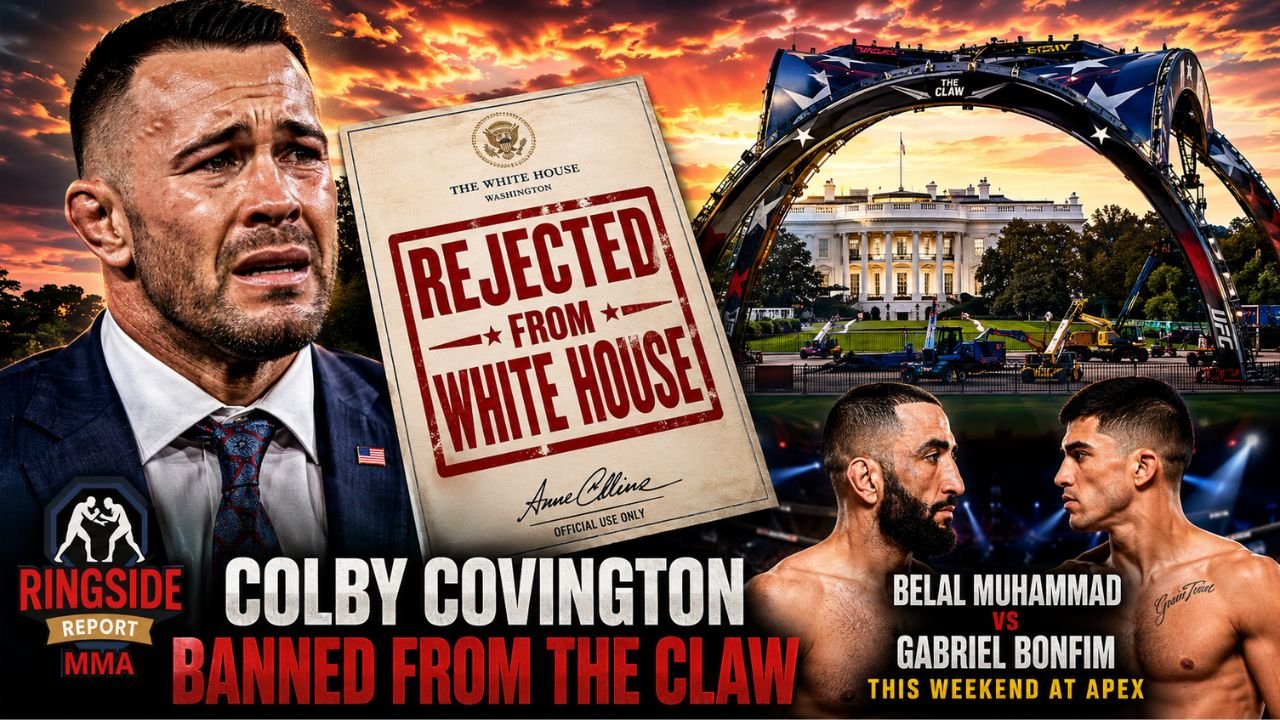
And in the strangest footnote of the week: Colby Covington, the man who built a career on wanting to be at exactly this kind of event, beat Chris Weidman on points at a Real American Freestyle wrestling card over the weekend. He’s not a UFC athlete anymore, he’s not booked to fight anyone, and he remains fascinated with attaching himself to the White House show. The wrestling win was legitimate, and the RAF lane suits him — but nobody’s experience at Freedom 250 is going to be enhanced by a Covington crowd shot.
The Claw Is Built — And the UFC Is Losing Money on It
The structure is real, it’s finished, and it’s enormous. The fan-dubbed “Claw” — the towering grandstand-and-canopy build dominating the White House lawn — looks less like a fight venue and more like a movie set, with the Washington Monument framed behind it.
Donald Trump has even floated the idea that the structure could become permanent, which seems unlikely given what event infrastructure does to grass, but the fact that it’s even being discussed tells you the scale of the thing. Production-wise, this will be unlike anything combat sports have produced: outdoors, at night, at the seat of American power. Spectacular or dystopian, depending on your vantage point — possibly both.
Here’s the under-discussed part: the UFC is almost certainly losing money on this event, and doing it on purpose. There’s no gate to speak of. There are no pay-per-view sales, because the Paramount deal is already locked in — the UFC doesn’t earn an extra dollar no matter how many people watch.
The build cost is enormous, the lawn restoration afterward is real money, and the upside is merchandise and marketing value. This is a prestige play, pure and simple: a global advertisement for the brand, paid for out of pocket. It’s already pulled Jon Jones back out of retirement, and the card itself is legitimately loaded — Alex Pereira vs Ciryl Gane for the light heavyweight title, and Justin Gaethje challenging Ilia Topuria in the main event.
And the calendar after it doesn’t slow down. Conor McGregor’s long-teased return finally lands in July against Max Holloway. After what has felt like a dead zone for months, the UFC suddenly has the most consequential eight-week stretch it has run in years: White House, McGregor, and a champion at war with all of it.
Did You Know?
Gabriel Bonfim is a former professional boxer, and his lone career loss sits next to 19 wins. His last four Octagon appearances are all victories, including a TKO of Randy Brown and a split decision over Stephen “Wonderboy” Thompson — and at 28, he’s hitting his physical prime exactly as the welterweight division’s old guard starts aging out.
Belal Muhammad vs Gabriel Bonfim Is a Career-Defining Crossroads
Saturday’s UFC Vegas 118 main event at the Apex is exactly what a Fight Night headliner should be: a fight with real divisional consequences that the oddsmakers genuinely cannot agree on. Some books have Belal Muhammad at -130 with Bonfim at +102. BET99 flips it entirely — Bonfim -120, Muhammad -110. Polymarket gives the former champion a 54 percent implied probability. When the market is that split, it usually means both outcomes are easy to picture. They are.
The case for Belal Muhammad starts with the résumé. This is the man who dominated Leon Edwards to win the welterweight title, and his two losses since — dropping the belt to Jack Della Maddalena, then a decision against Ian Machado Garry — came against the absolute top of the division, both on the scorecards, neither a beatdown. He’s still elite. He still has championship cardio, a relentless wrestling-first fight IQ, and the ability to turn any fight into a five-round grind that nobody enjoys but him. If this one goes to the judges, it likely goes his way.
The case for Gabriel Bonfim is simpler: he’s 19-1, he’s 28, and he finishes people. The former pro boxer has genuinely dangerous hands; he marches forward, and his grappling is aggressive enough — and likely good enough — to keep this fight standing long enough to land something heavy. Yes, this is a step up.
The Wonderboy win came against a 42-year-old version of Thompson, and Bonfim has never faced anyone with Muhammad’s blend of pressure and control. He has to prove he belongs at this level. But that’s exactly what this card was designed for: either a young lion makes his name off a former champion, or Belal Muhammad reminds everyone he’s still there.
The stakes are brutally asymmetric, and that’s what makes it compelling. If Bonfim loses, he’s a 28-year-old prospect who took his first big swing too early — no lasting damage. If Muhammad loses, that’s three in a row at 37, with the third coming against lower-ranked competition than the first two.
That’s the kind of streak that moves a former champion from “rebuilding” to “people openly asking whether he should still be doing this.” Five rounds give Belal time to impose the wrestling; it also gives Bonfim ten extra minutes to find a chin. The read here: Bonfim has more ways to win — the knockout power Belal simply doesn’t carry, plus good enough takedown defence to keep it upright — but if it goes the distance, expect a razor-thin 48-47 that could land on either side of the table.
The Co-Main: Brendan Allen vs Edmen Shahbazyan
The co-main event is a quietly excellent middleweight matchup between two contenders trending up at the same time. Brendan Allen, 26-7, rides two straight wins, including a victory over Reinier de Ridder, and sits firmly in the top tier at 185. Edmen Shahbazyan, 16-5, has rebuilt himself impressively with three consecutive wins after his early-career hype train derailed.
The stylistic shape is clear: Shahbazyan wants to keep it standing and use his boxing and natural power; Allen, a -190 favourite, wants to walk him down, get the body lock, and drag him into deep grappling water. Shahbazyan’s takedown defence has improved, but Allen’s submission game is a different tier than anything he’s defended recently. If it hits the mat, it likely ends there.
Pay-Per-View in Canada Has Six Months to Live
The news Canadian fans have waited a year for is finally official: starting in January 2027, UFC pay-per-view will no longer be available in Canada. Every numbered event moves to Paramount+, exactly the way American fans already get them. We called the death of pay-per-view when the Paramount deal first landed, and the Canadian carve-out was always living on borrowed time. Now it has an expiration date: roughly six more months of $80 buys, and then a single streaming subscription covers the whole calendar.
For Canadian MMA fans, this is an unambiguous win — dramatically cheaper, no per-event decision fatigue, no more watching American fans enjoy a deal you can’t have. The one open question is what happens to the sports bars that have built UFC pay-per-view nights into their business model. Commercial licensing in a streaming-first world is genuinely unsettled territory, and bar owners deserve a clearer answer before January than they currently have. We’ll be following up on that one.
A Heavier Note: Remembering Ava
This week’s episode was dedicated to Ava Ciampini, a three-year-old girl from the Montreal area who lost her life in a tragic accident at a local park — one of those inflatable bounce house incidents you hear about on the news and assume could never happen close to home, until it does. Our hearts are with the entire Ciampini family, who are beloved in this community. A GoFundMe has been set up to help the family at gofundme.com/f/ciampini-family, and we’d encourage anyone who can to contribute. Hug your kids tight. Nothing in this sport — or any sport — matters more than that.
The Bottom Line
The next ten days will tell us a lot about what the UFC actually is in 2026. A champion in open revolt against the company’s crown-jewel event is uncharted territory, and how the UFC handles Sean Strickland — punish him, ignore him, or quietly book him into a buzzsaw — will set a precedent for every outspoken fighter who comes after. Saturday at the Apex, Belal Muhammad either holds the line for the old guard or hands the welterweight division another new name to learn. And in Canada, the pay-per-view era is finally, mercifully, dying. The sport is louder, stranger, and more political than it has ever been. It’s also more watchable than it has been in years. Both things are true at once.
Why is Sean Strickland banned from the UFC White House event?
Sean Strickland, the reigning UFC middleweight champion, says he has been blacklisted from UFC Freedom 250 at the White House on June 14, 2026, after publicly criticizing the event, the administration hosting it, and related political issues. The UFC has not issued an official statement on his status, but Strickland maintains he is not allowed to attend.
What is the Sean Strickland vs Justin Gaethje feud about?
Justin Gaethje, who faces Ilia Topuria in the UFC Freedom 250 main event, responded to Strickland’s criticism of the White House event with a series of hostile social media posts questioning Strickland’s patriotism. Strickland fired back, telling Gaethje to switch flags, and the exchange escalated into one of the ugliest public feuds between two elite UFC fighters in recent memory.
Who is favoured in Belal Muhammad vs Gabriel Bonfim?
Oddsmakers are split. Some books list Belal Muhammad at -130 with Gabriel Bonfim at +102, while BET99 has Bonfim favoured at -120 with Muhammad at -110. Polymarket gives Muhammad a 54 percent implied win probability. The fight headlines UFC Vegas 118 at the Apex on June 6, 2026.
What is at stake for Belal Muhammad against Gabriel Bonfim?
Belal Muhammad, 37, has lost two straight decisions — to Jack Della Maddalena, where he lost the welterweight title, and to Ian Machado Garry. A third consecutive loss, this time to a lower-ranked opponent, would raise serious questions about the former champion’s future at the top of the division.
When does UFC pay-per-view end in Canada?
Starting January 2027, all numbered UFC events in Canada will move to Paramount+, ending traditional pay-per-view purchases. Canadian fans will get the same all-inclusive streaming arrangement American fans already have, leaving roughly six months of pay-per-view remaining as of June 2026.
What fights headline UFC Freedom 250 at the White House?
UFC Freedom 250 takes place June 14, 2026, on the White House lawn. Ilia Topuria defends the featherweight title against Justin Gaethje in the main event, and Alex Pereira faces Ciryl Gane for the light heavyweight championship. Conor McGregor returns the following month, in July, against Max Holloway.