In the high-stakes world of Mixed Martial Arts, a fight can end in a heartbeat. While knockouts make the highlight reels, the technical application of a choke often decides who leaves the cage with the win. For fans and fighters alike, understanding these submissions is the key to appreciating the grappling chess match that unfolds on the canvas.
Whether you are watching Ringside Report MMA on Thursdays to catch the latest UFC breakdowns or you’re a practitioner yourself, this guide breaks down the mechanics behind the sport’s most dangerous maneuvers.
⚡ Quick Facts: MMA Chokes
Key Takeaways: The Science of the Squeeze
- Blood vs. Air: Most MMA finishes are blood chokes (restricting the carotid arteries). These are faster and more efficient than air chokes (crushing the windpipe).
- The Big Three: The Rear-Naked Choke, Guillotine, and Triangle account for the vast majority of all submission wins in professional MMA.
- Position Before Submission: Control is the key that unlocks the lock. You must secure a dominant position before hunting the neck.
- Deep Roots: Many of these techniques trace back to Judo and Catch Wrestling, refined over decades for modern competition.
📊 By the Numbers: According to UFC statistics, the Rear-Naked Choke accounts for over 35% of all submission victories in UFC history. The Guillotine and Triangle round out the “Big Three,” combining for nearly 70% of all choke finishes. Source: UFCStats.com
1. Rear-Naked Choke (RNC): The Undisputed King
The RNC is the most successful submission in MMA history. Applied from the back, it leaves the opponent with almost no room to counter.
The Technical Secret: It is called “naked” because it doesn’t require a Gi. The attacker snakes one arm under the opponent’s chin and hides the other hand behind the opponent’s head to prevent escape.
The Man Who Proved It First: Gene LeBell’s Historic RNC
Long before the UFC existed, the devastating effectiveness of the Rear-Naked Choke was proven in one of combat sports’ most legendary moments. In 1963, Gene LeBell—a Judo black belt and professional wrestler—faced boxer Milo Savage in a highly publicized mixed-rules bout in Salt Lake City.
The fight was meant to settle the age-old debate: could a grappler beat a striker? LeBell answered definitively. After weathering Savage’s punches and closing the distance, LeBell took the boxer’s back and sunk in the RNC. Savage was choked unconscious in the fourth round—one of the first documented instances of a rear-naked choke finish in American combat sports history.
This victory, decades before the Gracie family brought Brazilian Jiu-Jitsu to mainstream attention, established the template that would define MMA submissions. LeBell’s triumph demonstrated what every modern fighter now knows: once the back is taken and the choke is locked, the fight is essentially over.
🛡️ Defensive Tip: Survival 101
The Secret: Drop your chin and “two-on-one” the choking arm immediately. Pulling the wrist down prevents the second hand from locking behind your head. [Read our Complete RNC Escape Guide Here]

2. Guillotine Choke: The Takedown Tax
Often the “go-to” weapon for punishing a sloppy takedown, the Guillotine is a front-facing blood choke that can be finished from the feet or the floor.
- How it Works: The attacker wraps one arm under and around the opponent’s neck, clasping the opponent’s hands. They then arch their back and lift, constricting the carotid arteries.
- Elite Finishers: UFC veteran and the UFC’s all-time submission leader Charles Oliveira, has turned the Guillotine into a terrifying art form.
🛡️ Defensive Tip: Beat the Guillotine
The Secret: Don’t stay in front of them! Move your body to the side opposite your trapped head. This “clears the line” and makes the finish impossible. [See the 3-Step Guillotine Escape]
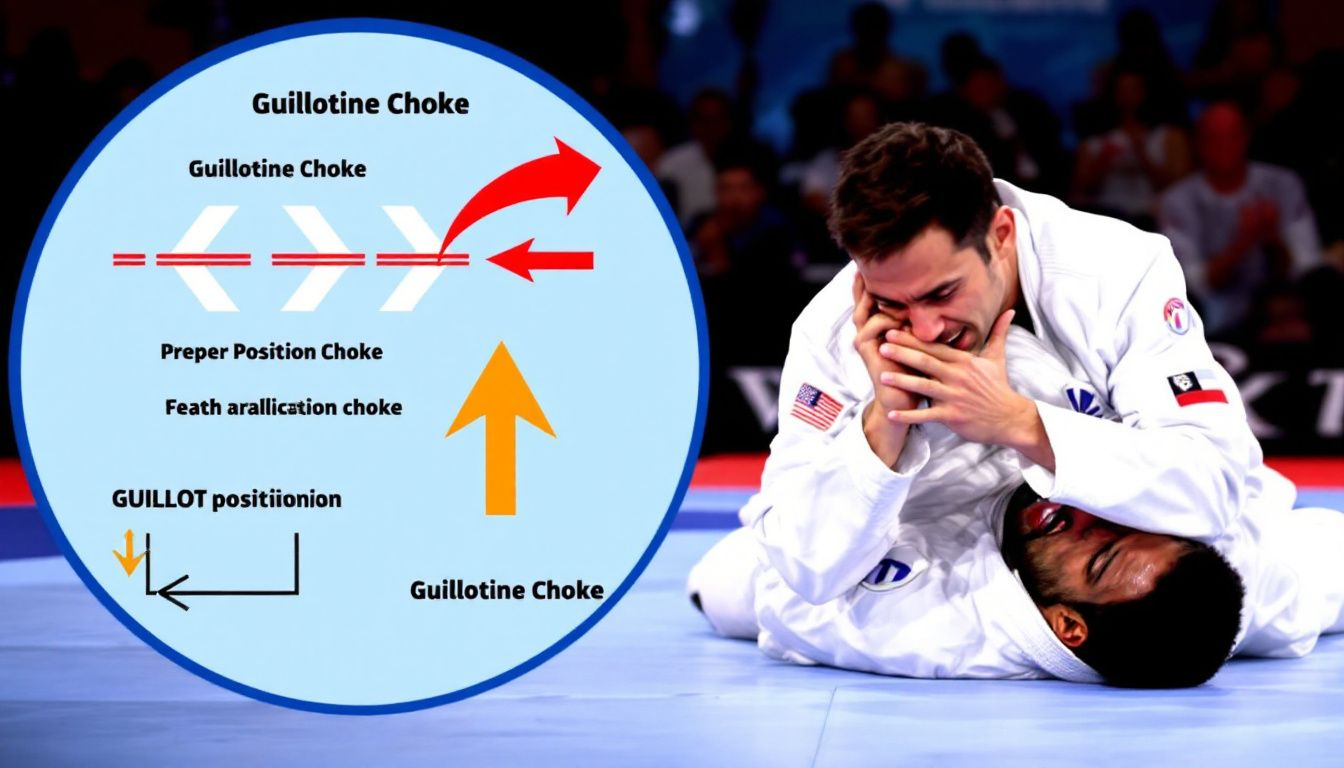
3. Triangle Choke: The Guard’s Greatest Weapon
A classic from the bottom position, the Triangle uses the attacker’s legs to form a figure-four lock around the neck and one arm.
Watch the Technique: How to Do the Triangle Choke
The “Pre-Triangle” Setup: Success starts by achieving the “one arm in” position. Once you clear the shoulder, the leg locks over the ankle to finish. This fundamental technique is taught across all major IBJJF-certified academies worldwide.
🛡️ Defensive Tip: Breaking the Triangle
The Secret: Posture is your best friend. Look at the ceiling and stack your weight onto the opponent. If you can’t posture up, you can’t escape. [How to Posture Out of a Triangle Choke]
4. Arm-Triangle Choke: The Heavyweight Squeeze
Typically applied from the mount, this choke uses the opponent’s own shoulder to help cut off their blood flow.
The “Sprawl” Finish: The finisher often dismounts to the side and “sprawls” their weight downward to create a crushing pressure.
How it Works: The attacker pushes the opponent’s arm across their throat and then wraps their own arms around the head and trapped arm. By applying pressure to the shoulder, they cut off circulation.
💡 Pro Tip: Notice how the top 4 chokes (RNC, Guillotine, Triangle, Arm-Triangle) all share one principle: controlling the head while trapping one arm. This creates the “figure-four” configuration that makes blood chokes so effective.
5. D’Arce Choke (Brabo Choke): The Long-Arm Special
A favorite for fighters with long limbs attacking from the front headlock or half-guard.
The Technical Shift: If an opponent is too “thick” to lock the bicep, specialists use the Japanese Necktie variation, gripping the forearm instead.
Named After an Innovator: Named after grappler Joe D’Arce, it’s a testament to the constant evolution of submission grappling.
How it Works: The attacker threads their arm under the opponent’s armpit, across their back, and under their neck, locking hands in a figure-four grip. Squeezing and torquing the body finishes the choke.
6. Anaconda Choke: The Gator Roll
The cousin of the D’Arce, the Anaconda threads the arm under the neck, then out through the armpit. To finish, the attacker performs a “Gator Roll” to collapse the opponent’s base.
How it Works: The setup is similar to the D’Arce, but the arm is threaded under the neck before exiting the armpit. The finish often involves rolling the opponent over in a move called the “gator roll.”
7. North-South Choke: The Silent Pressure
This is a “specialist’s move” that is notoriously difficult to avoid because the attacker remains completely flat on the mat.
The Secret: It’s not about the arm squeeze; it’s about dropping your pectoral muscle (pec) directly onto the opponent’s shoulder.
How it Works: The attacker wraps an arm under the opponent’s neck and connects it to their shoulder. They then put all their body weight onto the opponent’s neck and chest to get the finish.
8. Peruvian Necktie: The Exotic Hybrid
Developed by Tony De Souza, this is a vicious variation of the front headlock that uses the legs to create immense downward leverage on the spine.
The “Harness” Grip: The attacker uses a specific harness grip and sits back, throwing their legs over the opponent’s back.
How it Works: From a front headlock, the attacker grips their hands in a specific way and then steps a leg over the opponent’s back, sitting down to wrench the neck.
9. Ezekiel Choke: The Surprise From Mount
While usually a Gi move, fighters like Aleksei Oleinik have mastered the no-gi version using a powerful wrist-to-wrist grip to bar the throat.
Watch the Technique: Renzo Gracie BJJ – Ezekiel Choke
How it Works: From the mount position, the attacker uses one forearm as a bar across the throat while the other hand reinforces it, creating a powerful air choke.
10. Gogoplata: The Rarity
Perhaps the most unique and flashy submission on the list. The Gogoplata is a blood choke applied from the guard, using the attacker’s shin bone.
Rare But Spectacular: It requires incredible flexibility and timing, making it one of the rarest but most memorable submissions in MMA history.
How it Works: From a high guard or rubber guard (popularized by the 10th Planet Jiu-Jitsu system), the attacker brings their shin across the front of the opponent’s throat and pulls down on their head to apply pressure.
Chokes by Popularity
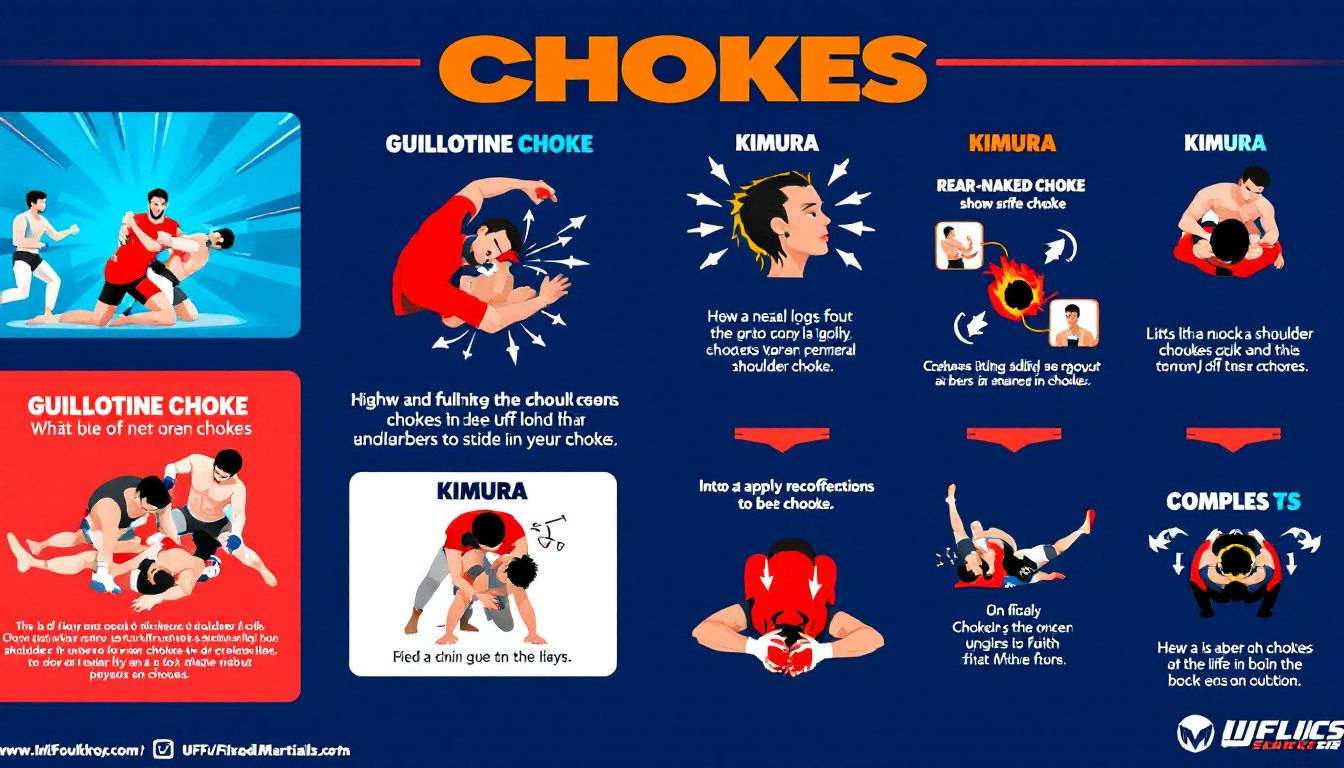
Chokes at a Glance: Comparison Chart
| Choke | Type | Position | Skill Level | Escape Difficulty |
|---|---|---|---|---|
| Rear-Naked | Blood | Back | Beginner | Very Hard |
| Guillotine | Blood | Front/Guard | Beginner | Medium |
| Triangle | Blood | Guard | Intermediate | Medium |
| Arm-Triangle | Blood | Mount/Side | Intermediate | Hard |
| D’Arce | Blood | Top/Side | Advanced | Hard |
| Anaconda | Blood | Front | Advanced | Hard |
| North-South | Blood | Top | Advanced | Very Hard |
| Peruvian Necktie | Blood/Crank | Front | Advanced | Hard |
| Ezekiel | Air | Mount/Guard | Intermediate | Medium |
| Gogoplata | Blood | Guard | Expert | Easy |
Blood chokes cut off circulation; Air chokes compress the windpipe. Most MMA finishes are blood chokes.
Take Your Fight IQ to the Next Level
Want to see these submissions analyzed in real-time? Join the community at Ringside Report Network.
- Ringside Report MMA (Thursdays 8 PM ET): Dave Simon, Fred Garcia, and AJ D’Alesio break down the latest UFC and PFL results.
- Wrestling Uncensored (Fridays 10 PM ET): Dave Simon and Johnny North explore the crossover between the WWE, AEW, and the combat sports world.
What is your favorite submission to watch? Let us know in the comments, or check out our latest articles on RingsideReport.net.
Frequently Asked Questions
What is the most common choke in MMA?
The Rear-Naked Choke is by far the most common and successful submission in MMA. Its dominance was first demonstrated in 1963 when Gene LeBell used it to defeat boxer Milo Savage, proving its effectiveness decades before the UFC existed.
What is the difference between a blood choke and an air choke?
A blood choke (vascular restraint) cuts off blood to the brain and causes unconsciousness quickly and with less damage. An air choke constricts the windpipe, is generally more painful, and can cause damage to the throat if held for an extended period.
Can you do a cross-collar choke in MMA?
The traditional cross-collar choke, which requires grabbing the gi lapels, is not possible in MMA. However, the principles can be applied to chokes such as the Guillotine.
Why is taking the back so important in MMA?
Taking an opponent’s back is the most dominant position because it puts the attacker in a safe spot where they can strike freely or set up the Rear-Naked Choke, while the opponent cannot effectively defend or attack.
Who was the first person to use the Rear-Naked Choke in a major fight?
While the choke has ancient roots in Judo (where it’s called Hadaka Jime) and other grappling arts, one of the first documented uses in American combat sports was Gene LeBell’s 1963 victory over boxer Milo Savage. This fight predated the UFC by 30 years and helped establish grappling’s effectiveness against strikers.
Is the Gogoplata a blood choke or an air choke?
The Gogoplata is primarily a blood choke. The shin bone presses against the carotid arteries on the sides of the neck, restricting blood flow to the brain. However, depending on placement, it can also compress the windpipe, creating an air-choke effect.