The 10th Planet Rubber Guard is one of the most effective — and most misunderstood — systems in modern jiu-jitsu. This guide breaks down everything: the core positions, the submission paths, how to drill them, and why they work in MMA.
The Rubber Guard is a high-control guard system developed by Eddie Bravo as the foundation of his 10th Planet Jiu-Jitsu approach. Built specifically for no-gi and MMA environments, it uses your leg to break an opponent’s posture, eliminating their ability to strike or pass while creating a continuous chain of submission threats. For many grapplers, it looks like a confusing web of flexible legs and strange position names. This guide demystifies the system from the ground up.
In This Article
What Is the Rubber Guard and Why Use It?
Traditional closed guard has a fundamental problem: if your opponent postures up, you lose your ability to attack. They can sit up, stack their weight, and begin working a guard pass while you struggle with arm strength alone to pull them back down. The Rubber Guard solves this structurally.
Instead of using your arms to fight their posture, you use your leg — specifically, by bringing your leg high over your opponent’s back and using it like a clamp. This physically pulls their head down and keeps it there. Once posture is broken and controlled, your opponent is forced to survive rather than attack, while you have free hands to work submissions from a position of structural advantage.
The system was designed by Eddie Bravo for submission grappling and MMA — specifically to address the problem of opponents in shorts and no gi, where traditional lapel and sleeve grips don’t exist. Its focus on body-based control rather than grip-based control makes it one of the most transferable guard systems from the mat to the cage.
Key Takeaways
- Posture control is the entire game. The primary goal of the Rubber Guard is breaking your opponent’s posture with your leg, not your arms. Everything else flows from that.
- It is a system, not a single position. Mission Control, New York, and Chill Dog are connected checkpoints that flow into one another on the way to a submission.
- Every position leads somewhere. Each control point is designed to threaten a specific submission — Omoplata from New York, Triangle from Mission Control, Gogoplata from the Gogo Clinch.
- Flexibility helps, but is not required. Proper angles, hip movement, and hand-assisted positioning allow grapplers of all body types to play an effective Rubber Guard.
The Control System: Core Positions
Mastering the Rubber Guard means understanding its main control checkpoints. Think of these as stages on the path to a submission — you must secure each stage before advancing to the next.
Mission Control
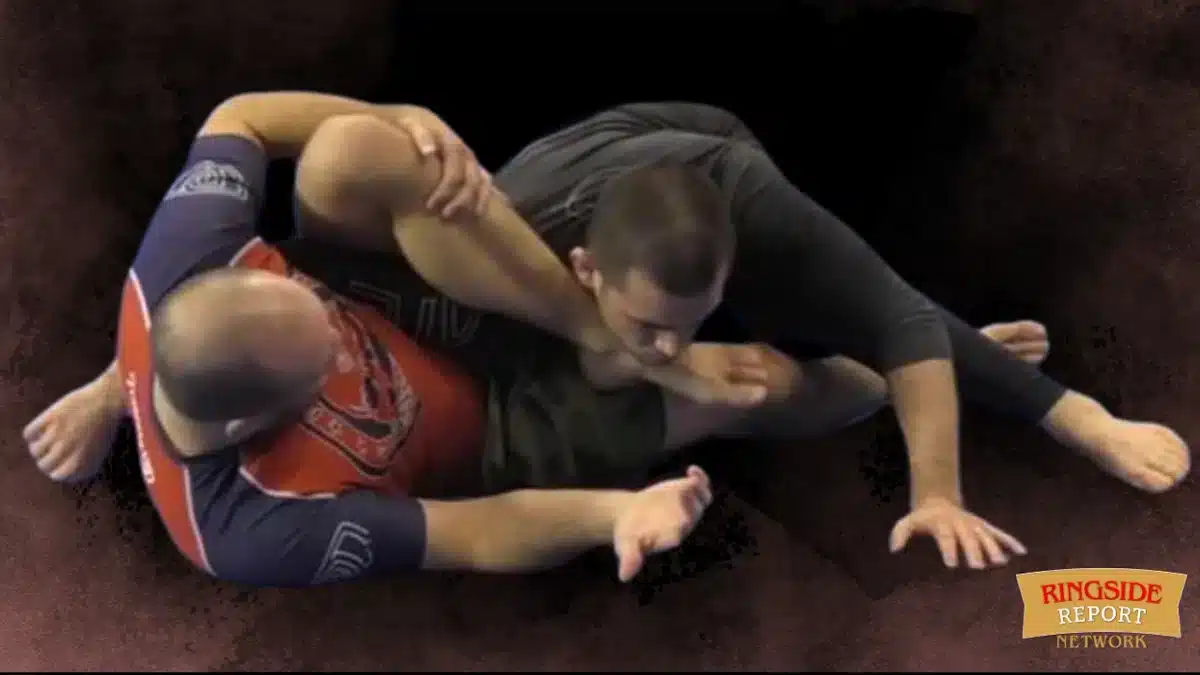
Mission Control is the home base — the foundational position of the entire system. From closed guard, you clear one of your opponent’s arms and bring your same-side leg high up their back, using it to clamp their posture down. Your opposite hand controls their remaining wrist or bicep to prevent them from posting out and recovering structure.
The key detail most beginners miss is where the leg sits. It needs to be above the shoulder blade, not on the lower back. If the leg drops, your opponent can simply posture back up. The higher the leg, the harder the posture break — and the better the angle for your next transition.
New York
New York advances the control by trapping your opponent’s arm. From Mission Control, you grab your own ankle with your hand and pull your controlling leg over and across their arm, pinning it against your body. This does two things: it deepens the posture break and eliminates one of their defensive arms entirely, setting up the Omoplata directly.
The common problem here is losing the leg position during the transition. Use your hand to physically guide the ankle rather than trying to muscle the leg across with hip flexor strength alone.
Chill Dog
Chill Dog is an adjustment position rather than a primary control point — it exists to address insufficient hip flexibility. If you cannot get your leg high enough on your opponent’s back from Mission Control, place the foot of your free leg on their hip, use it to shrimp your hips out slightly, and create a better angle to bring your attacking leg higher. Think of it as a repositioning tool that resets you for a cleaner Mission Control or New York entry.
The Gogo Clinch
The Gogo Clinch is a deeper control position that brings your leg over your opponent’s head and behind their neck. It is the entry point for the Gogoplata — one of the rarest and most visually striking submissions in grappling. From Mission Control, instead of trapping the arm toward New York, you continue the leg’s path upward until your shin is behind their neck, and you can clasp your hands together to secure the clinch. It requires significant hip flexibility and a well-broken posture, but once locked, it is extremely difficult to escape.
Submission Paths from the Rubber Guard
The key takeaways section promised submission paths — here is where the system actually finishes fights. Each control position connects to a specific set of high-percentage attacks.
Omoplata (from New York)
The Omoplata is the primary submission threat from New York. With the opponent’s arm already trapped and their posture broken, you have a direct path to rotating your hips out and applying a shoulder lock. The Rubber Guard’s control makes this Omoplata far more reliable than a standard closed guard Omoplata attempt — your opponent has no free hand to post and stop the rotation. If they attempt to roll through the Omoplata, follow them and maintain the shoulder lock as they roll over.
Triangle Choke (from Mission Control)
Mission Control sets a direct triangle entry because your controlling leg is already positioned high on their back. When your opponent attempts to posture up or free their arm, you can shoot the triangle by swinging your free leg across their neck and locking your ankles. The broken posture you’ve maintained throughout means their head is already pulled forward into the choke — you are not fighting their posture at the moment of the triangle attempt, which is where most triangles fail.
Gogoplata (from the Gogo Clinch)
The Gogoplata is applied by driving your shin into the underside of your opponent’s jaw or throat while pulling down on their head with both hands. The Gogo Clinch position provides the mechanical leverage — the shin acts as the fulcrum of the choke, and your clasped hands provide the compression. It is not a common finish at high-level competition, but in the 10th Planet system, it functions as a powerful threat that forces defensive reactions, opening up triangles and Omoplatas.
Armbar (from New York)
With the arm already trapped in New York, an armbar is available as a secondary option if your opponent defends the Omoplata by hiding the arm or rolling. Rather than following the roll, extend the arm against your hip before they complete the escape. The trapped position of New York means you already have the arm isolated — the armbar here requires less setup than a standard guard armbar because the control work has already been done.
Drills to Build the System
The Flow Drill
The most important drill in the 10th Planet toolkit is the position flow sequence. With a cooperative partner, practice the full chain: Closed Guard → Mission Control → Chill Dog → Mission Control → New York → back to Mission Control. Repeat continuously for two to three-minute rounds. The goal is not speed — it is smoothness. Jerky, muscled transitions signal that you are still fighting the position rather than understanding it. See the full 10th Planet no-gi drilling guide for the complete sequence.
Single Position Isolation
Before drilling the flow, isolate each position. Have your partner start in your guard and give light, consistent posture pressure. Your only goal is to achieve and hold Mission Control for 30 seconds. Once that feels easy, add the transition to New York. Isolating positions removes the cognitive load of the full system, letting you feel the mechanics of each checkpoint independently.
Flexibility and Hip Mobility Work
Hip flexor stretches, butterfly stretches, and pigeon pose will directly improve your ability to lift your leg high onto your opponent’s back without exhausting yourself. You do not need extreme flexibility — you need enough range to maintain Mission Control without cramping under resistance. Ten minutes of hip mobility work after training, three to four times per week, produces noticeable improvement within four to six weeks.
The Rubber Guard in MMA
The Rubber Guard was engineered specifically for MMA, not adapted from a gi system after the fact. The problem it solves — keeping a dangerous opponent from posturing up and landing ground strikes — is more urgent in a cage fight than in a grappling tournament. Traditional closed guard in MMA is a survival position at best. The Rubber Guard converts it into an offensive one.
When your opponent is in your guard in MMA, their primary weapon is the posture-up-and-punch sequence. Mission Control eliminates that sequence structurally. With their posture broken and their head pulled forward, they cannot generate power on ground strikes, and their base becomes unstable enough that submission attempts become viable rather than theoretical.
The most high-profile MMA Gogoplata finish is Shinya Aoki’s 2009 DREAM submission of Mizuto Hirota — a finish that demonstrated the system could work against top-level competition in a real MMA context. The most common submissions in MMA remain rear naked chokes and guillotines, but the Rubber Guard’s value is less about finishing frequency and more about making the bottom guard position dangerous rather than passive.
Find a 10th Planet or No-Gi Gym Near You
The Rubber Guard is best learned in person with a qualified 10th Planet instructor. Use the gym finder below to locate 10th Planet affiliates and no-gi BJJ gyms in your area. You can also check the ranked list of top 10th Planet gyms in North America for a curated starting point.
Ringside Report Network’s Combat Sports Gym Finder
Find BJJ, Boxing, Muay Thai & more near you
Enter your location, select disciplines,
then search to find combat sports gyms nearby
Rubber Guard FAQs
Do I need to be super flexible to play Rubber Guard?
No. While flexibility helps, using proper angles, hip movement (the Chill Dog adjustment), and hand-assisted positioning — grabbing your ankle to physically guide your leg into place — allows grapplers of most body types to play an effective Rubber Guard. Consistent hip mobility work will improve your range over time without requiring extreme flexibility from the start.
What’s the biggest mistake beginners make with the Rubber Guard?
Jumping to the submission without first establishing posture control in Mission Control. Most beginners try to reach New York or attempt an Omoplata before their opponent’s posture is genuinely broken. If their head is still up, the submission attempt will fail. Win the posture battle first — everything else follows from there.
Is the Rubber Guard effective in MMA?
Yes. The system was designed specifically for MMA. It provides structural posture control that prevents an opponent from posturing up to land ground-and-pound strikes — the primary problem with traditional closed guard in a cage context. It was Eddie Bravo’s direct response to the limitations of gi-based guard systems in no-gi and MMA environments.
What is the best way to start learning the Rubber Guard?
Start with one single objective: achieving and holding Mission Control on a resisting partner for 30 seconds. Don’t attempt transitions until that baseline control feels automatic. Once you can consistently break and hold posture in Mission Control, add the New York transition. Build the system one checkpoint at a time rather than trying to drill the full flow from day one.
What submissions can you get from the Rubber Guard?
The primary submissions are the Omoplata (from New York), the Triangle Choke (from Mission Control), the Gogoplata (from the Gogo Clinch), and the Armbar (as a secondary option from New York when the opponent defends the Omoplata). The Triangle and Omoplata are the highest-percentage finishes in competitive grappling.