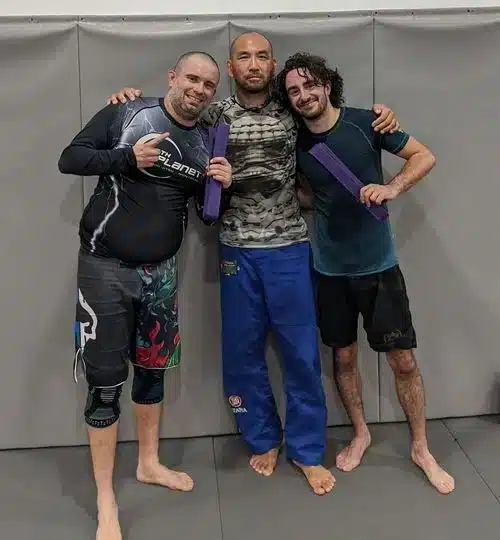
Two of Ringside Report Network’s cohosts are active 10th Planet Jiu-Jitsu practitioners: Dave Simon and Fred Garcia both hold Purple Belts from 10th Planet Montreal under coach Louis Ho. With that insider perspective, this is our definitive guide to the 10th Planet belt system — how it works, what makes it different from traditional BJJ, and what you need to know at every rank.
10th Planet Jiu-Jitsu is the innovative no-gi grappling system created by Eddie Bravo, a black belt under the legendary Jean-Jacques Machado. Since founding his first school in Los Angeles in 2003, Bravo has built a global network of over 100 affiliated academies — all united by a single philosophy: every technique should work without a gi. The system has produced world-class grapplers and UFC fighters, and its belt system reflects that competition-first mentality.
But if there’s no gi, how do belts work? And what’s different about 10th Planet’s ranking compared to a traditional Brazilian Jiu-Jitsu belt system? Here’s the complete breakdown.

Key Takeaways
- Same Belt Colors, Different Delivery: 10th Planet uses the standard BJJ progression — White, Blue, Purple, Brown, and Black — but since training is exclusively no-gi, practitioners wear colored rashguards on the mat instead of belts.
- No Stripes, No Degrees: Unlike traditional BJJ schools that award up to four stripes per belt and degrees on black belts, 10th Planet uses no stripe or degree system at all. Promotion is belt-to-belt.
- Head Coach Authority: Purple and Brown Belt instructors can promote students up to Blue Belt. All promotions beyond Blue go through Black Belts, with high-level promotions coordinated through Eddie Bravo himself.
- Built for MMA: Every technique in the 10th Planet curriculum is designed to work without clothing grips, making the system directly applicable to mixed martial arts and real-world self-defense.
- Global Standard: With over 100 affiliated schools across six continents, the 10th Planet curriculum and ranking standards are consistent worldwide.
The 10th Planet Adult Belt Progression
The adult ranking system in 10th Planet Jiu-Jitsu mirrors the same five belt colors used in traditional Brazilian Jiu-Jitsu. The key difference is in how rank is displayed and how promotions are handled. Since 10th Planet athletes never train in a gi, the physical belt is awarded ceremonially upon promotion — practitioners take it home as a symbol of achievement. On the mat, rank is identified by the color of the rashguard.
10th Planet Jiu-Jitsu — Adult Belt Progression
Same colors as traditional BJJ · No stripes · No degrees · Rashguards replace belts on the mat
White Belt — The Starting Point
Every 10th Planet practitioner begins at White Belt, regardless of experience in other martial arts. The white-belt phase focuses on learning fundamental body mechanics, basic guard positions, positional escapes, and the core principles of no-gi grappling: overhooks, underhooks, and hip control. Students are introduced to the signature 10th Planet warm-up drill sequences from day one, which form the foundation of the entire system.

Blue Belt — Building a Game (1–3 Years)
Blue Belt is typically the first major promotion, awarded after one to three years of consistent training. At this level, practitioners are expected to have a working knowledge of the core 10th Planet positions—the Rubber Guard, the Lockdown from half guard, and the Truck—and to apply them during live rolling. Blue belts begin developing their own “game” and competing in submission grappling tournaments.
Purple Belt — Technical Depth (3–6 Years Total)
Purple Belt signifies a practitioner who can chain techniques together fluidly and adapt to different opponents. At this rank, grapplers understand not just positions but transitions — moving seamlessly between systems like the Rubber Guard, Lockdown, and Truck based on what the opponent gives them. Both of Ringside Report Network’s cohosts, Dave Simon and Fred Garcia, hold Purple Belts from 10th Planet Montreal, a rank that typically requires three to six years of total training.
Brown Belt — Refining Mastery (5–8 Years Total)
Brown Belt represents a practitioner who is close to complete mastery of the system. Brown belts are expected to be able to teach, troubleshoot techniques for lower belts, and compete at a high level. Many Brown Belt instructors run their own 10th Planet affiliate schools and can promote students up to Blue Belt.
Black Belt — Mastery (8–12 Years Total)
The Black Belt in 10th Planet Jiu-Jitsu represents full mastery of the system. It typically takes eight to twelve years of dedicated, consistent training to achieve. Unlike traditional BJJ, where black belts progress through numbered degrees (up to 9th degree, with coral and red belt designations), 10th Planet black belts do not earn degrees. As Eddie Bravo has stated, “We use the same colors, we just don’t do degrees.” This reflects the system’s emphasis on practical skill over hierarchical distinction.
No Stripes, No Degrees: How 10th Planet Promotions Work
One of the most frequently asked questions about 10th Planet is how students track progress between belts when there are no stripes. The answer is straightforward: they don’t need to. The 10th Planet system deliberately avoids the stripe and degree systems used by IBJJF-affiliated schools. There are no tape marks on belts, no numbered dans on black belts, and no coral or red belt ranks.
Promotion is at the head coach’s discretion, based on the student’s skill development, mat time, competition performance, and overall understanding of the 10th Planet curriculum. The system’s promotion hierarchy is structured clearly: Purple and Brown Belt affiliate instructors can award belts up to Blue Belt. Only Black Belts can promote to Purple, Brown, and Black. High-level promotions are coordinated through Eddie Bravo to maintain consistency across the global network.
This approach reflects Eddie Bravo’s philosophy that the belt is a recognition of ability, not a checkbox progression. As the 10th Planet community often puts it: the belt just keeps your pants up — and since there are no pants in no-gi, the focus stays on what you can do on the mat.
10th Planet vs. Traditional BJJ: How the Systems Compare
While 10th Planet and traditional BJJ share the same belt colors and the same fundamental goal of submission grappling, the two systems differ significantly in training methodology, competition philosophy, technique naming, and promotion structure. The table below breaks down the key differences side by side.
10th Planet vs. Traditional BJJ — Key Differences
| Feature | 10th Planet | Traditional BJJ (IBJJF) |
|---|---|---|
| Training attire | No-gi only (rashguard + shorts) | Gi (kimono) and/or no-gi |
| Belt colors | White → Blue → Purple → Brown → Black | White → Blue → Purple → Brown → Black |
| Stripes | None — no stripe system | Up to 4 white stripes per belt |
| Degrees (Dan) | None — “We don’t do degrees” (Eddie Bravo) | Up to 9 degrees on black belt; coral & red belts at highest levels |
| Belt worn in class | No — rank shown via rashguard color | Yes — belt tied over gi jacket |
| Physical belt awarded | Yes — ceremonial; taken home | Yes — worn in every training session |
| Who can promote | Purple/Brown coaches → up to Blue only; Black belts → all ranks; high-level promotions through Eddie | Black belt 2+ stripes can promote to black; lower ranks promote below their level |
| Competition focus | Submission-only (EBI rules) | Points-based (IBJJF rules) or submission-only |
| Curriculum | Standardized warm-up drill system (A–H sequences); unique 10P terminology | Varies by school/lineage; traditional Portuguese terminology |
| Technique naming | Creative English names (Rubber Guard, Lockdown, Twister, Truck, Electric Chair, Zombie, Crackhead) | Traditional names (De La Riva, Berimbolo, Kimura, Americana) |
| Leg locks | Taught from white belt | Traditionally introduced at purple/brown belt (IBJJF rules restrict heel hooks until brown) |
| MMA applicability | Core design philosophy — all techniques built for no-gi combat | Gi techniques (collar chokes, sleeve grips) don’t transfer to MMA |
Both systems share the same belt colors and respect the same fundamental grappling principles.
The 10th Planet Youth Belt System (Under 16)
For practitioners under 16, 10th Planet schools follow a youth ranking system based on the standard BJJ kids belt progression. The youth system uses a wider range of belt colors to provide more frequent milestones for younger students, keeping them motivated as their skills develop. The children’s belts are organized into five color groups — White, Grey, Yellow, Orange, and Green — with each color group containing three sub-levels (color/white stripe, solid color, and color/black stripe).
10th Planet Youth Belt System (Under 16)
Follows the standard BJJ kids belt progression · Stripes used in some 10P kids programs
| Belt Group | Colors | Min. Age | Level |
|---|---|---|---|
| White | Solid white | 4+ | Beginner |
| Grey | Grey/white · Solid grey · Grey/black | 4–15 | Intermediate |
| Yellow | Yellow/white · Solid yellow · Yellow/black | 7–15 | Intermediate |
| Orange | Orange/white · Solid orange · Orange/black | 10–15 | Advanced |
| Green | Green/white · Solid green · Green/black | 13–15 | Advanced |
At age 16, youth practitioners transition to the adult belt system.
Green belts may be promoted directly to adult Blue Belt. White and lower-ranked kids belts typically restart at adult White Belt.
Each belt group has 3 sub-levels (color/white → solid → color/black). Stripe usage varies by school.
Some 10th Planet kids’ programs do use stripes within the youth system (four stripes per belt before advancing to the next), though this varies by school. The key transition happens at age 16, when youth practitioners move into the adult belt system. Green Belts with sufficient skill may be promoted directly to Adult Blue Belt, while younger or less experienced students may restart at Adult White Belt.
Why No-Gi? The Philosophy Behind the System
To understand the belt system, you need to understand why the gi was removed. Eddie Bravo’s breakthrough moment came at the 2003 ADCC Submission Wrestling World Championship, where he — still a brown belt at the time — submitted the legendary Royler Gracie with a triangle choke. That victory validated his belief that no-gi grappling could be just as sophisticated and effective as traditional gi-based BJJ.
After earning his black belt under Jean-Jacques Machado, Bravo opened the first 10th Planet Jiu-Jitsu school in Los Angeles with a radical premise: the entire curriculum had to work without clothing grips. No collar chokes, no sleeve controls, no pant grabs. Instead, the system is built around body mechanics — overhooks, underhooks, clinch work, and leg entanglements that translate directly to MMA and submission-only grappling.
This philosophy also shaped the belt system. Since there is no gi, there is no belt to tie. Since the system rejects the IBJJF’s traditional competitive framework (which uses a points-based format), it also rejects the IBJJF’s degree and stripe conventions. The result is a leaner, more skill-focused promotion structure that emphasizes what a practitioner can do, not how long they’ve been doing it.
Signature Techniques: The 10th Planet Language
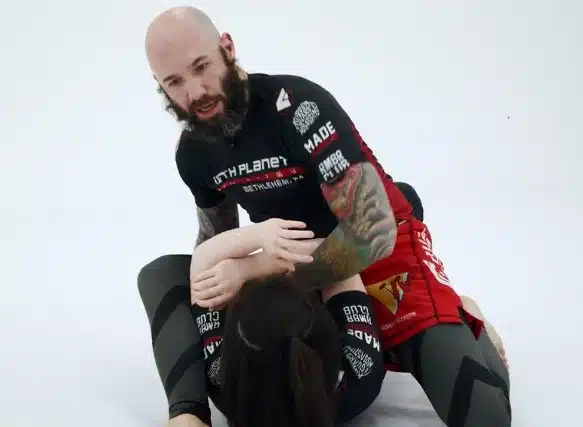
One of the most distinctive aspects of 10th Planet is its creative naming system. Eddie Bravo named every position and transition in the curriculum — drawing on pop culture, slang, and humor — so coaches could communicate instructions during matches without opponents understanding them. The result is a vocabulary that sounds like it belongs in a video game, but every name maps to a specific, highly technical position.
The three core systems that define 10th Planet Jiu-Jitsu are:
The Rubber Guard is a high, flexible closed guard from the bottom position. The practitioner pulls their shin behind the opponent’s head to break posture, creating a tight clinch that eliminates striking distance (critical in MMA) and sets up submissions like omoplatas, triangles, and gogoplatas. Key sub-positions within the Rubber Guard include Mission Control (the initial clinch with one shin behind the opponent’s head), Zombie (when the opponent’s hand is trapped on the mat), and Crackhead Control (both feet crossed behind the opponent’s neck for maximum control).
The Lockdown is a half-guard system where the bottom player locks their feet around the opponent’s trapped leg using a figure-four entanglement. This prevents the top player from passing guard and creates powerful sweeping opportunities. From the Lockdown, practitioners fight for underhooks to access the Electric Chair — a devastating groin-stretching submission that doubles as a sweep — and the Dogfight position, a seated scramble that leads to back takes.
The Truck is a back-control position where the practitioner triangles the opponent’s legs while facing away from their head, creating an extremely difficult position to escape. From the Truck, the signature submission is the Twister — a painful spinal lock adapted from wrestling (where it was known as a guillotine). The Twister is one of the rarest and most spectacular submissions in all of combat sports, and it remains the holy grail of the 10th Planet system.
Other notable 10th Planet techniques include the Electric Chair (a sweep/submission hybrid from the Lockdown), Old School (a classic half-guard sweep), and the Vaporizer (a leg attack). The naming system extends to warm-up positions as well — New York, New Jersey, Home Alone, and Dead Orchard are all position names within the Rubber Guard pathway.
The 10th Planet Warm-Up System
Unlike traditional BJJ schools, where warm-ups typically consist of generic exercises (running, shrimping, breakfalls), 10th Planet has developed a comprehensive warm-up drill system that is essentially a shadow-grappling curriculum. The system is organized into eight lettered scenarios (A through H), each with four drill sequences, for a total of 32 unique sequence combinations.
Each warm-up scenario focuses on a specific area of grappling — for example, one might cover butterfly guard sweeps to mount escapes, while another flows through Lockdown entries to Electric Chair finishes. Both partners drill actively, making the sequences more like cooperative situational sparring than traditional warm-ups. Eddie Bravo has compared the system to shadow boxing or bag work for grapplers — the closest you can get to practicing technique flow without live resistance.
This warm-up system is standardized across all 10th Planet schools worldwide. A practitioner can walk into any 10P affiliate and know exactly what “Warm-up C, Sequence 3” means. The system is also constantly evolving, with Bravo regularly adding and refining sequences, so even experienced practitioners must stay current.
Prominent 10th Planet Practitioners

The effectiveness of the 10th Planet system is demonstrated by the success of its practitioners at the highest levels of MMA and submission grappling:
Tony Ferguson is a former UFC Interim Lightweight Champion and one of the most prominent 10th Planet black belts in MMA history. Ferguson famously used 10th Planet techniques throughout his UFC career, including landing a Twister submission against Anthony Pettis’s training partner and regularly employing Rubber Guard and D’Arce chokes in the octagon. His relentless pace and creative submissions made him the ideal showcase for the system’s applicability in MMA.
Geo “Freakazoid” Martinez is a multiple-time Eddie Bravo Invitational (EBI) champion and one of the most decorated submission grapplers in the 10th Planet system. His creative use of the Truck and Twister in high-level competition has earned him a reputation as one of the most exciting grapplers in the sport.
Grace Gundrum became the youngest 10th Planet black belt ever promoted and has built an impressive competitive record in submission grappling. Her technical skill demonstrates that the system is effective across age groups and genders.
Bryce Mitchell made history in the UFC by becoming only the second fighter to land a Twister in UFC competition — the signature 10th Planet submission — during his fight against Matt Sayles at UFC Fight Night 162 in 2019. While Mitchell trains broadly in MMA grappling, his use of the Twister brought 10th Planet techniques into the global spotlight.
The Eddie Bravo Invitational: Where the System Is Tested
No discussion of the 10th Planet belt system is complete without understanding the Eddie Bravo Invitational (EBI), the submission-only tournament that serves as both a proving ground for 10th Planet practitioners and a showcase for the system’s philosophy. EBI uses a unique ruleset: matches are decided by submission only during regulation. If no submission occurs, the match goes to overtime rounds where each competitor alternates starting from a dominant position (spider web or back control), and the fastest escape or submission wins.
This ruleset directly reflects the 10th Planet ranking philosophy. The system values finishing ability over positional dominance, which is why the belt system rewards practitioners who can submit opponents rather than just control them. Many of the highest-profile 10th Planet promotions have followed standout performances at EBI events, reinforcing the link between the competitive format and the ranking structure.
The Gi vs. No-Gi Debate

The 10th Planet system is not without its critics. Some in the traditional BJJ community argue that gi training develops a deeper understanding of leverage, defensive gripping, and patience that no-gi training alone cannot replicate. Others note that collar and sleeve techniques reflect centuries of refined martial arts knowledge that shouldn’t be discarded.
However, the modern grappling landscape has largely moved beyond this binary debate. Many elite competitors train in both styles, and major promotions such as the ADCC Submission Wrestling Championship (no-gi) coexist with the IBJJF World Championships (which include both gi and no-gi divisions). Cross-training in gi and no-gi is widely considered the most effective path to becoming a well-rounded grappler, and many 10th Planet practitioners compete successfully in traditional BJJ tournaments despite training exclusively without the gi.
The bottom line: whether a practitioner trains in gi, no-gi, or both depends on their goals. For those focused on MMA, self-defense, or submission-only competition, the 10th Planet system offers a purpose-built curriculum. For those who value the tradition, grip fighting, and methodical control of gi-based BJJ, traditional schools may be a better fit. Many serious grapplers do both.
The Global Reach of 10th Planet Jiu-Jitsu
What started as a single school in Los Angeles has grown into a global network of more than 100 affiliated academies across the United States, Canada, Australia, Brazil, the Netherlands, the United Kingdom, Sweden, South Africa, Slovenia, and dozens of other countries. The curriculum is standardized globally, meaning a practitioner can walk into any 10th Planet school in the world and encounter the same warm-up system, the same technique names, and the same ranking standards.
This consistency is a key part of the 10th Planet identity. Unlike some traditional BJJ lineages, where curricula vary dramatically from school to school based on the head instructor’s preferences, 10th Planet maintains a unified system. The naming conventions, the warm-up drill sequences, and the core techniques are the same whether you’re training at 10th Planet headquarters in Los Angeles or at 10th Planet Montreal — where Ringside Report Network’s own Dave Simon and Fred Garcia train under coach Louis Ho.
Summary
The 10th Planet belt system provides a clear, streamlined path of progression within one of the most innovative grappling systems in martial arts. By using the same belt colors as traditional BJJ but stripping away stripes, degrees, and the gi itself, Eddie Bravo created a ranking structure that reflects the system’s core values: practical skill, submission-focused competition, and direct applicability to MMA. From the creative technique naming to the standardized warm-up system to the global consistency of its curriculum, 10th Planet Jiu-Jitsu continues to push the boundaries of what grappling can be — and its belt system is designed to recognize the practitioners who push those boundaries with it.
Read more about combat sports ranking systems on Ringside Report Network: Brazilian Jiu-Jitsu Belt Ranking · Karate Belt Order · Judo Belt Order · Taekwondo Belt Order
Frequently Asked Questions
Does 10th Planet Jiu-Jitsu use belts?
Yes. Students receive a physical belt upon promotion, but since training is exclusively no-gi, the belt is not worn during class. Instead, practitioners wear rashguards that match their belt color to signify their rank on the mat.
How long does it take to get a black belt in 10th Planet?
On average, it takes 8 to 12 years of consistent, dedicated training to earn a Black Belt in the 10th Planet system. This timeline is similar to traditional BJJ and depends on training frequency, competition performance, and the head coach’s assessment.
Does 10th Planet use stripes on belts?
No. Unlike traditional BJJ schools that use up to four white stripes per belt to mark progress, 10th Planet does not use a stripe system for adults. Promotion goes directly from one belt color to the next. Some 10th Planet kids’ programs may use stripes, but this varies by school.
What is the difference between 10th Planet and traditional BJJ?
The main differences are: 10th Planet trains exclusively without a gi (no-gi only), does not use stripes or degrees on belts, uses creative English technique names instead of traditional Portuguese terminology, teaches leg locks from white belt, and is designed primarily for MMA and submission-only competition rather than points-based gi tournaments.
Is 10th Planet Jiu-Jitsu good for self-defense?
Many practitioners consider it highly effective for self-defense because the system is specifically designed to work without relying on clothing grips. Since real-world self-defense situations rarely involve a gi, the techniques — based on body mechanics, underhooks, and clinch control — translate directly to realistic scenarios.
Can a 10th Planet practitioner compete in traditional BJJ tournaments?
Absolutely. While the techniques and strategies may differ, the fundamental principles of grappling are universal. Many 10th Planet practitioners compete successfully in IBJJF no-gi divisions and other traditional BJJ tournaments, demonstrating the system’s effectiveness across competitive formats.
What is the 10th Planet warm-up system?
The 10th Planet warm-up system is a comprehensive series of 32 drill sequences organized into eight lettered categories (A through H). Each sequence progresses through connected positions and transitions, functioning more like cooperative shadow grappling than traditional warm-ups. The system is standardized across all 10th Planet schools worldwide.
Does 10th Planet have a kids’ belt system?
Yes. 10th Planet schools follow the standard BJJ youth belt system for practitioners under 16. The kids’ progression moves through White, Grey, Yellow, Orange, and Green belt groups, each with three sub-levels. At age 16, youth practitioners transition to the adult belt system, with skilled Green Belts potentially promoted directly to adult Blue Belts.
Why is it called 10th Planet?
The name comes from the writings of author Zecharia Sitchin, who theorized about a 10th planet in our solar system inhabited by an advanced civilization called the Anunnaki. Eddie Bravo adopted the name to convey the idea that his jiu-jitsu system was from another world — a step beyond conventional martial arts.